
Water officials denied blackout rumors as water supply falls below 8%, with drought conditions tightening across Corpus Christi.
CORPUS CHRISTI, Texas — City of Corpus Christi officials outlined the latest updates on the city’s long-range water supply planning during a public briefing on Friday, emphasizing ongoing projects, conservation efforts, and future diversification of the water supply.
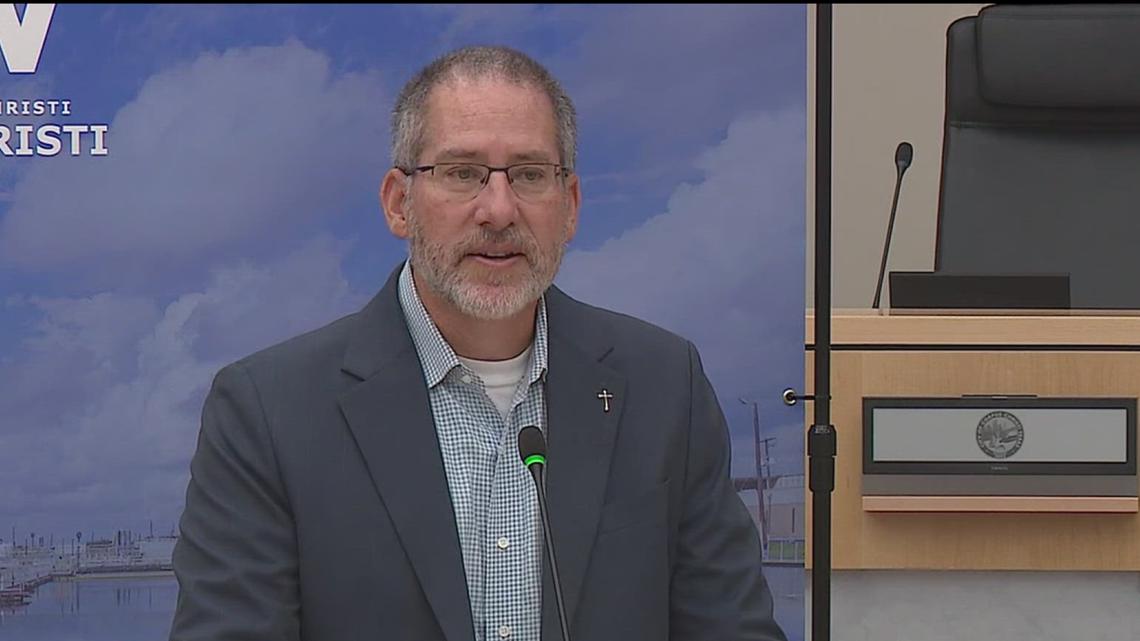
Nick Winkleman, Chief Operating Officer of Corpus Christi Water, said residential customers have significantly reduced water use and are already performing projected allocation levels below.

This story continues below.
Winkleman emphasized that reports of water blackouts or evacuations are false.
“I’m here to emphatically state that that information isn’t true,” Winkleman said. “We want to ensure everyone has the most accurate information.”
According to the latest data, Choke Canyon Reservoir sits at 7.3% and Lake Corpus Christi at 8.7%, bringing the combined capacity to about 7.7%, while Lake Texana remains higher at 66% following recent rainfall.
Despite the low levels, officials say residents are already doing their part, using less water than projected targets.
“Our residential customers…have made tremendous efforts to reduce their water usage,” Winkleman said. “They are already below what a potential allocation might be.
Winkleman also highlighted continued progress on major supply projects, including groundwater development in Nueces County, seawater desalination planning, reclaimed water reuse initiatives, and pipeline construction tied to new treatment systems.
Winkleman noted that construction and design work are advancing across multiple projects, including brackish groundwater treatment, which is expected to begin initial deliveries in 2027.
Officials also reiterated its goal of diversifying water sources to include surface water, groundwater, seawater, and reclaimed effluent to ensure long-term supply stability.
Officials said no level one water emergency but stress that no restrictions are currently in effect. “Allocations and baselines…are not in effect until we go into a level one water emergency,” Winkleman said.
If that happens, Texas law requires water reductions to be applied evenly across all users, including residential, commercial and industrial customers. At the same time, officials highlighted ongoing efforts to expand supply, including groundwater projects, wastewater reuse and desalination planning.
“Our strategy is to diversify the water supply…to make it sustainable for future generations,” Winkleman said.