
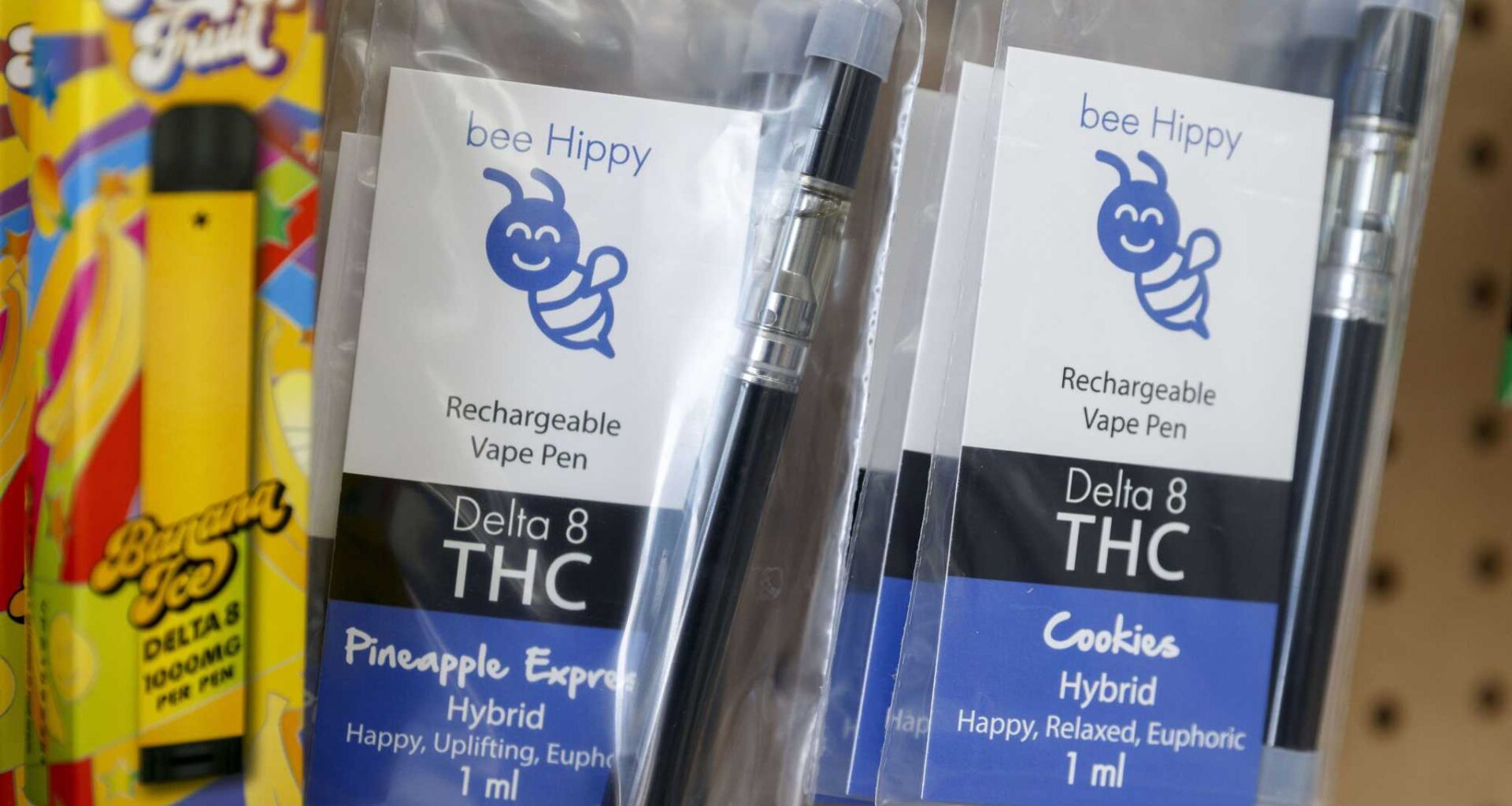
Delta-8 THC products sit for sale at Bee Hippy on Oct. 22, 2021, in Garland, Texas.
Elias Valverde II/TNS
Army veteran, Ty Cobb, shops for CBD gummies which he says helps reduce his anxiety at Rock N’ Roll It Vape Shop on Saturday February 25, 2023 in Houston, TX. “Edibles enable me to process and understand my emotions and high levels of anxiety. I have a better quality of life and am not so uptight and intense,” he said.
Raquel Natalicchio/Staff photographer
The Texas Supreme Court ruled Friday that state regulators may criminalize Delta-8 THC, the intoxicating compound found in some hemp products — a significant blow to an industry fighting for its survival.

The ruling, which reverses a lower court decision, says the Department of State Health Services can enforce rules it set in 2021 that classified Delta-8 as an illegal substance.
Article continues below this ad
The change primarily affects products containing Delta-8, a milder form of THC found in many gummy, candy and vape products, including at gas stations and hemp-focused retailers. But the court’s finding that the Department of State Health Services has broad authority to regulate controlled substances could have wider implications for the industry.
READ MORE: Texas Republicans want to keep THC away from children. New hemp rules don’t bar marketing to kids.
DSHS said it was reviewing the ruling and didn’t have an immediate comment.
In a separate, smaller win for hemp businesses on Friday, a Travis County judge granted a temporary injunction against newer restrictions from DSHS that would hike fees on retail stores and limit the sale of THC-A, which would effectively ban smokeable hemp. But the decision is likely to be appealed and could be complicated by the Supreme Court’s ruling.
Article continues below this ad
The 2021 rules on Delta-8, meanwhile, had long been on hold after a group of hemp business owners, led by Austin-based Hometown Hero, sued to block them. The plaintiffs argued that officials overstepped their authority by banning a substance that had not been explicitly outlawed by legislators and said the decision would make it difficult for retailers to operate.
A lower state court sided with the business groups and put the rules on hold as the case played out.
But the state Supreme Court overturned the decision, finding that a state law known as the Texas Controlled Substances Act gives the DSHS commissioner “primary responsibility for overseeing the civil schedules of controlled substances.”
“The statutory framework consciously, purposefully, and expressly authorizes her— indeed requires her—to undertake this task with a substantial and unusual degree of discretion,” wrote Justice Evan Young, one of nine Republicans on the court.
Article continues below this ad
The legal loss comes at a tough moment for the state’s hemp industry, which had boomed since the products and sales became federally legal in 2018, but is now facing a nationwide ban imposed by Congress and scrutiny from state lawmakers worried about the rise of intoxicating products.
Still, the industry celebrated their smaller victory in the separate Travis County case. In that case, Judge Diana Deseta Lyttle ruled that DSHS likely overstepped their bounds, making sweeping changes without approval from the Legislature, which voted to ban smokable hemp last year before Gov. Greg Abbott vetoed it.
The health agency issued the new regulations on March 31, at the direction of Abbott. They included increasing fees from $155 to $5,000 for retailers and from $258 to $10,000 for manufacturers, as well as a block on out-of-state hemp materials. Proponents of the rules have argued they curb bad actors in the industry and raise money for the state to perform more inspections.
Article continues below this ad
“Consumers can expect to see the products, ones they’ve been relying on, back on the shelves for now,” said Andrew Alvarado, a lawyer who represented one of the hemp groups.
This is a developing story and will be updated.