
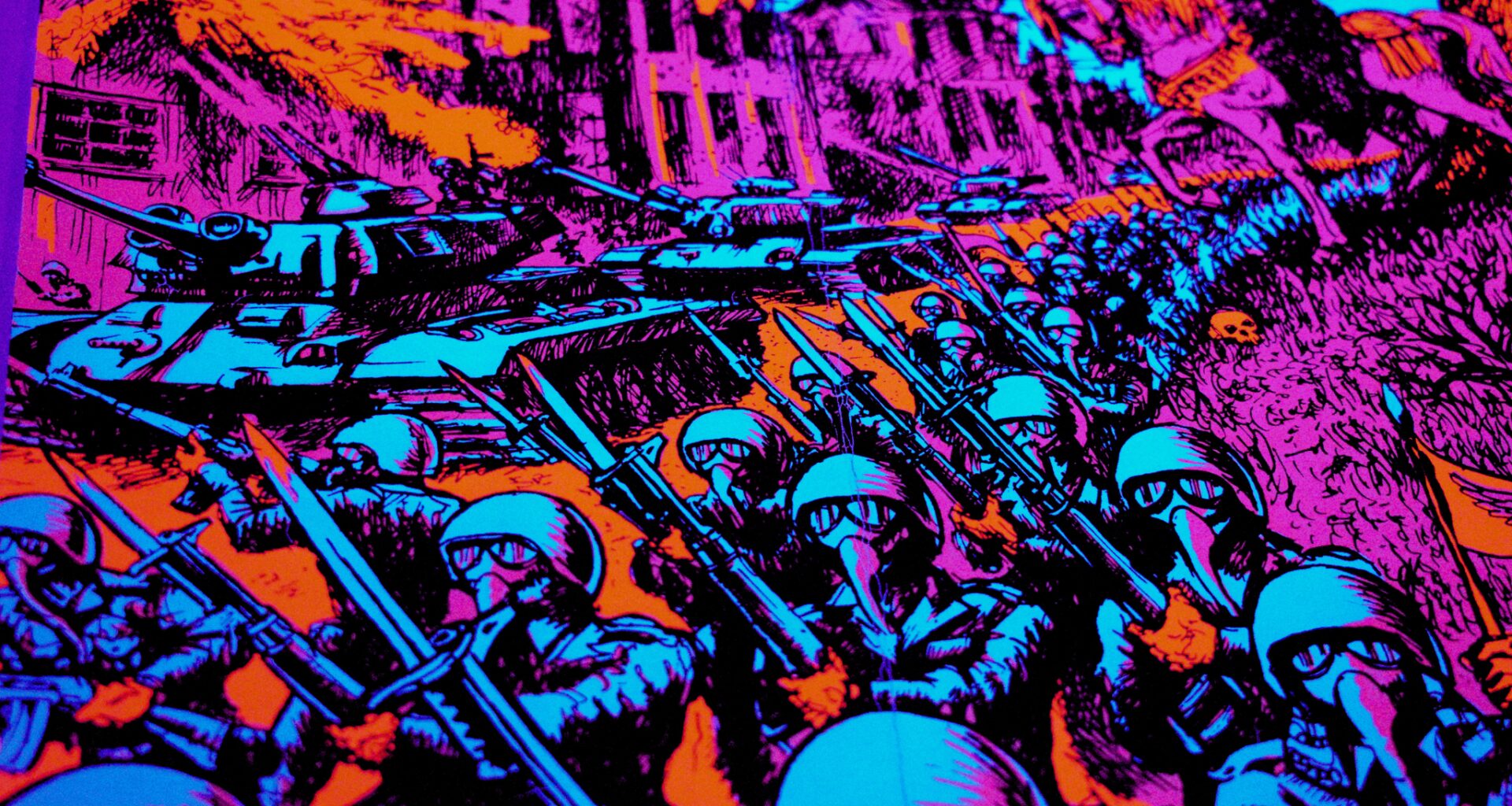
The University of Houston’s Special Collections Library is home to thousands upon thousands of priceless books and ancient manuscripts. But I was there to look at something most people threw away when they left college: blacklight posters from the 1960s and ’70s printed and sold by a Houston company that no longer exists.

My guide (or perhaps trip-sitter) for the day was Christian Kelleher, the Director of Exhibitions and External Relations at UH’s libraries. Founded in 1969, Houston Blacklight & Poster Company was once one of the biggest distributors of the bright, colorful posters that adorned dorm rooms, basements and garage hangouts and became synonymous, along with lava lamps and bongs, with hippies and the counterculture movement.
“Boom” by Gayle Morgan, done in 1971 for the Houston Blacklight & Poster Company.
Gwen Howerton/Chron.com
But just a few years later in 1973, the Houston Blacklight disappeared. All that’s left are the posters. Kelleher first came across one displayed in public and began researching the company. As the curator of UH’s Visual Arts Research Collection, which preserves art from Texas and Houstonian artists, much of what Kelleher works with is “fine” art. But fascinated by the neon posters of warriors and psychedelic landscapes, Kelleher began chasing the white rabbit, so to speak, down the hole.
Article continues below this ad
“It was seeing this poster somewhere in the wild and noticing, you know, that it was the Houston Blacklight & Poster Company,” Kelleher recalled. “I really got interested in the counterculture that they represent, but also the way that Houston was really significant in the production of blacklight posters and establishing this medium as a popular art form.”
If you go chasing rabbits …
Before me, Kelleher has rolled out a poster called “War Queen.” One of the company’s most popular artworks, it depicts a tall, Black female warrior with an afro, striking in normal lighting. Then, Kelleher flicked the lights off and brought a blacklight wand.
Article continues below this ad
“War Queen” comes alive. Her highlighter-yellow jewelry glows almost the color of toxic waste as the pinks turn purple. The contrasts, legible in normal light but not as stark, stand out as the poster seems to hum with electricity. Though it was painted in 1970, “War Queen” remains seductive, provocative, alluring.
Though ultraviolet lights date back to about 1903, fluorescent ink wasn’t developed until 1932, when two brothers, the sons of a pharmacist, founded the Day-Glo Color Corp. The popularity of psychoactive drugs led to the popularization of “trippy” aesthetics like neon poster art, like that of “War Queen.” Staring at it under UV light, you can begin to imagine her staring at you from the wall of a basement hangout, radiating as you smoke a joint and listen to Funkadelic’s Maggot Brain.
“As I became more familiar with the Houston Black Light & Poster Company, I recognized that the artists represented in the posters have their works all across the country,” Kelleher said as he unfurled one such poster. “Thousands of editions of their work would be in bedrooms and basements and garages.”
Article continues below this ad
“Everybody who worked there was a hippie.”
Operating out of a large downtown warehouse at 102 San Jacinto St., the Houston Blacklight & Poster Company sat on the banks of Buffalo Bayou by Allen’s Landing, the epicenter of the hippie counterculture scene in the 1960s. The company’s headquarters was just around the corner from Love Street Light Circus Feel Good Machine, the city’s psychedelic nightclub where acts like the 13th Floor Elevators played regularly and where ZZ Top got their start.
The Blacklight hired from this scene: drifters, runaways, hippies and punks, and aspiring artists and musicians. Mark Townes came to work at the Blacklight after running away from home. At age 16, he ended up living with a Blacklight employee named James, who got Townes a job at the company’s retail shop selling bongs, pipes, rolling papers, matchbooks, and yes, posters.
“Rolling the posters was kind of a s–t job there,” said Townes, who now lives in California. “Everybody who worked there was a hippie.”
Article continues below this ad
“Those Were The Days?” was one of the Houston Blacklight & Poster Company’s few non-flourescent posters and depicts the freewheeling hippie scene in downtown Houston.
Gwen Howerton/Chron.com
Along with the Ohio-based Pro-Arts Poster Company (which produced an infamous Farrah Fawcett poster) and Minnesota’s Pandora Productions, the Houston Blacklight company was one of the biggest players in the burgeoning blacklight poster space. It sold stickers and pins, clothing, and other smoking paraphernalia locally and wholesaled to head shops all around the country. It was a massive operation: Besides the San Jacinto Street location, the Houston Blacklight ran head shops and distribution warehouses in Atlanta and Los Angeles. Later posters produced by the company are labeled with an address in Uvalde, Texas.
All of it was overseen by an enigmatic Houston man named Jerry Jones (no, not that one). Jones was a contradiction. He was a former New Orleans cop who sold drug paraphernalia but forbade his employees from dealing. He hung with hippies, though he wasn’t one himself. He was patriotic, once paying $2,500 so the Houston American Legion chapter could have a parade in 1970. Some thought he was an undercover FBI agent, and Townes recalled that Jones recorded every conversation in his office.
“He was a real weirdo,” Townes said of one meeting he had with Jones.
Article continues below this ad
But Jones had a soft side and loved his wife, Mecky, dearly. One of the Houston Blacklight’s first posters depicts a woman with flowing neon hair. The title? “Mecky.” And Jones took chances on local Houston artists like George Goode, a Black teenager from Phyllis Wheatley High School who became one of the Houston Blacklight’s most prolific artists.
“Mecky,” by Jerry Jones for the Houston Blacklight Poster Co.
Gwen Howerton/Chron.com
“It was sort of groundbreaking.”
While he was still in school, Goode would take his sketchbook to Allen’s Landing and watch hippies go by. Goode created more than 40 other posters for the Houston Blacklight, including “War Queen.” His love of science fiction and fascination with Afrofuturism combined for stunning posters. Some depict fierce African warriors and nude lovers embracing; others, like “The Losers,” depict a “Pusher Man” poisoning hippies with drugs. Goode’s posters are all at once trippy and apocalyptic. One shows an army of soldiers wearing plague doctor masks marching behind Death as an army of guerrilla hippies prepares to ambush them. Under UV light, it glows like radioactive fallout.
Article continues below this ad
“The idea of this kid, this teenager with his sketchbook being part of this very psychedelic scene and documenting what was happening at the time for his posters was really interesting,” Kelleher said.
An undated photo of Houston Blacklight & Poster Company artist George Goode. A graduate of Phyllis Wheately High School, he would go on to work on some of the biggest cartoons of the ’70s, ’80s and ’90s.
Gwen Howerton/Chron.com
A poster drawn by Houston artist George Goode for the Houston Blacklight Poster Company.
Gwen Howerton/Chron.com
A poster drawn by Houston artist George Goode for the Houston Blacklight Poster Company.
Gwen Howerton/Chron.com
A poster drawn by Houston artist George Goode for the Houston Blacklight Poster Company.
Gwen Howerton/Chron.com
A poster drawn by Houston artist George Goode for the Houston Blacklight Poster Company.
Gwen Howerton/Chron.com
A poster drawn by Houston artist George Goode for the Houston Blacklight Poster Company.
Gwen Howerton/Chron.com
A poster drawn by Houston artist George Goode for the Houston Blacklight Poster Company.
Gwen Howerton/Chron.com
A poster drawn by Houston artist George Goode for the Houston Blacklight Poster Company.
Gwen Howerton/Chron.com
A poster drawn by Houston artist George Goode for the Houston Blacklight Poster Company.
Gwen Howerton/Chron.com
Goode would eventually move to Los Angeles in the mid ’70s and go on to work on shows such as Star Trek: The Animated Series, Fat Albert and the Cosby Kids, and the original run of Transformers cartoons. Other artists took different trajectories.
Article continues below this ad
Horace Mitchell was an undergraduate student at Rice University in 1968. Though he was studying physics, he was an amateur artist who loved science fiction novels and comic books. After reading about the Houston Blacklight in a local paper, Mitchell went to downtown Houston, sketchbook in tow. He sold his sketches to Jones, which would become the basis of four posters the company would publish: “The Trip,” “Hassles,” “Saturn” and “Chess.” Mitchell was inspired by the work of the legendary Marvel Comics artists Jim Steranko and Jack Kirby, whose covers depicted towering characters set against psychedelic space-age landscapes.
“I had always sketched and drawn even as a kid,” Mitchell remembered. “I got this bug that I would try to draw some big things.”
“Saturn” by Horace Mitchell for the Houston Blacklight & Poster Company.
Gwen Howerton/Chron.com
The posters that went to market are different from what Mitchell drew. Some were resized, and colors were changed to be trippier under a black light. But for Mitchell, it was an exercise in representing abstract emotions and thoughts—ideas like space and time, optimism about the future—in accessible ways.
Article continues below this ad
“It was sort of groundbreaking, the kinds of things they put in the posters that then wound up hanging in students’ rooms because they represented ideas that really resonated with the students,” Mitchell said.
That experience would serve him well in a much different role. After he finished his master’s and PhD, Mitchell went on to work at NASA’s Goddard Space Flight Center, running the agency’s Scientific Visualization Studio in 1991, making hundreds of videos explaining everything from Mars’ magnetic fields to hurricane animations. His work has been on news channels around the nation and even appeared in Leonardo DiCaprio’s 2016 documentary Before the Flood. But he has always seen his work for the Houston Blacklight as the foundation of his career.
“I always had a joke: people would ask, ‘Well, are you a real artist?’ And I’ll say, yes, I am. I’m published, but only because of those four things that got printed,” Mitchell joked.
“Chess” by Horace Mitchell for the Houston Blacklight & Poster Company.
Gwen Howerton/Chron.com
The Blacklight’s lasting impact is everywhere, even if you don’t realize it. Houston Blacklight posters and paraphernalia resell for hundreds on eBay and at estate sales. Posters can be found in bars and haunts around the country; a now-shuttered Portland bar was even called The Houston Blacklight. A Facebook group of former employees is still working to keep the company’s history alive. Mitchell remembers feeling the significance of the company even as a young artist.
Article continues below this ad
“There were a few times that I would walk into a poster store or a head shop and I would see one of my posters,” Mitchell said. “I was just amazed.”
Tomorrow never knows
Christian Kelleher shows off posters done by the Houston Blacklight Poster Company at the University of Houston’s Special Collections Library on April 21, 2026.
Gwen Howerton/Chron.com
In 1973, Jones sold the company to his brother, who changed the name before everything about the Houston Blacklight scattered to the winds. Kelleher is still learning about the company and scours the internet for new posters when he can. The Houston Printing Museum exhibited them several years back, but Kelleher hopes to find a permanent space on campus to showcase them. Maybe with bean bags and lava lamps and some Janis Joplin. (LSD not provided.)
Article continues below this ad
“How do you do research on these unless they’re up on the wall?” Kelleher said. “You can turn out the lights and view them under black light and take a step back almost 60 years.”
To Kelleher, the blacklight posters are more than just trip aids. They are ephemeral cultural artifacts of a brief, tumultuous moment in history that most people threw away when they moved out of their parents’ houses. The posters, then, tell a story, not just about Houston or about hippies, but about us. Kelleher believes that’s worth archiving.
“These are the stories of a group of society. Maybe they don’t write books, and their art doesn’t make it into the museums,” Kelleher said. “But they have a story to tell, and it’s important that we are able to hear that story long into the future.”
Article continues below this ad
Brittanie Shey contributed to this story.