
Polls in Dallas County close at 7 p.m. Check back for updates as results come in.
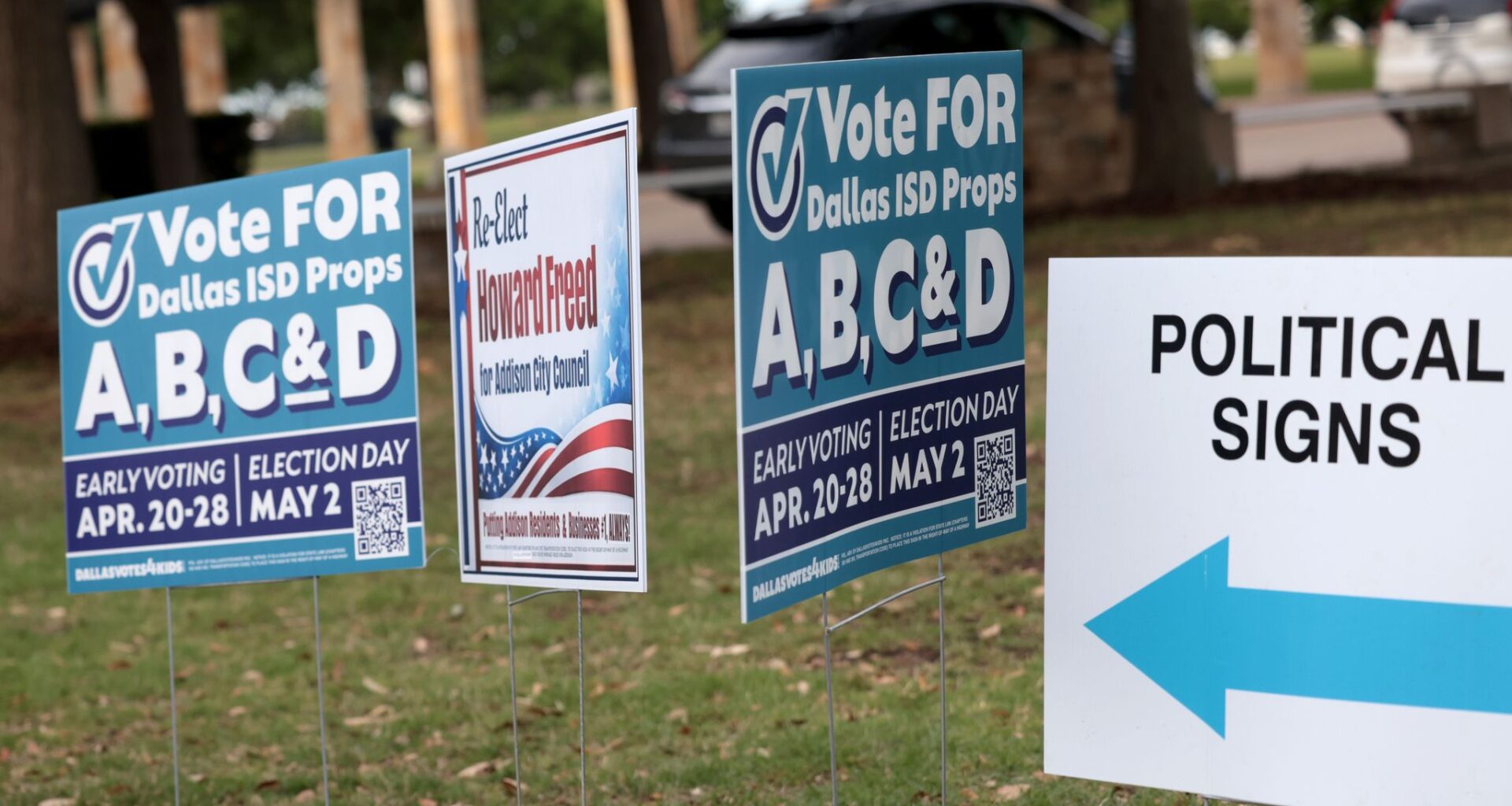
Campaign signs greet citizens as the first day of early voting in the Dallas area attracted voters to the polls located at Addison Town Hall in Addison on April 20, 2026.
Steve Hamm/The Dallas Morning News
Dallas ISD voters went to the polls Saturday to determine the fate of a proposed $6.2 billion bond issue, the largest in Texas history.

If the proposal passes, residents would see a school property tax increase of about $2.79 a month on a $500,000 home, which is the average home value in the district. District leaders would use money from the bond issue to build more than two dozen new schools, among other projects.
Article continues below this ad
Related: Dallas ISD leaders want voters to approve a record bond issue. What did the district get last time?
Jeri Foshee, who voted at Mockingbird Elementary School in Lower Greenville on Saturday, said the bond issue brought her to the polls.
Although Foshee doesn’t have children, she said she places great importance on supporting public schools. While she acknowledged that the bond issue would mean a small property tax increase, she said she’s willing to vote to raise her own taxes if it means giving more money to public schools.
Make Dallas News a preferred source so your search results prioritize writing by actual people, not AI.
Add Preferred Source
“I always vote for anything that’s pro-education,” she said.
Article continues below this ad
Business leaders also have come out in support of the bond plan. Dallas Regional Chamber President and CEO Brad Cheves said at a panel earlier this year that if North Texas wants to remain competitive, it needs to build a strong public education system, including passing Dallas ISD’s proposed $6.2 billion bond issue.
Organized opposition around the massive bond plan has been minimal.
What Dallas ISD’s bond would pay for
Proposition A, the largest piece of the bond issue, totals $5.9 billion. It would fund the construction of 26 new schools to replace 28 existing schools. Under the district’s plan, four campuses — Dr. Frederick Douglass Todd Sr. Middle School and Whitney M. Young Elementary School in the Cedar Crest neighborhood and Piedmont G.L.O.B.A.L. Academy and San Jacinto Elementary School in the Piedmont Addition neighborhood — would be merged into two consolidated campuses.
Article continues below this ad
Bond organizers said the proposition would also allow the district to modernize classrooms, upgrade the district’s tech infrastructure and add enough classroom space to remove the more than 700 portable classrooms in use around the district.
Proposition B totals $144.7 million. It would pay for planned replacements of student and teacher devices and other technology-related purchases.
Proposition C totals $143.3 million. District leaders hope to use that money to pay off older debt, saving the district $10 million in interest payments.
Proposition D totals $26.25 million. It would pay for repairs and renovations to the district’s aging swimming pools. District voters rejected a similar proposal in 2020.
Article continues below this ad
Related: What to know about Arlington ISD’s $501.3 million bond proposal
Dallas ISD mom Courtney Butler also voted at Mockingbird Elementary on Saturday afternoon. She came out in large part to support the bond issue, she said.
Butler said her kids spent their entire school careers in Dallas ISD. Her youngest daughter is enrolled at Woodrow Wilson High School. Dallas ISD needs the construction projects and upgrades included in the bond issue if it wants to stay competitive with other districts in the area, she said.
If the bond issue passes, Woodrow Wilson would get $41.9 million in improvements, including a secure vestibule, upgrades to its electrical and plumbing systems and the removal of its portable classrooms. If Proposition D passes, the district would also be able to upgrade the swimming pool Woodrow Wilson’s swim team shares with other campuses.
Butler said she wasn’t surprised to see voters reject the swimming pool renovation proposal in 2020. Anyone who doesn’t have kids in the district might not understand the need, she said. But the district’s swim teams need facilities that will help them compete at a high level, she said.
“All these kids are working so hard, trying to get scholarships to do all sorts of things,” she said. “Having a facility to do it in is helpful.”
Related: Dallas-area school board elections are May 2. Here are the races to watch
Article continues below this ad
Dallas ISD school board races
Some Dallas ISD voters also saw school board races on the ballot. Incumbent Joyce Foreman faced challenger Stephen Poole in District 6, and incumbent Sarah Weinberg faced challenger Winnetka Smith-Alford in District 2. Board President Joe Carreón ran unopposed in District 8.
Weinberg has represented District 2 — which covers North and Near East Dallas, including the Preston Hollow, Lakewood and Lower Greenville neighborhoods — since 2023. She has said ensuring that the 2026 bond, if it passes, is implemented effectively is one of her biggest priorities.

By signing up, you agree to our Terms Of Use and acknowledge that your information will be used as described in our Privacy Policy.
Foreman has represented District 6, which covers southwestern Dallas, since 2014. The race with Poole represents a rematch of the 2023 election, in which Foreman won with 77% of the vote.
Article continues below this ad
The DMN Education Lab deepens the coverage and conversation about urgent education issues critical to the future of North Texas.
The DMN Education Lab is a community-funded journalism initiative, with support from Bobby and Lottye Lyle, Communities Foundation of Texas, The Dallas Foundation, Dallas Regional Chamber, Deedie Rose, Garrett and Cecilia Boone, Judy and Jim Gibbs, The Meadows Foundation, The Murrell Foundation, Ron and Phyllis Steinhart, Solutions Journalism Network, Southern Methodist University, Sydney Smith Hicks, and the University of Texas at Dallas. The Dallas Morning News retains full editorial control of the Education Lab’s journalism.