
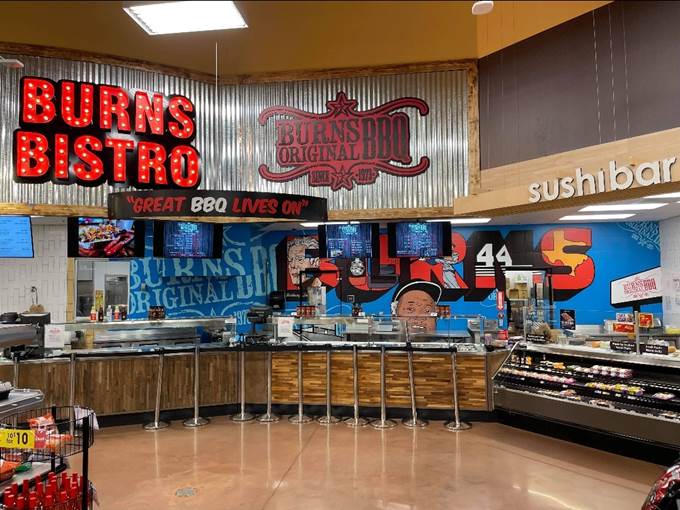
Burns BBQ inside the Kroger grocery store at 14221 East Sam Houston Parkway North.
Courtesy Lemon-Lime Light Media
About a year ago, I remember hankering for some barbecue. There are two places near my neighborhood that, I would say, are pretty solid. But my family and I didn’t go to either one of them. After a half-hour of grocery shopping, we went to the in-store restaurant at the Kingwood H-E-B instead. It was just more convenient.

The rise of the “grocerant” is not a new trend, but it is one that has quickly accelerated alongside the frequently tossed-and-turned American economy. H-E-B, Kroger, Randalls and other neighborhood supermarkets have emerged as a new threat to restaurants, siphoning away dollars and even staff. Shoppers can grab a ready-to-cook steak dinner or sit down with a tray of brisket and sides.
Article continues below this ad
And restaurants, since 2020, have been caught on their back foot. But what if, instead, restaurants could look at grocery stores as something else—an opportunity?
A half century of grocery dining
Sunny Kim, manager of the SushiYa section at H-E-B, slices sushi.
R. Clayton McKee/For The Chronicle
The grocerant first emerged roughly 50 years ago at Kroger, according to Supermarket Guru Phil Lempert. It wasn’t anything flashy: just some seating areas next to its deli, which offered rotisserie chickens and sandwiches. The most significant evolution of the trend came from Central Market in Texas and Mariano’s in Chicago. The former put picnic tables outside the store.
Article continues below this ad
“Bob and Nina Mariano hired a guy who owned a couple restaurants to put together this great experience, different booths for sushi and lobster rolls,” Lempert said. “Chicago Magazine picked it as the hottest pickup place to pick up a date.”
Today, grocery stores can offer quality sit-down and grab-and-go experiences at both value and convenience. Central Market’s sandwiches, for instance, have become a well-known secret among Houstonians. Houston Chronicle food critic Bao Ong had glowing remarks on the California Connection, the store’s most popular sandwich. Some of that, Lempert noted, has been fueled by supermarkets hiring professional chefs.
“It was a great opportunity to work for a supermarket,” Lempert said. “It’s a 9-5 job instead of a 5-12 job. You get benefits, good pay and so on.”
Article continues below this ad
A mixed bag
The Meal Simple section of H-E-B is a special place where lazy meets lonely meets delicious.
Dan Carson
And while grocers have adopted restaurants as a profitable segment of its business, the reverse has had varied success. In 2014, Dimitri Fetokakis partnered with H-E-B to open a Niko Niko’s restaurant inside their Pearland store. It closed three years later.
“I felt I was competing with the pricing of the supermarket a little bit,” Fetokakis told Chron in 2025. “People would walk in and say, ‘Why am I paying $5 for hummus when I could get it off the shelf for $2?'”
Article continues below this ad
During COVID, H-E-B launched the “Texans Helping Texans” program statewide. The San Antonio-based grocer partnered with multiple restaurants to help provide a critical line of revenue for the locked down businesses. Businesses were able to get out their signature meals in front of shoppers, like Brennan’s famous turtle soup.
“During the shutdown, we worked with restaurants as a way to support local businesses while offering customers access to local favorites. While we strived to meet the needs of the community, it was a short-lived effort,” said Lisa Helfman, Managing Director of H-E-B Public Affairs in Houston.
At the height of the pandemic, Brennan’s products were in 18 H-E-B stores. “It was unbelievably helpful,” Brennan-Martin said. “When you have customers not coming in—anything north of 0 was music to our ears.”
Curiously, Brennan-Martin noted, the H-E-B products and takeout orders started to drop off by the end of the lockdowns. “Frankly, in our type of restaurant, people aren’t just coming for the food. They’re coming for the southern hospitality, the ambience, and the experience,” he said.
Article continues below this ad
Some success is found
An afternoon tea service is on display at the Central Market on Westheimer Road, Monday, Sept. 10, 2018, in Houston. Central Market is preparing for its annual Passport series where they highlight the culinary traditions of a certain country. This year they will highlight the United Kingdom. (Photo by Mark Mulligan/Houston Chronicle via Getty Images)
Houston Chronicle/Hearst Newspapers/Houston Chronicle via Getty Images
But there has been success. Sushiya, H-E-B’s main provider of Japanese food products, was previously one of the first Japanese sushi restaurants in Texas: Tokyo Garden. The restaurant later pivoted to catering, finding an audience with corporations and, later, grocery stores. As of 2024, Tokyo Gardens Catering now supplies more than 300 H-E-B stores across Texas.
Elsewhere, Burns Original BBQ out of Houston’s Acre Homes partnered with Kroger to open sit-down locations at their stores. Customers can walk in and eat barbecue inside the store or grab it and go. They can also purchase Burns’ sauces off their shelves.
Article continues below this ad
“The successful ones, in my opinion, are the ones that are more local and home baked versus the chain operations,” Lempert said. “If you take a look at what shopping malls did, they put in all the chain restaurants and people stopped going because it was boring.”
Thus, the relationship between restaurants and grocers doesn’t have to be antagonistic. There is room for partnership and even friendly collaboration. It’s on restaurant operators to figure out how to build those connections and the infrastructure to support those efforts.
“Texans helping Texans was critical,” Brennan-Martin said. “It was simple, it was quick, and it was heartfelt from H-E-B. And we felt we helped them attract some customers to their stores. That’s what they told us.”
Article continues below this ad