
AP Photo/Karen Warren & Win McNamee/Pool Photo via AP
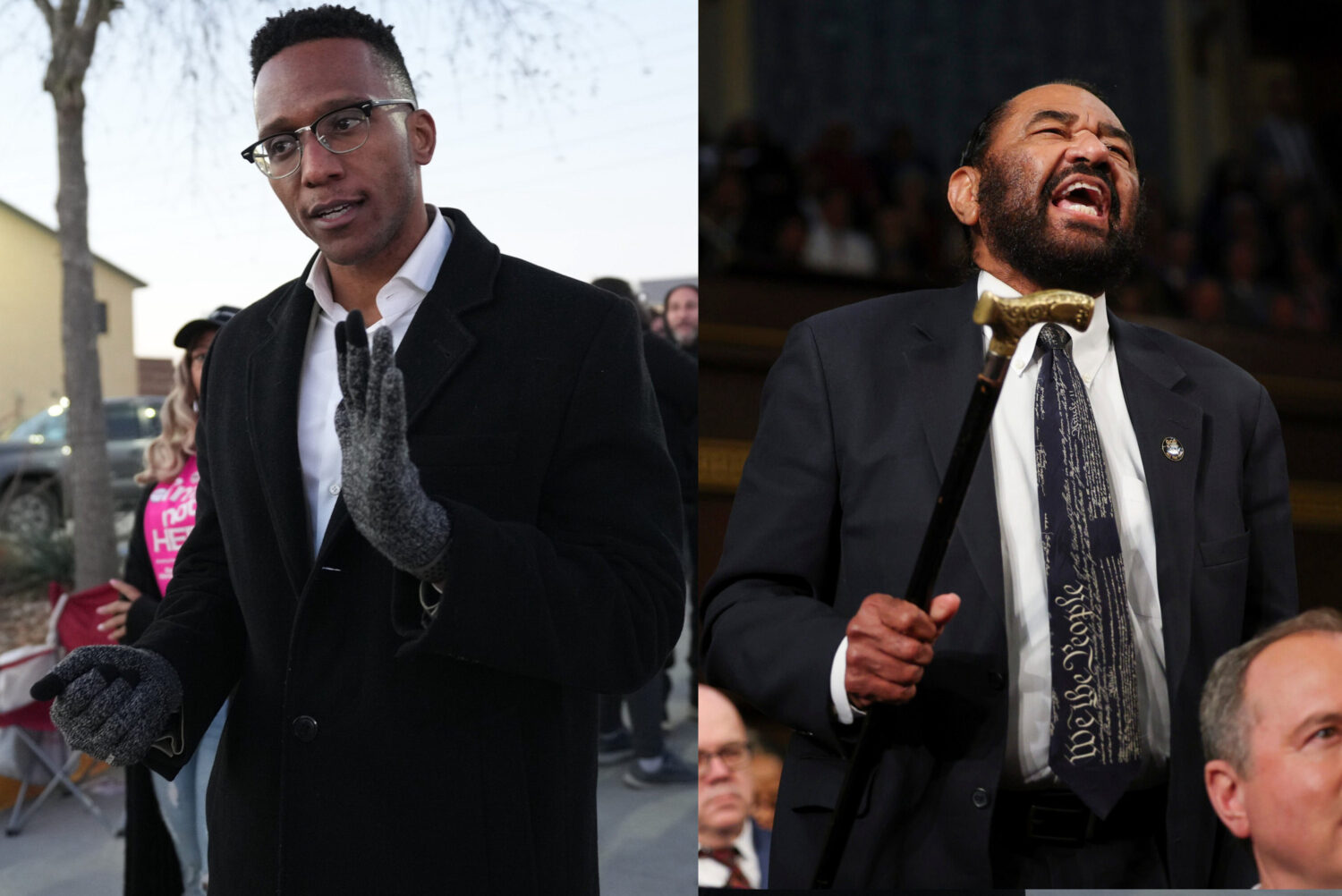
U.S. Reps. Christian Menefee, left, and Al Green are competing in the Democratic primary in the 18th Congressional District.
U.S. Reps. Christian Menefee and Al Green are vying for the same seat in the Democratic primary runoff election for Texas’ 18th Congressional District. But the two Houston-based lawmakers are on the same page when it comes to backing new voting rights legislation, in the wake of the Supreme Court’s decision last week to gut a key provision of the Voting Rights Act.
The Supreme Court ruled last Wednesday, in Louisiana v. Callais, that Section 2 of the Voting Rights Act — the provision that allowed enforcement of the act — didn’t bar states from using non-racial factors when drawing maps, including to achieve partisan advantage.
The immediate effect was to strike down a congressional district Louisiana had created as an African American opportunity seat. Justice Samuel Alito, writing for the court’s conservative majority, called the district an “unconstitutional racial gerrymander.”
Sign up for the Hello, Houston! daily newsletter to get local reports like this delivered directly to your inbox.
Justice Elena Kagan, in her dissent, said the ruling “renders section 2 all but a dead letter,” making it much harder for plaintiffs to obtain any redress of racial discrimination in redistricting through the courts.
Menefee, speaking with Houston Public Media, called for Congress to pass a national ban on partisan gerrymandering.
“Because of the court decision,” Menefee said, “that can be used as subterfuge as an excuse where you can take a racist map, put some lipstick on it and call it a partisan gerrymandering instead of racial gerrymandering. And so we have to ban partisan gerrymandering as quickly as possible.”
Menefee said there was effectively no chance that Congress would pass new voting rights legislation as long as Republicans are in charge. He said that made it even more important for Democrats to prioritize strengthening voting rights the next time they return to power.
“I think it is a stain on the Democratic Party that we weren’t able to pass voting rights legislation when Kyrsten Sinema (I-AZ) and Joe Manchin (I-WV) held it up the last time that we had a majority in the Senate,” Menefee said. “But it is going to be incumbent upon us that next time we get the majority that we do whatever is necessary — I don’t care if it means suspending the filibuster — do whatever we can to make sure that we have fair access to the ballot box so that we can continue this pursuit of a true multiracial multicultural democracy.”
Green currently represents Texas’ 9th Congressional District, but his home was moved into TX-18 during last year’s controversial mid-decade congressional redistricting by Republican state lawmakers, under pressure from President Donald Trump and Gov. Greg Abbott.
Green issued multiple statements condemning the Supreme Court’s ruling.
“The Court’s decision undermines the principle that every voice deserves to be heard and that electoral maps must reflect the diversity of the communities they serve,” Green said. “For generations, Americans have fought to dismantle barriers that dilute the voting power of marginalized communities. This ruling threatens to erode those gains and signals a troubling retreat from the protections that have helped move our democracy forward.”
Green said he would work with his colleagues in Congress as well as activists to strengthen voting rights, and he called for peaceful protest as part of the effort.
“If we are indeed being forced to revisit the struggles of the 1960s,” Green said, “then we must be prepared to meet this moment with the same resolve those struggles required.”
Both TX-18 and TX-9 were major targets of Texas’ 2025 redistricting effort, raising the prospect that both could be redrawn to be less favorable to non-white voters after the 2030 census, if not sooner.
“I have concerns for communities across Houston that Greg Abbott and legislators in Texas may play political games with their congressional districts,” Menefee said. “I’m not worried about myself. I will be fine either way, because this was never about me. The ultimate losers in that would be the people in our communities, and that’s who I’m fighting and protecting.”
Menefee took office in early February after a marathon special election campaign to fill the seat of the late U.S. Rep. Sylvester Turner, who died in March 2025. Abbott called for the special election to take place in November of last year.
The wide field to replace Turner led to a first round in which no candidate garnered more than 50% of the vote, forcing Menefee into a January runoff against former Houston City Council member Amanda Edwards.
The gap between Turner’s death and Menefee’s swearing in left TX-18 without a representative for more than 330 days.
Last week, Menefee filed his first bill since taking office. Dubbed the Special Elections Timeliness (SET) Act, the bill would put a 180-day deadline on states to hold a special election in the event of a vacancy in Congress.
“I’m hopeful that we’ll get some bipartisan support because it’s not partisan,” Menefee said. “We’ve already seen Republican officials out of California complain when the governor out there set an election at a time that they felt was too delayed. So, this is an issue that could impact folks in both parties, and I’m hopeful that my colleagues on the other side of the aisle will see it that way.”
The winner of the May 26 primary runoff between Menefee and Green is likely to win the general election in November. TX-18 has been represented by a Black Democrat since the 1970s and was redrawn to be even more solidly blue.