
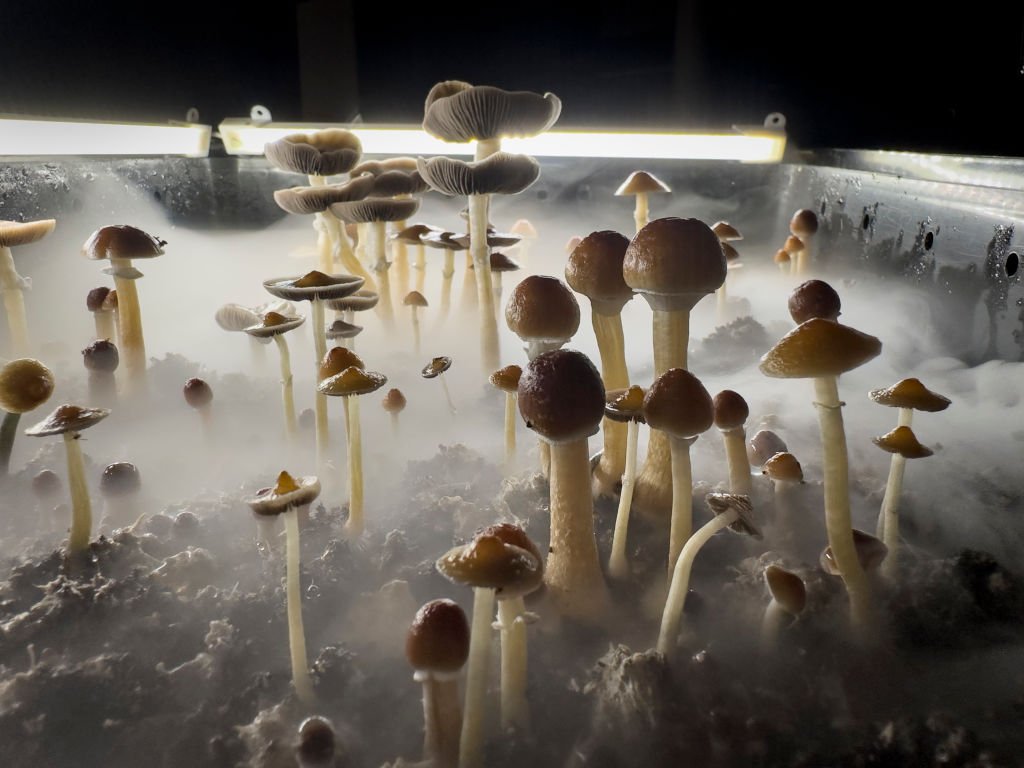
Psilocybin mushrooms stand ready for harvest in a humidified “fruiting chamber” in the basement of a private home. Studies have suggested that psilocybin mushrooms, also known as magic mushrooms have promise in combating anxiety, anorexia, depression, PTSD, obsessive-compulsive disorder and various forms of substance abuse.
John Moore/Getty Images
Three years ago, the Church of the Sacred Synthesis was riding high.

The church — then called the Church of Psilomethoxin — had been founded in 2021 in Austin around a novel and legally dubious psychedelic it distributed to its 1,500 global members, earning as much as $100,000 per month.
Article continues below this ad
Its military veteran founders — Kemal Ian Benouis, Greg Lake, Ryan Begin and Benjamin Moore — spoke of abating the suicide crisis among service members by easing the PTSD pushing some of them over the edge, as well as selling a good and safe hallucinogenic high. Their mission of helping people heal through the use of a psychedelic drug that married toad venom and so-called magic mushrooms was growing in strength and legitimacy, they said.
In 2023, it was featured in stories in national publications such as Vice and Salon. When it conducted its first-ever “Entheogenesis,” 350 people traveled to Austin to trip on the church’s synthesized blend. It says it was even talking with Dell Medical School about its work.
Then the bottom fell out.
A research paper was published in April 2023 suggesting the church was selling blasphemy. The substance it sold as its “holy sacrament” had no psilomethoxin in it, the paper said. It dubbed the church’s claims that it had successfully cultivated the toad venom-based high in psilocybe mushrooms “Fungi Fiction.”
Article continues below this ad
The church’s membership was aghast. As part of a lawsuit the church filed after the paper’s publication, it said it lost 80% of its monthly revenue as members left, many sending angry missives on their exits. It had to lay off staffers, to whom it still owes nearly $500,000. Founders lost their investments.
The uproar couldn’t have come at a worse time. The notion of psychedelics as a therapy is gaining legitimacy nationally and, powered in part by former Gov. Rick Perry, Austin is seeking to become a hub of the movement. Tens of millions of dollars will flow into the University of Texas Dell Medical School to research Ibogaine, a psychedelic derived from an African shrub. Both the Texas Legislature and President Donald Trump have shown support.
The church founders’ 2024 suit in state District Court in Travis County said they had been libeled and suffered $2.5 million in damages.
Later that year, all 16 counts of libel, business disparagement and fraud against the people and entities that produced the paper or republished it were dismissed. Not only did District Court Judge Laurie Eiserloh order that the church get nothing, it had to pay the defendants attorney fees and was told the claims could not be refiled.
Article continues below this ad
Whose fungi, whose fiction?
Now, the church is back in court, pivoting to business claims and the Texas Business Court in a cause of action it says could be worth millions in a market it claims is worth billions.
The case hinges on a compound that science has yet to prove even exists.
The article “Fungi Fiction: Analytical Investigation into the Church Of Psilomethoxin’s Alleged Novel Compound Using UPLC-HRMS” written by Alexander Sherwood and Samuel Williamson was published in April 2023 on an open repository for chemistry papers.
Article continues below this ad
The article that the church said upended its operation used mass-spectrometry analysis of samples of the church’s “sacramental compound” and found it contained no psilomethoxin. It found some amount of psilocybin — the naturally occurring psychedelic found in fungi — and another psychoactive substance found in so-called magic mushrooms. The study highlighted concerns for the safety of the product the church was sending its members. At the time, the church said it had distributed more than 500,000 doses.
Former Gov. Rick Perry speaks during an October panel discussion in Dallas on veterans’ mental health and the potential of Ibogaine, a psychedelic drug, as a treatment.
Jason Janik/Dallas Morning News
The church now says its own testing has found the compound.
Sherwood and Williamson are defendants in the lawsuit but did not reply to requests for comment.
Article continues below this ad
The two work for Usona Institute, another defendant, which does research into psychedelics and is deep into testing for its own psychoactive trauma-abating treatments.
In its initial lawsuit, the church admitted it had not tested its product for psilomethoxin. Its founders’ belief in the “holy synthesis” based on their methods and research was part of their religion, they said, instead relying on the experiences of members. Also, testing for a new compound that has limited reference points is expensive and difficult, though the church said it intended to test for it at some point.
The church attacked the study by Sherwood and Williamson for not being peer-reviewed, for its testing method, chain of custody and omissions, calling it “completely devoid of scientific rigor” in its original libel suit.
It says Usona wanted to destroy a potential competitor in a lucrative market and used the study to do it.
Article continues below this ad
In its previous lawsuit, Sherwood and Williamson said their study was independent of Usona, focused on the claims the church made and the safety of its “holy sacrament.” They argued their work was true and protected under the First Amendment.
They were critical of the church for not testing its product. The two defendants said the church essentially stated what was in their argument, that science had yet to prove psilomethoxin exists.
“This lawsuit is based on the premise that the Article was false in precisely that assertion when Plaintiffs admitted it was true,” it states.
So its new lawsuit takes a different approach. In the earlier Travis County case, the church attempted to prove the malice of publishers and the motivations of Usona, its founder Bill Linton and other parties. The new lawsuit is focused solely on business and must prove the church has a trade secret, that it has value and that its intellectual property was misused by the defendants.
Article continues below this ad
Going corporate
The drive to find a mellower high for the toad-deprived psychedelic public could be lucrative.
The drug, which most users smoke, is derived from the Sonoran Desert toad. Officially known as 5-MeO-DMT, it’s a Schedule I drug that can produce a psychedelic high but can also cause chills, vomiting and heart attack — a stark tradeoff for what users describe as intense visual hallucinations, ego death and life-altering perspective shifts.
Several peer-reviewed studies have shown early success in the use of the drug for treatment of trauma, noting quick reduction in symptoms and long-lasting remission.
Article continues below this ad
Scientists say psilocybin also has seen success in abating depression. It may promote neuroplasticity, a rewiring of the brain that gives patients fresh perspectives on longstanding psychiatric problems. Although it is classified in the U.S. as a Schedule 1 substance, making it illegal by federal law, moves in many municipalities to decriminalize it are creating a growing market.
The church’s new lawsuit lists an investor who valued its work at $500 million.
It also alleges that Usona and its cohorts violated its secret research and used a knowingly false study to discredit its product while raising funding for similar research that it advanced through the church’s trade secret.
Usona Institute did not respond to requests for comment.
Article continues below this ad
The church’s civil claims include misappropriation of trade secrets and unjust enrichment.
Unlike the first go-round in court, the church now says it has done independent research to back up its claim with chemists, listing two scientists.
It is vital to their claim that they prove the compound actually exists. If they can’t, no trade secret could be stolen and the case will likely be closed.
Article continues below this ad