
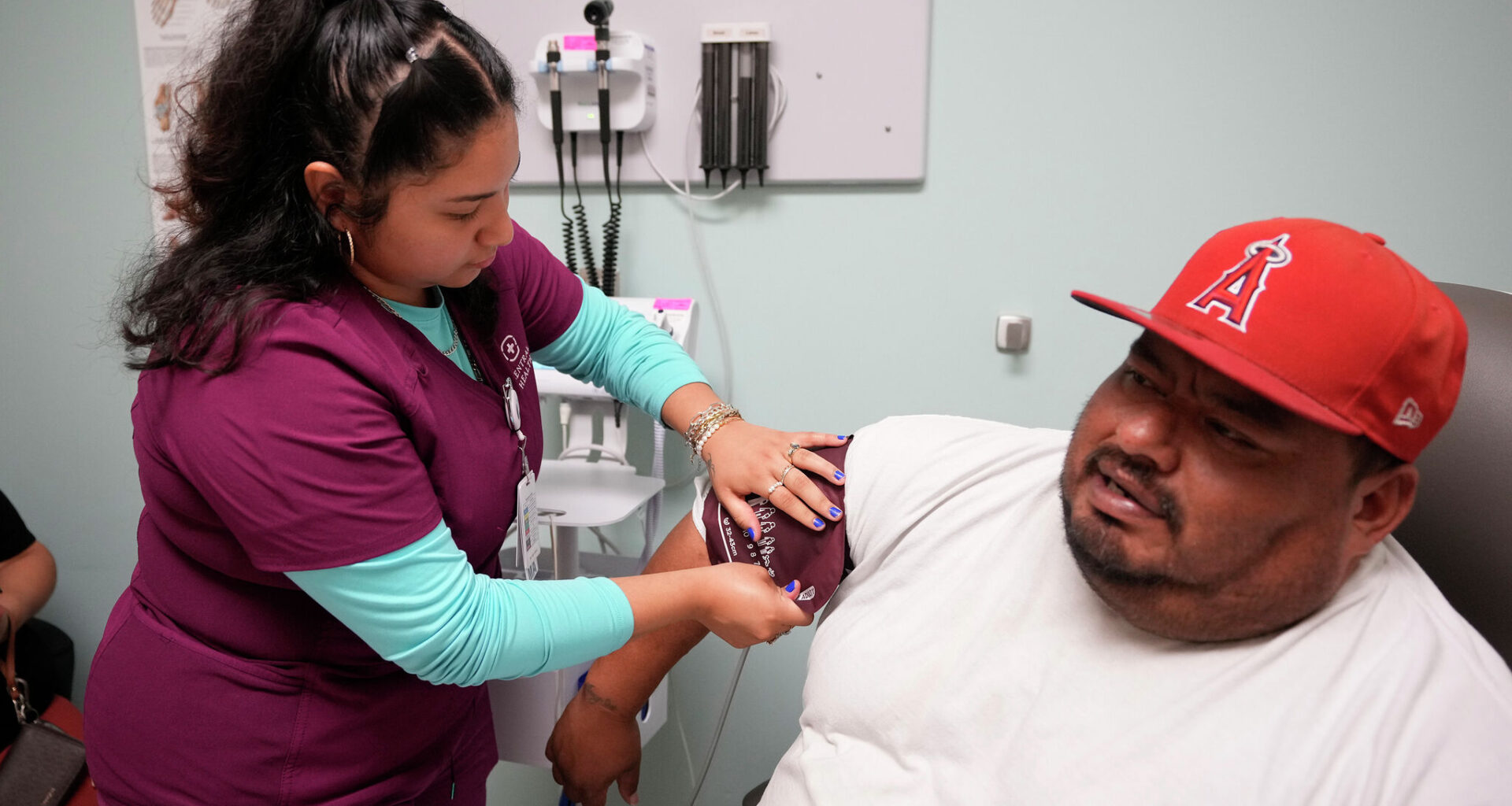
Medical assistant Sarai Vences takes the blood pressure of patient Eloy Herrera at the Central Health East Austin Specialty Clinic. Having access to both specialty care and primary care can improve health outcomes. Central Health’s Medical Access Program provides a health insurance-like program for people who make less than 200% of the federal poverty level.
Jay Janner/Austin American-Statesman
How equitable is Texas’ health care system? Turns out, not very.

That’s true across the United States with people who are Hispanic or Black having less access to care and worse health outcomes, according to a new report from the Commonwealth Fund. The fund is a nonprofit that supports independent research into creating a better healthcare system.
Article continues below this ad
For Texas, though, the disparities show up in greater amounts because of the number of people who are uninsured.
“There are opportunities to do better,” said David Radley, a researcher with the fund, of Texas’ situation. “Having health insurance is the first step to making sure that people can get access to primary care.”
Equity should be a concern for everyone, said Dr. Laurie Zephyrin, the senior vice president at Commonwealth Fund and an obstetrician-gynecologist. “Disproportionate access doesn’t just affect people who are marginalized,” she said.
Higher insurance premiums, higher costs of procedures and less community access to providers and procedures occur when areas have more uninsured people.
Article continues below this ad
Texas ranked 43rd of the 51 states and Washington, D.C., that Commonwealth Fund was able to rank for white people. For Hispanics, Texas was 45th out of 49. For Blacks, 22nd out of 39. For American Indians and Alaska Natives, second out of 21. For Asian American, Native Hawaiian and Pacific Islanders, 17th out of 33.
“Disparities are multifactorial,” said Dr. Joseph Betancourt, the president of the Commonwealth Fund. Differences in housing, education and economic opportunity all impact a person’s ability to get healthcare coverage that is affordable enough to be used.
The research for this report was based on 2022 through 2024 data. The disparities are expected to worsen as changes to Medicaid and decreased subsidies for Marketplace insurance have gone into effect, Betancourt said. Immigration changes also will make these disparities increase as people are afraid to seek healthcare, he said.
How well does the healthcare system work in Texas?
Commonwealth Fund created a percentile ranking to compare Texas groups to all population groups nationwide. The highest percentile was for Asians, which was in the 80th percentile. White people were in the 62nd percentile.
Article continues below this ad
Then Texas begins to have worse outcomes than average groups: 37th percentile for American Indians; 35th percentile for Blacks; and 7th percentile for Hispanics.
“Compared to other states in the Southwest region, Texas has more severe racial and ethnic disparities,” the report concluded.
Medical assistant Jalen Reasonover, of the Central Health Mobile Bridge Clinic, checks the blood pressure of Aldophine Mukendi at the Therapeutic Diversion Program building. Targeted programs for underserved people has been shown to improve health disparities.
Jay Janner/American-Statesman
How equitable is access to care?
Texas has one of the highest rates of uninsured people, regardless of race or ethnicity.
Article continues below this ad
It was worse than the average state for American Indians, Blacks, Hispanics and white people: 13% for whites, 17% for Blacks, 21% for American Indians and 34% for Hispanics. Only Asians had lower rates of 10%.
For children, the uninsured rates were similarly disparate: 9% white people, 12% Blacks and 19% Hispanics. American Indians and Asians both had 6% uninsured children.
When it came to adults who went without care because of the cost, Texas’ rates were higher than the national average. About 12% of white people went without care; 6% of Asians; 18% of Blacks; 24% of Hispanics and 26% of American Indians.
Ali Algertani has his blood sugar checked by Erica Lopez of CommUnityCare at a health fair. Locally federally qualified health centers like CommUnityCare have filled in gaps for people who do not have insurance or cannot afford their co-pays.
Austin American-Statesman
What about health outcomes?
Texas was among the worst for white people and Hispanics, but better for American Indians, Asians and Blacks. However, the health outcomes for Black people across the country were not good compared to other groups.
Article continues below this ad
Most of the time, access to care can be correlated with deaths from preventable causes. However, that does not prove to be true nationally for Hispanics, Betancourt said. Researchers think may be because the population is typically younger, he said, but there could be other reasons for the difference.
Texas still had higher rates of preventable deaths in adults younger than 75 for whites and Hispanics compared to national numbers. Preventable deaths are caused by things such as car crashes, gun violence, drug overdoses and treatable diseases like flu. For white people in Texas, 204 died of preventable causes per 100,000 people; for Blacks, 234; for Hispanics, 155; for Asians, 105, and for American Indians, 70.
In infant mortality per 1,000 live births, the rates are similar to national rates, but show disparities. For white people, 5 infant deaths per 1,000 live births, 5.3 for Hispanics, 3.8 for Asians, no data for American Indians, but for Blacks 10.3, double that of other groups.
Colorectal cancer death rates in Texas also show a disparity of 15 deaths per 100,000 people for white people, 13 for Hispanics, 7 for Asians and 8 for Indians, but 19 for Blacks.
Article continues below this ad
Breast cancer deaths also had similar disparities. Even though Black women had higher rates of screening, differences in follow-up care or later-stage diagnoses meant death rates were still higher, Zephyrin said.
In Texas, rates were 21 per 100,000 for white people and 25 for Blacks, but Hispanics fared better at 15, Asians at 11 and American Indians at 5.
Obesity rates across the board were similar to national rates and similar across groups, with Asians having half- to one-third the rates of other groups. American Indian and Blacks had slightly higher rates than Hispanics and white people.
About one-third of People’s Community Clinic’s patients are adults, and a third do not have insurance. The clinic, like other federally qualified health centers, has been a resource for underserved communities.
People’s Community Clinic
What about health quality?
There was less data provided across all groups in health quality, but Texas had worse quality for white people and Hispanics, but better than other states for Blacks, Asians and American Indians.
Article continues below this ad
For colorectal screenings, 67% of white people had been screened recently; 66% of Blacks, 70% of American Indians; 50% of Hispanics and 48% of Asians.
In mammography, 76% of whites had a recent scan; 74% of Hispanics and American Indians, 70% of Asians but 84% of Blacks.
The percentage of children who received primary care or dental care visits in Texas was typically lower than national rates: 69% of white people, 67% of Blacks and 62% of Hispanics. Data for Asians and American Indians were not available.
How can the data shape healthcare initiatives?
“Focused actions can really help improve disparities,” said Sarah Collins, a researcher at the Commonwealth Fund.
Article continues below this ad
The fund’s experts recommend starting with providing more access to care through connecting people to insurance or other programs. “Coverage does not high-quality care make, but high-quality care cannot exist without coverage,” Betancourt said.
Zephyrin recommends putting patients first to shrink equity gaps and create an “intentional shift to improving patient outcomes.”
Maternal mortality and infant mortality are one of the “starkest” examples of inequity “but the most promising to resolve,” she said.
Commonwealth Fund only included infant mortality not maternal mortality, but other reports have shown disparities in maternal deaths in Texas.
Article continues below this ad
Zephyrin recommended training more nurses, doctors, midwives and doulas from underserved communities and training providers not of that community to recognize their biases.
This data can be used to implement new programs to improve healthcare screening rates and provide more primary care access in certain communities. It can be used to target technologies like artificial intelligence in underserved communities, but that AI has to be programmed with cultural sensitivities and in a language understood by that community.
“States that perform well have taken pains to collect data and identify gaps,” Betancourt said.
Article continues below this ad