
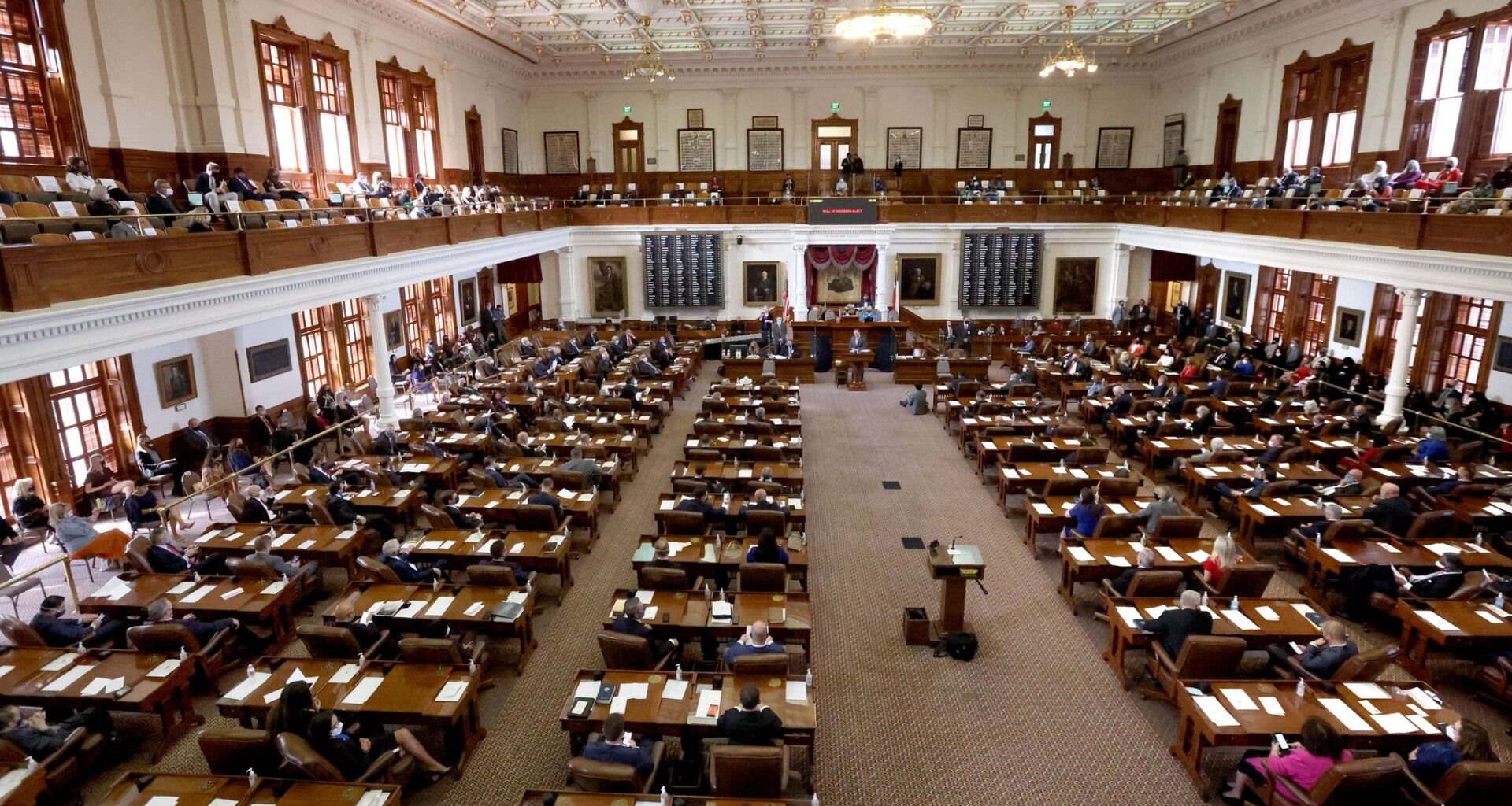
The 87th Texas Legislature is called into session at the Texas Capitol building in Austin, Texas, on Tuesday, Jan. 12, 2021. (Lynda M. González/The Dallas Morning News)
Lynda M. González/Staff Photographer
AUSTIN — For all the talk of shakeup in the GOP-led Texas House, the battlefield is small.

Just nine of the chamber’s 150 seats were truly competitive in 2024, according to an analysis by The Dallas Morning News, and only three of those were held by Republicans.
Article continues below this ad
That leaves Democrats needing to stretch the current map to flip the House, undercutting Lt. Gov. Dan Patrick’s warning that the GOP could lose control and bolstering House Speaker Dustin Burrows’ prediction that Republicans will keep it.
Patrick’s concern comes as Texas Democrats look to overperform in the midterm elections, with Senate nominee James Talarico topping their ticket.
But even with that backdrop, the path to a majority is narrow.
Make Dallas News a preferred source so your search results prioritize writing by actual people, not AI.
Add Preferred Source
Republicans hold 88 of the 150 House seats. Democrats would need to take at least 14, far more than the handful of districts that recent election results suggest are in play.
Article continues below this ad
That means, based on The News analysis, redistricting and recent voting patterns have squeezed the path to a majority into a narrow set of districts.
Since Republicans redrew House boundaries in 2021 over Democratic objections, far fewer seats have been competitive than at the end of the previous decade. Competitive races are those decided by less than 10 percentage points.
Article continues below this ad
At present, political experts see Democrats maintaining control of all six seats that were competitive in 2024 — three in Dallas-Fort Worth, two along or near the border and one in Harris County.
Even if Democrats win the other three seats, two in Bexar County and one in Dallas County, it would only dent the Republican majority.
Democrats last controlled the House in 2003.
During the 2021 redraw, Republicans consolidated their base voters, fortifying seats for many of the party’s once-vulnerable legislators. They also entrenched many progressives, packing reliable Democratic voters into dense, urban districts.
Article continues below this ad
“As a result, there are fewer competitive districts,” Rice University political scientist Mark Jones told The News. “There was a conscious decision to try to concentrate so that Republicans would not have to worry … [and] a majority was a virtual certainty.”
Jones said the approach marked a sharp break from the previous redistricting round in 2011, when Republicans spread their voters across more districts to maximize winnable seats after a Democratic wipeout during Barack Obama’s first term.
It worked, but left some Republicans vulnerable during Democratic gains in 2018 and 2020.
Now, as the effects of the 2021 map begin to loosen, the number of competitive districts could tick up again.
Article continues below this ad
Lt. Gov. Dan Patrick (right) speaks to reporters alongside House Speaker Dustin Burrows, R-Lubbock, outside a joint hearing of the Texas Senate and House Select Committees on disaster preparedness and flooding, Thursday, July 31, 2025, in Kerrville, Texas.
Elías Valverde II/Staff Photographer
That might have prompted Patrick to “juice Republicans” with his message that GOP control of the House could be in danger, SMU political scientist Cal Jillson said.
“You’ve got to get the Republicans up on their hind legs and ready to fight, and that’s what Patrick was doing,” Jillson said.
Burrows, the Republican speaker from Lubbock, said his party is not at risk. “I’ve seen the numbers. We are not going to lose the Texas House,” he said last month.
Article continues below this ad
Democrats say more House districts are in play than the numbers suggest.
“The whole country is in a period of electoral realignment right now,” state Democratic Party chair Kendall Scudder said. “As a consequence, you’re going to have some surprises on election night.”
Another factor is how many districts are contested this year. Democrats have fielded a full slate of candidates for every House seat for the first time in modern history, according to the party.
Article continues below this ad
Gov. Greg Abbott’s chief political strategist Dave Carney dismissed the move as “just a gimmick,” but said it could have a measurable effect on the election.
“There is something to recruiting candidates to run in some of the second-tier seats, so that you’re well positioned to take advantage of any potential waves,” Jones said.
Article continues below this ad
University of Houston political scientist Brandon Rottinghaus said the odds of Democrats seizing the House were not “out of the question,” but remain slim.
“Given the way these districts are gerrymandered, given the amount of money incumbents have been banking, it is unlikely to happen,” Rottinghaus said.
One of those incumbents is Garland Republican Angie Chen Button. She’s running for a 10th term in the House, and her campaign has more than $1 million on hand, thanks to large donations from Burrows, conservative PACs and a pro-gambling group backed by Dallas Mavericks owner and casino magnate Miriam Adelson.
Button’s Dallas County seat, House District 112, is one of the few competitive seats held by a Republican. It routinely has been competitive in recent years, the only district in the state to earn that designation in the past four elections.
Article continues below this ad
Her margin of victory against Democratic challengers has varied, from less than one percentage point in 2020 to nearly 8 percentage points in 2024.
She’s facing first-time candidate Zach Herbert, a Garland attorney and Marine veteran who has about $30,000 banked for his campaign. Herbert said he was encouraged by Democratic turnout in the March primary.

By signing up, you agree to our Terms Of Use and acknowledge that your information will be used as described in our Privacy Policy.
Democrats outvoted Republicans in the district by more than 2,000 votes, despite Herbert running unopposed while Button topped a four-way primary.
Article continues below this ad
Herbert said in an interview that he expects strong Democratic turnout in the district, but “we can’t bank on it.”
Button was unavailable for an interview due to travel, her spokesman said.