
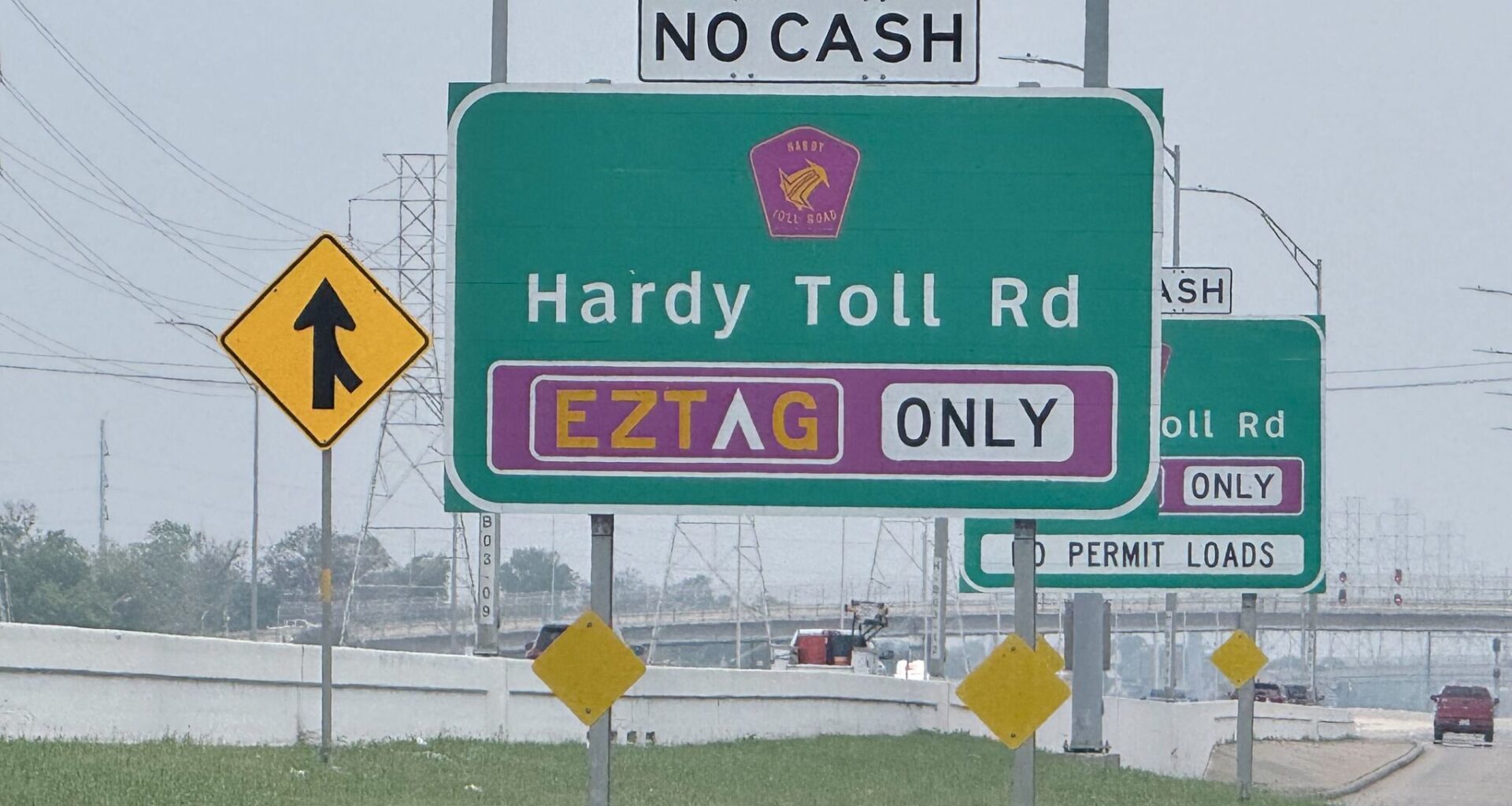
Hardy Toll Road signage near Aldine, Texas.
Macy Meinhardt
There likely will always be more questions than answers when it comes to the Harris County Toll Road system. From memes to lawsuits, campaigns, investigations and Senate Bills, it seems like almost everyone in the Houston area has a bone to pick with the toll roads.

When Chron requested documents showing how Harris County spends its portion of annual toll road revenues, the picture became even muddier. Even county officials agreed that the records would be hard for a non-government worker to understand.
Article continues below this ad
For drivers who pay into the system, that lack of clarity also has also led to distrust. When toll revenues generate a surplus, it is a common expectation for those dollars to be invested in a way that directly benefits drivers, like lowering tolls or improving traffic. Instead, funds are distributed to county precincts under a broad definition of “mobility.”
Since 2023, Harris County’s four commissioners’ offices have each received an average of over $200 million from toll road surplus. By law, this money is supposed to go toward “mobility projects.” What constitutes mobility, however, remains up for debate.
“Toll revenue being diverted to matters unrelated to transportation projects continues to raise major concerns throughout the community,” a legal analysis penned by Texas Sen. Paul Bettencourt’s office states.
Article continues below this ad
Chron reached out to each commissioner office for an itemized list showing how the money was spent in the past three years.
No two reports came in the same.
Some precincts provided partial spending breakdowns, others shared lists of future projects and some offered only general descriptions of how the money was used.
Article continues below this ad
However, that information, combined with reports from the county auditor’s office and previously-adopted budgets revealed that those mobility funds covered everything from road improvements to bike trails and employee payroll during the past three fiscal years.
Inside the mobility funds
The commissioners have received around $854 million total from the toll roads in the past three years.
Article continues below this ad
When voters approved the toll road system in 1983, revenue generated from drivers was originally pitched as a way to expand the toll road system and pay off debt, according to official ballot language.
But county records show those dollars now also are routinely used for maintenance and operations. Larger capital projects, meanwhile, are covered by bonds and other forms of debt.
Commissioner Rodney Ellis Precinct 1: $208 million
Commissioner Adrian Garcia Precinct 2: $208 million
Commissioner Tom Ramsey Precinct 3: $216 million
Commissioner Lesley Briones Precinct 4: $204 million
Ramsey, who represents the largest swath of the county by square miles, received the highest total allocation. His office’s spending list showed that $38.5 million went toward “mobility expenses,” largely covering vehicles, salaries and maintenance.
Article continues below this ad
The rest of Precinct 3’s report included an itemized list of each project and operational expense, with the largest expense being $28.8 million for on-call concrete repair contracts and the biggest single project cost being $9.5 million for the widening of Wallisville Road.
Precincts 1 and 2 show a similar pattern, with substantial spending on operations and maintenance alongside investments in sidewalks and broader connectivity projects.
Ellis’ office shows that $116 million went toward road improvement, $89 million went toward operations and maintenance and $38 million went toward sidewalk and connectivity projects.
Meanwhile, Garcia’s office shows that $28 million went toward sidewalks and connectivity projects like hike-and-bike trails, while $39 million went toward roads and $90 million went toward labor, equipment and “other mobility-related costs.”
Article continues below this ad
Precinct 4’s Commissioner Lesley Briones’ office offered the least detailed list of expenses, omitting connectivity projects and overall operation and maintenance costs. Their report did, however, include a list of several road improvement and lane-widening projects.
But the records still leave a fragmented picture of toll road spending. While Chron’s requests were identical, all four precincts sent back something different.
At a roundtable with Harris County Auditor Chief Assistant Glenn Holloway, 1st Assistant Leslie Wilkes, and the auditor himself, Michael Post, Chron reviewed the printed records requests.
They all came to the same conclusion: this would be confusing for any normal person to understand as presented.
Article continues below this ad
However, it does not mean anything inherently shady is going on, as many online already have claimed.
As the office explained, Harris County Commissioners’ offices are empowered to conduct their own oversight and accounting of their mobility fund expenditures. A lengthy internal report on the mobility fund or annual audit is not required.
Per Texas Transportation code Chapter 284, commissioners court “without state approval, supervision or regulation” may use surplus revenue to pay for costs of “a project for the study, design, construction, maintenance, repair, or operation of roads, streets, highways, or other related facilities.”
Even still, the auditor’s office has access to mobility fund expenditures and is reviewed for compliance.
Article continues below this ad
Further complaints against mobility spending is that precincts are using it to build things like bike lanes and trails, rather than road improvement that benefit drivers directly.
Efforts to amend the law to limit spending purposes—particularly using the money for bike lanes and trails, rather than road improvement—have failed so far. Senate Bill 2722 sought to restrict mobility dollars for only for toll road related projects or to retire debt related to a toll road project. It also called for 30 percent of revenue to be diverted to the city of Houston, as it hosts a large share of the toll road system.
Harris County Commissioners at the time reportedly argued that the diversion would be a “bail out” to plug a glaring $330 million budget deficit within the city, rather than actual fund transportation-related improvements.
Article continues below this ad
The bill died after failing to get a full vote from the Texas House, however the debate and tug of war over funding is likely far from over.