
For TCU Chief of Police Robert Rangel and his officers, decades of policing experience have been put toward keeping “purple Disneyland” a safe and happy place to be, Rangel said in a spring semester crime prevention briefing.
“We’ll keep them happy,” said Rangel, who has been a police officer for 44 years, 15 of those undercover and his last 12 at TCU. “People can thrive. They can thrive better in a safe environment.”
TCU PD’s main objective is what’s known as “community policing,” which shifts the focus off of crime reaction and more to prevention, building ties within the community.
Rangel said many students have good relationships with patrol officers and encouraged more students to look past what he called “resting cop face.”
“They’re the ones that have demonstrated a strong sense of understanding the value of community policing,” Rangel said. “So they’re big teddy bears, because that’s where they derive their satisfaction. They get fulfilled from the positive interactions that we have.”
Rangel picks his officers for their “servant hearts” and “warrior spirits,” he said.
The first line of defense is TCU PD’s presence on campus, a natural crime deterrent. “I have designed the police service here to be seen all the time,” Rangel said. “I don’t think you can get from one end of the campus to the other without seeing a police officer.”
Since TCU is a learning environment, minor offenses (drugs, alcohol etc.) are turned over to the Dean of Students’ office.
Rangel said that while he’s grateful for the collaborative effort, the police department has ultimate authority over criminal issues and will show no preferential treatment to any particular student.
“The university doesn’t tell the police what to do and how to do police work,” Rangel said.
For more serious issues, at least in the past 12 years, TCU police officers have not had to use anything beyond “open hand control,” the step before striking, use of the baton, pepper spray and so forth, Rangel said.
Still, he said, his officers, many of whom have been in active shootings before coming to TCU, are ready to jump into action if needed.
“Most of us are still within this job, because we’d rather die with our boots on,” Rangel said. “These are the real police from 40 or 30 years ago, and we don’t play.”
Along with the veteran officers, TCU PD has its own 24/7 dispatch and detectives.
“If somebody commits a crime on campus, we have not only a lot of cameras that give us some investigative leads, but we have people muscle,” Rangel said.
The clearance rate for crimes refers to the percentage of crimes that are closed cases, usually marked by an arrest. The national clearance rate is 34%, while TCU’s is 67% out of its 950 cases last year, Rangel said. Since many of the crimes are committed by a proportionately small number of criminals, the 33% may only represent a handful of people who avoided arrest.
“They’re used to, in a large city like Fort Worth, they commit a lot of crimes before they get caught, because the detectives are overwhelmed,” Rangel said. “Unfortunately, we push it off campus, and part of what’s off campus is the immediate area around that.”
Unlike the Fort Worth Police Department, TCU PD has every spot available filled. That said, they have one less police officer than in 2015, and, as the university continues to grow, they have appealed for more, Rangel said.
He said that without raising tuition, though, TCU PD can’t be expected to ensure off-campus safety.
“If I take the officers I have now and stretch them out over a wider area and enter more calls, then the campus itself becomes less safe, and that’s definitely what everybody’s paying for,” Rangel said. “There’s no disagreement from parents, students, faculty or staff that our first responsibility is to the campus.”
It’s also a matter of jurisdiction. TCU PD is responsible for protecting only the geographic property owned by TCU. Responding to anything else exposes TCU’s campus to threats and the university to liability, Rangel said.
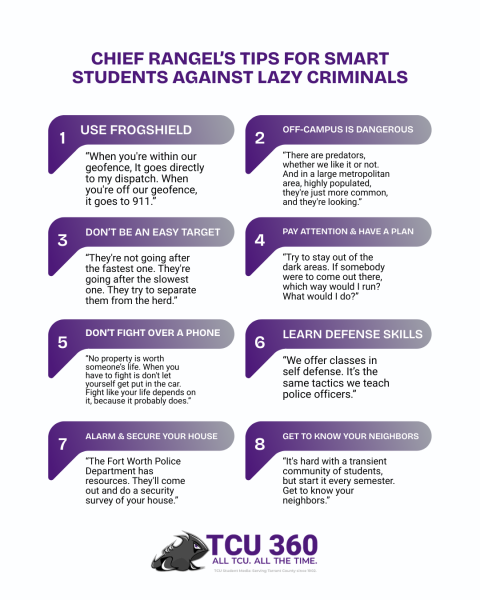
He said the exceptions to that rule are if Fort Worth PD calls them for help responding to a call near TCU or if a student uses FrogShield.
 Compiled by Caleb Gottry
“If you use FrogShield, our safety net, and you hit emergency FrogShield, and you’re within about a mile of campus, we’re coming,” Rangel said. “It’s not our jurisdiction, but for a life-threatening emergency, I don’t think they’re going to fire me, and I’ll be supported by the university.”
Since the area around TCU is relatively safe, Fort Worth PD often focuses its understaffed efforts elsewhere. That leaves calls like noise complaints in the neighborhoods around TCU sometimes unanswered.
The Safe Neighborhood Alliance, currently hosted on GoFundMe, is an organization seeking to combat this issue by pooling money to hire an off-duty Fort Worth police officer to patrol the neighborhoods around TCU to deter crime and “curtail unruly or hazardous behavior,” according to the fundraiser.
Beyond that, Rangel offered students advice on how to outsmart criminals, encouraging everyone to be aware of their surroundings and remember that TCU is positioned in a major metropolitan area.
“There’s not enough police officers in the world to keep everybody safe,” Rangel said. “You can’t put a police officer on every corner. Society can’t afford that, and so everybody has to take some responsibility for their safety.”