
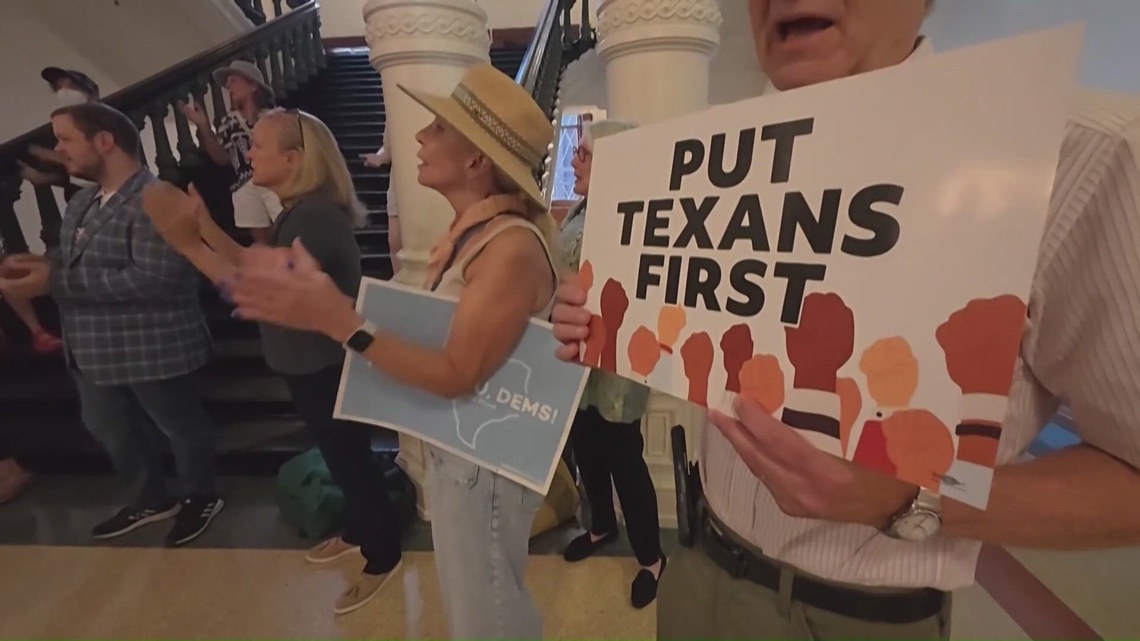
This all stems from a protest at the Texas Capitol during the battle over redistricting last summer.
AUSTIN, Texas — Three Texas women who are currently banned from entering the grounds of the Texas Capitol have filed a federal civil rights lawsuit against state leaders, arguing the ban is unconstitutional.
Angel Carroll, Jessica Cohen and Jill Van Voorhis were among a group arrested after they refused to leave the Texas Capitol grounds during the redistricting fight back in August.
On Monday, the Austin Community Law Center held a press conference on the steps of the U.S. District Courthouse for the Western District of Texas in Downtown Austin to announce a federal civil rights lawsuit.
The lawsuit names Texas Republican Gov. Greg Abbott, Texas Republican Lt. Gov. Dan Patrick, House Speaker Dustin Barrows (R-Lubbock) and members of the Texas State Preservation Board, which manages the Capitol complex, as defendants. KVUE reached out to all of the entities to see if they had any reaction to the lawsuit. The State Preservation Board said it had no comment at this time, while the others have not responded as of publication.
The lawsuit argues the yearlong criminal trespass notices issued from the peaceful protest are an unconstitutional prior restraint on their First and 14th Amendment rights.
“The Capitol is the seat of our state government. It has essential avenues for First Amendment expression and speech that are not available anywhere else,” Brian McGiverin, the executive director of the Austin Community Law Center, said. “It is a unique location. Banning a person from that location without an exceptionally good reason rooted in safety is a violation. It’s a violation of the First Amendment.”
The group was at the Texas Capitol to support State Rep. Nicole Collier (D-Fort Worth), who at the time was confined inside the House chambers.
When Texas House Democrats returned to Austin after they left the state for two weeks to delay a vote on a new congressional map, those who broke quorum were told they could not leave the chambers unless they signed a permission slip document promising they would be present when the House reconvened two days later.
“Members who have not been present until today for whom arrest warrants were issued will be granted written permission to leave only after agreeing to be released into the custody of a designated DPS officer appointment,” Burrows said at the time.
The House remained under a call, which meant all members needed written permission from the speaker to leave the chamber, and the Democrats who broke quorum also had to agree to a DPS escort to ensure they returned.
Collier refused to sign the document, instead opting to stay in the House chambers for two days and two nights.
The group of protesters was in front of the House chamber, where Collier and other House Democrats were, when DPS told them that the Capitol would close at 10:30 p.m. and that they had to leave or face criminal trespass charges.
DPS said they “were instructed to leave,” but “after multiple warnings,” they “remained and refused to follow instructions.”
The group was arrested and charged with criminal trespassing, a Class B misdemeanor, after they allegedly refused to leave the building when DPS told them it was closed to the public.
“We spent about an hour outside the State Capitol on the lawn and in a DPS trooper’s car, then six hours in county jail, where our charges were then dropped, yet this ban proceeds,” Carroll said.
The group was booked into the Travis County Jail, but the Travis County Attorney’s Office declined to prosecute those charges.
“The charges were not actually dropped. They were never filed. They were rejected,” Cohen said. “This is important to know, because we’re still being punished for something that the county attorney felt was so not consequential, who had so little evidence that the charges didn’t even need to be filed.”
In addition to the arrest, the group was also banned from the Texas Capitol grounds for one year.
“My ticket states that I’m not allowed on the Capitol complex – not the driveway, not the grass, not the parking garages,” Carroll said. “That also includes I can’t even go to the Bob Bullock Museum.”
Carroll, who is the director of advocacy for an Austin nonprofit, said it is hard to advocate for those she represents before state lawmakers without access to the Capitol.
“It’s made it hard to do my job in different capacities, not just with different nonprofit agencies, but even with collaborative councils that I serve on judicially,” Carroll said.
Cohen, who is vice chair of the Travis County Democratic Party and the chair of the Texas Democratic Party LGBTQ+ Caucus, said those roles require a presence at the Capitol, especially because state lawmakers from Austin do not have district offices outside of the Capitol.
“If I want to meet with my elected official to say I support something or don’t support something, I can’t do that now,” Cohen said.
Van Voorhis said she believes what happened at the Capitol “was an erosion of our rights.”
“I’ve been there for protests, for rallies. I was an organizer of two of the women’s rights marches, and now I’m unable to access the Capitol, not even for the book festival, which has always been one of my favorites,” Van Voorhis said.
She recalled recently reading a letter from her grandfather, who gave his life for the country while serving in World War II, to his mom, asking for recommendations on whom to vote for with his mail-in ballot.
“He wanted to vote for people who were honest politicians who would best serve our country. I see an erosion of that happening as well,” Van Voorhis said. “I think not being able to be there at the Capitol to meet with our representatives, to be there to fight for our rights, to speak out, is an absolute erosion of what this country stands for.”
By issuing the criminal trespass notices and banning them from the Capitol for a year, the lawsuit argues the state imposed a continuing prior restraint on their First Amendment expression.
“Those notices do not merely respond to past conduct, they operate prospectively, categorically prohibiting plaintiffs from entering the Capitol for any expressive purpose, at any time, regardless of whether any governmental interest is actually implicated at the moment of attempted entry, and thereby silencing speech before it occurs,” the lawsuit said. “Defendants imposed these restraints without any procedural safeguards. There was no hearing, no notice, no standard, no criteria, and no procedure governing whether and under what circumstances DPS officers may issue year-long exclusions from the Capitol.”
Because it is a “traditional and designated public forum,” the lawsuit argues that the content-based restrictions must satisfy strict scrutiny, meaning “they must be necessary to serve a compelling governmental interest and narrowly drawn to achieve that end.” The lawsuit argues the one-year Capitol bans “are not targeted at specific disruptive conduct,” and are not narrowly tailored, because there are less restrictive means that would have accomplished the same goal.
“Defendants could have required Plaintiffs to leave for the evening without banning them for a year. They could have imposed conditions on future access tied to specific conduct rather than categorical exclusion,” the lawsuit said. “They could have limited any restriction to the area immediately outside the House chamber doors where the protest occurred, leaving Plaintiffs free to access every other expressive sub-forum in the complex. They could have sought judicial relief if they believed a longer-term restriction was warranted. They did none of these things.”
The lawsuit argues that the ban forecloses the three women’s ability to access “the central forum of political expression in Texas without leaving open ample alternative channels of equivalent communication,” and that it was imposed “without any procedural safeguards or meaningful opportunity to be heard.”
“The Capitol is not merely one forum among many—it is the only venue where the full continuum of democratic advocacy is available simultaneously,” the lawsuit said. “A constituent can walk from a private office meeting, to a chance hallway encounter with a key committee member, to testimony at a committee hearing, to a demonstration on the Capitol lawn, all in the course of a single day. No alternative channel replicates any individual layer of that continuum.”
The three plaintiffs were joined at the press conference by State Sen. Sarah Eckhardt (D-Austin) on Monday. Eckhardt was present at the protest and said the Department of Public Safety asked her to help them move protesters outside of the building at closing time.
“I said that I believed I could, but that there might be some individuals who would remain so. I did assist in moving the protest outside and clarifying for the protesters that we could come back tomorrow,” Eckhardt said. “But when I saw that the Department of Public Safety was arresting three of the individuals chosen to stay, I followed them to the courthouse to assist in bailing them out, and was then shocked to find that they were given a one-year trespass.”
Not long ago, Eckhardt said the Capitol was open to the people of Texas 24/7, but over the years, she said, that access has been eroded and curtailed. Eckhardt said it is only possible to testify on a bill at a committee hearing by being physically present, meaning those who are not present cannot do so.
“Is this the kind of state that we want? A state that only allows certain people to participate and prevents others from participation?” Eckhardt asked. “Do we want a government that is opaque, that lacks transparency, that does not allow the people to petition their own government for redress, which, last I checked, is in the plain English of the U.S. Constitution?”
The bans for the three women are set to expire in a few months, but the women say this lawsuit is about more than their cases.
The three women suing hope not only to reverse their bans but also to prevent future bans.
“Any abridgment of a person’s constitutional rights is an irreparable harm. Any day that you’re banned from exercising your First Amendment rights, you cannot get back. Any amount of time deserves to be challenged,” McGiverin said. “We hope that by further illustrating that this practice is unconstitutional, which has been demonstrated as unconstitutional in other similar contexts, that we will eliminate this practice going forward at the State Capitol.”
The lawsuit asks a judge to declare the criminal trespass notices unconstitutional, block the state from enforcing them and award compensatory and nominal damages, as well as attorney’s fees, costs and litigation expenses.