
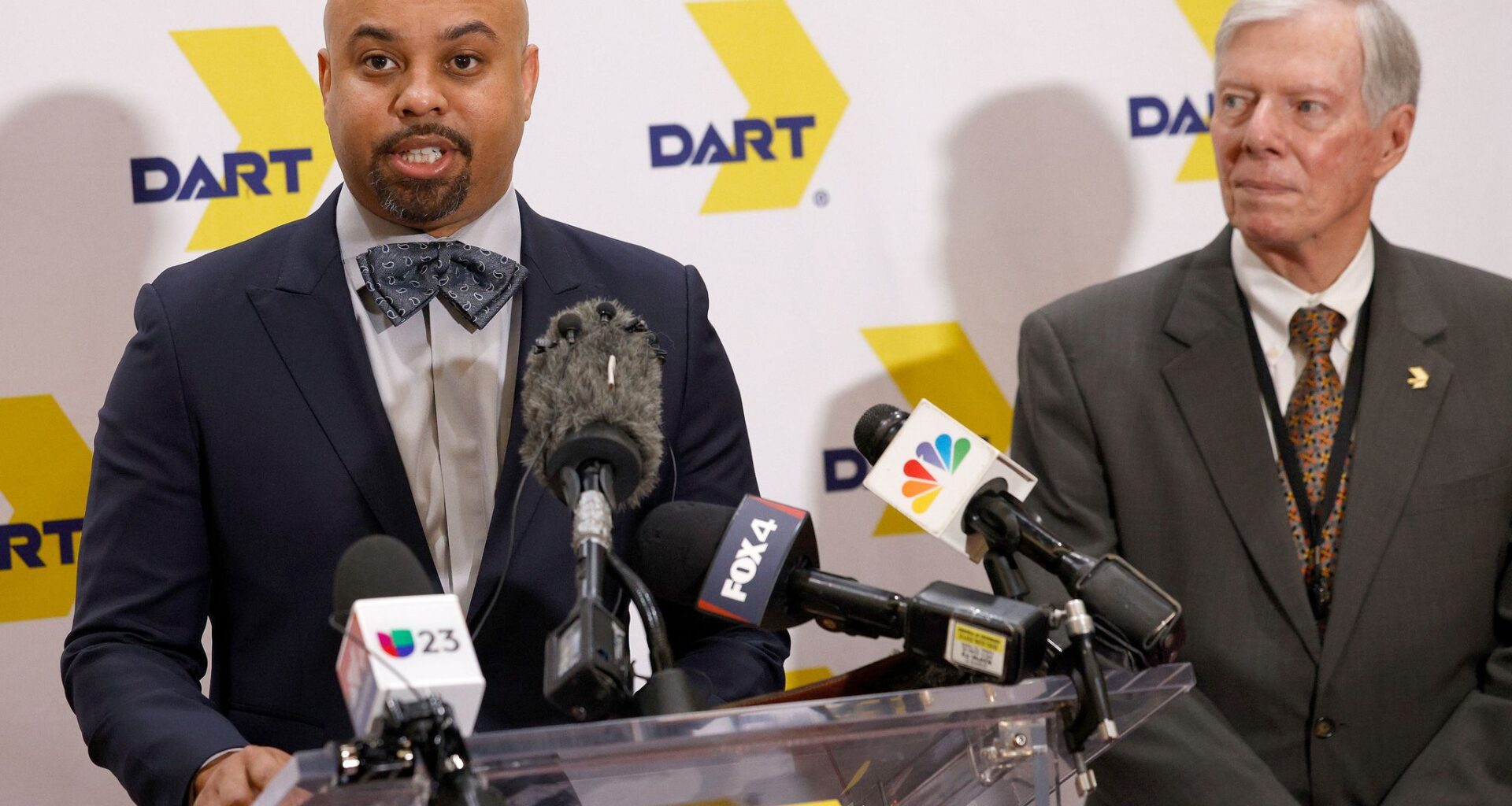
Randall Bryant (left), chair of the Dallas Area Rapid Transit Board of Directors, speaks during a news conference to address the outcome of the May election results and the future of DART, as interim CEO David Leininger listens, Monday, May 4, 2026, in Dallas.
Chitose Suzuki/The Dallas Morning News
After walking away from a suburban mutiny with one less member city, Dallas Area Rapid Transit leaders laid out goals not just for working with remaining cities on improvements, but for expanding service.

On Saturday, Highland Park became the first DART member city in almost 40 years to vote to leave the agency. The town’s voters overwhelmingly chose to cut ties with DART, after its leaders criticized the high cost of a one-cent sales tax they said does not match the value of services in its borders.
Article continues below this ad
Still, DART emerged victorious on election day in Addison and University Park, where residents voted to continue their membership. Plano, Irving and Farmers Branch had dropped their election plans months before.
At a news conference Monday, DART Board Chair Randall Bryant said governance and funding challenges “drove our 40-plus year partnership to its near breaking point” this year, despite the agency surviving rounds of withdrawal elections throughout its history.
The agency’s focus is now on following through on proposed changes to overcome those challenges, plans that convinced three cities to cancel elections. Ultimately, the board chair said his goal is to see DART expand to meet growing transportation needs that roads alone cannot fulfill.
Article continues below this ad
Make Dallas News a preferred source so your search results prioritize writing by actual people, not AI.
Add Preferred Source
“Even in the midst of ending transit services in our second smallest city in the days to come, we must continue to look beyond our current boundaries,” Bryant said, including north to McKinney, and in the southern sector. “That’s where the future of DART lies.”
Legislative priorities
Member cities will have the opportunity to call an election on DART next in 2032. Over the next six years, the agency will seek to change its governance structure and funding model in the state Legislature.
Article continues below this ad
Bryant said DART may need to go “back to the drawing board” on the agency’s planned governance structure now that Highland Park is out of the picture. A commitment to “one city, one vote” is still important, he said, referring to the proposed structure that adjusted power away from Dallas to smaller cities who felt their voice was not heard on DART’s board of directors.
“On the funding side, there are numerous proposals out there on how we bring in more revenue to DART,” he said. “We’re still working on those final priorities.”
Service to end in Highland Park
Bryant said Monday he respected Highland Park voters’ decision and would work to ensure a smooth transition as the town cuts ties with DART.
Article continues below this ad
After votes are canvassed in Highland Park on May 13, all DART microtransit and paratransit will end the next day, and the bus on the town’s lone route will continue through without stopping.
The Town Council approved a locally controlled microtransit pilot with on-demand and paratransit components, covering trips within the town and nearby destinations, including Love Field and Mockingbird Station.
A sign warns of the possible closure of the bus stop as a woman waits for a DART route 237 bus on Preston Road at Livingston in Highland Park, Monday, May 4, 2026.
Smiley N. Pool/The Dallas Morning News
Interim CEO David Leininger, on his first day back on the job after serving as interim chief in 2021, said DART will reach out to Highland Park officials to understand what services the town will provide and how to inform riders, especially those who rely on paratransit.
Article continues below this ad
“We have to … make sure that people are not falling through the cracks during the transition,” Leininger said. “It’s likely that the city will come to realize there was a lot more going on in terms of services being delivered to different parties than they anticipated. We’ll try to help them with that.”
DART’s path forward
Bryant thanked voters in Addison and University Park for their confidence and trust in DART and vowed to “honor that trust.” He said the agency plans to meet with leaders in both cities to discuss the path forward.
Both cities are no longer eligible for receiving funds back from DART for local transportation needs, part of the agreement that convinced Plano, Irving and Farmers Branch to cancel withdrawal elections.
Article continues below this ad
“We still have all of the rights and responsibilities to maintain a high level of service,” in the two cities, Bryant said. “And ensure that … those council members now, going forward, truly understand the value of DART.”
As Leininger rejoins the agency as it searches for its next CEO, he will focus on preparing for the FIFA World Cup, developing the agency’s next budget and reestablishing connections with DART’s staff and cities.

By signing up, you agree to our Terms Of Use and acknowledge that your information will be used as described in our Privacy Policy.
“There’s a good bit of communication with the individual cities … to really actually reestablish communications on a happier basis,” Leininger said. “Our job is to listen, not lecture.”
Article continues below this ad
He said DART “is a much better organization” than when he was last with the agency in 2021. Bryant emphasized DART’s goals for partnership and regionalism.
“DART should never be looked at as just a collection of cities on a map,” Bryant said. “Rather, it’s a shared commitment to mobility, to economic opportunity and to a region and structure that works for everyone.”