
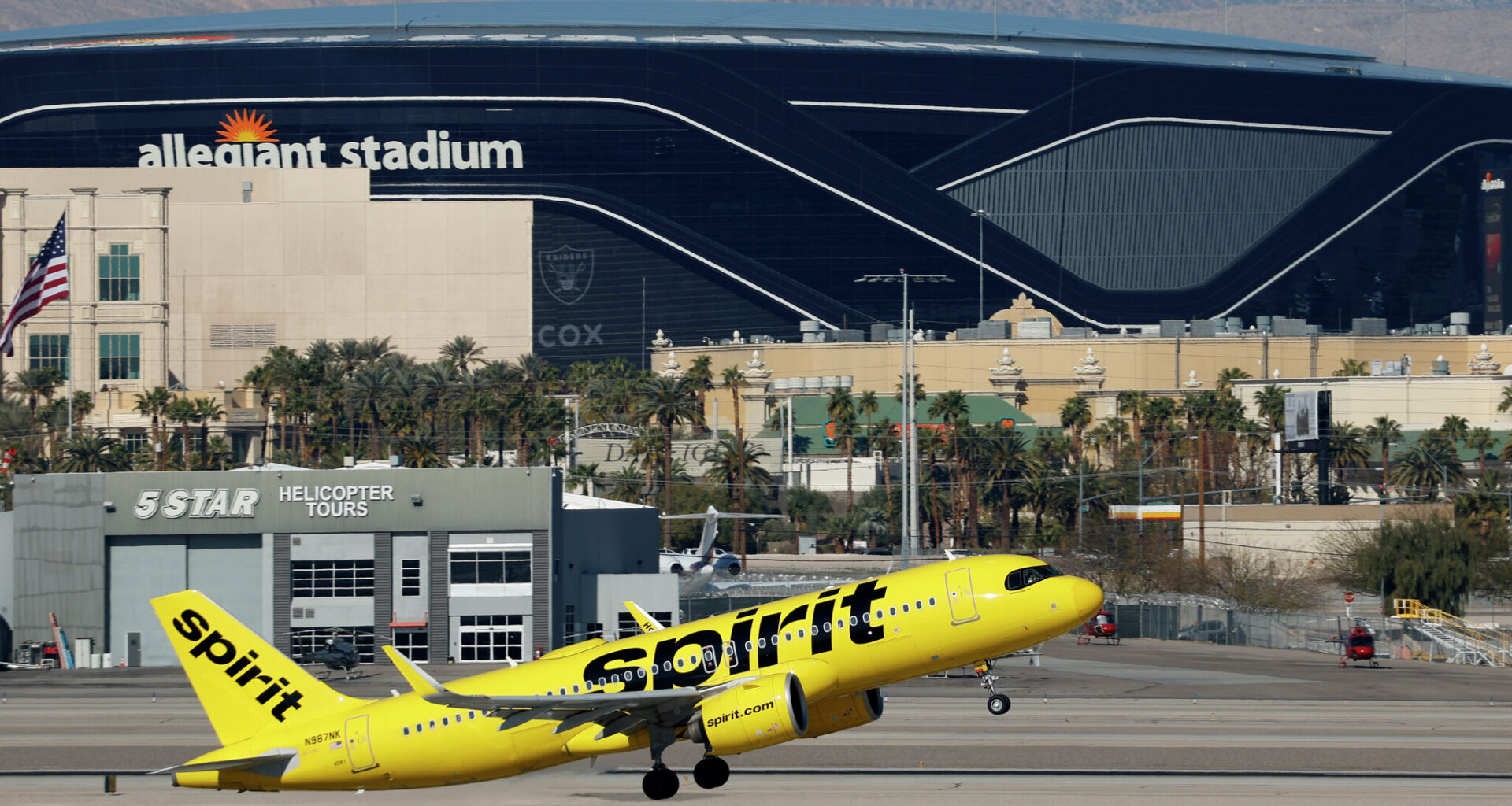
Spirit Airlines used to serve as a go-to choice for ferrying college sports recruits in and out of Texas. As of Saturday, that’s no longer an option.
Kevin Carter/Getty Images
A certain segment of America saw its travel plans, even those already in progress, come to a screeching halt this past weekend.

On Saturday, Spirit Airlines ceased all flight operations, causing upheaval across the airline industry and affecting thousands of passengers and airline employees.
Article continues below this ad
“To our Guests: all flights have been canceled, and customer service is no longer available,” the company said in a statement.
The death of the budget airline operator is another signal of rapidly changing times in travel and the economy in America. Southwest Airlines, another former budget airline operator, recently pivoted to keep up with the likes of Delta, United and American Airlines. Southwest’s changes include eliminating its biggest brand markers—free checked bags and open seating—in hopes of increasing customer spend and elevating the brand’s prestige.
Add to oil prices’ wartime high of more than $120 a barrel, driving up fuel costs for both planes and automobiles, and travel has likely never felt so painful on the wallet, especially for many college athletics programs in the state of Texas.
“Oil doesn’t show up as an ESPN headline, but it quietly changes how football programs move,” Prairie View football general manager Christopher “Cruize” Williams told Chron.
Article continues below this ad
Chron spoke to six spokespeople—athletic directors, general managers and head coaches—across the state to better understand how shifts in the airline industry affect their programs.
“Those costs add up quickly.”
Many athletic programs tapped Spirit or Southwest to ferry potential recruits to and from campus and get teams to away games across the country. Spirit’s one-way flights routinely cost less than $100, making the now-defunct airline an attractive option for smaller sports programs looking to nab a recruit.
“In football, those costs add up quickly because you are moving a large roster, staff and equipment while also managing recruiting travel and other program responsibilities,” Williams said. “It forces administrators and coaches to be more strategic with budgeting, scheduling, and resource allocation.”
Article continues below this ad
The Prairie View A&M Panthers are one of the most successful college football programs in the state, but rising fuel costs for airline and ground travel make balancing the budget more difficult.
Justin Ford/Getty Images
Moving luggage and equipment is nearly as vital as getting the players and coaches to their final destination for teams. Southwest’s radical shift put many schools’ brand loyalty to the test.
“We used to do Southwest almost exclusively for team travel due to the free baggage, but now that they have changed their stuff, we have utilized the other airlines more often this year,” said Ben Rikard, Sam Houston’s Director of Athletics Media. The Bearkats compete in Conference USA.
“We use Southwest, American or Frontier,” said Vincent D. Robinson, Huston-Tillotson’s Director of Intercollegiate Athletics, which competes in the National Association of Intercollegiate Athletics.
Article continues below this ad
“For baseball, we primarily use Southwest or United with the occasional American when we have no other option,” said Rice’s head of athletic communications, Chuck Pool.
Many of the top programs in the state, most notably Texas, Texas A&M and Texas Tech, are so well-funded that dealing with the likes of Spirit or Southwest is never even in consideration. According to Sportico, the Aggies spends nearly $1 million in charter flights just for their football team each season.
A Southwest Airlines Boeing 737 MAX flies over the stadium with the landing gear down and flaps extended in preparation for landing at a nearby airport during the college football game between the Southern Methodist Mustangs and the Louisville Cardinals in 2024.
Icon Sportswire/Icon Sportswire via Getty Images
In addition, the Southeastern Conference’s partnership with Southwest helps funnel more funds to schools like Texas and Texas A&M, along with additional perks associated with the airline.
Article continues below this ad
Even smaller, but still well-resourced, programs rarely dip their toes into budget airline land.
“In five years of travel with baseball, we’ve never flown Spirit,” Pool said of Rice, which competes in the American Athletic Conference. “We charter for football and quite a bit of basketball.”
“We feel it.”
The power dynamics at play in travel accommodations for student-athletes are notable. Every school that can fly Delta or United for a recruiting visit rather than Southwest or Frontier, another budget airline, could make the difference in landing a recruit.
Article continues below this ad
For some programs, increased travel costs or unique geographies also mean making business decisions to ensure logistics or the balance sheet works.
“Recruiting flights are almost exclusively into McAllen, [which is] about 20 minutes from Edinburg campus,” said Jonah Goldberg, University of Texas-Rio Grande Valley’s athletic director of communications. The Vaqueros completed their first season in FCS football in 2025.
“We usually use Southwest…during the recruiting process, they don’t typically check a bag but rather carry it on,” said Ryan Pratt, head coach of Houston Christian’s men’s soccer team. “We will still use Southwest, will probably have the guys carry on their bags and check as few bags as possible to keep prices at a minimum.”
“Each team has to account for those travel increases on their own,” said Rikard, of the BearKats, which traveled over 2,200 miles to Beaverton, Oregon, to face the Oregon State Beavers in 2025. “Could be not purchasing a uniform, or maybe less team meals out of season, or a number of things.”
Article continues below this ad
The Sam Houston Bearkats earned a big road win over the Oregon State Beavers in a 21-17 slugfest in Beaverton, Oregon.
Icon Sportswire/Icon Sportswire via Getty Images
College sports have never been more of an arms race than they are now. With broadcast television rights exploding and the demands of funding NIL for top athletes ever-present, those with the deepest pockets seem poised to move further ahead. For programs in Texas outside the power conferences (SEC, Big 12, ACC), recalibrating the travel budget has become another stressor in running a successful program.
“We may not always say ‘oil prices’ directly, but we feel it through higher travel expenses tied to buses, flights, rental vehicles, and overall logistics,” Williams said of Prairie View’s football, who happen to be the defending SWAC champions. “It may not always be a headline issue, it is absolutely something that affects football operations behind the scenes.”