
Nonprofits equipped with CIA tactics and data experts are helping Texas officials take down illicit massage parlors.
Illustration by Susan Barber. Images from Google Earth, court filings, courtesy photo
Intrigued by businesses that operate in the legal shadows, in 2017, a team of Texas Christian University researchers set out to measure how busy Houston’s illicit massage parlors were. For help, they turned to the international spy community.
Once concentrated in seedy neighborhoods, today businesses advertising massages but selling sex are everywhere. They are in strip malls alongside pharmacies and restaurants, in medical buildings and office parks. They have become so woven into the landscape that they are practically invisible.
Texas has more than all but one state, according to the most recent counts. In Houston, there are approximately five for every McDonald’s restaurant.
Article continues below this ad
To measure their traffic, the TCU researchers placed hidden cameras outside more than 30 of them, Sean Crotty, an urban geography professor, recalled. They calculated the businesses serviced about 120 men every hour of every day. In the years since, the number of illicit massage parlors has ballooned.
In 2024, Crotty used location data from cell phones to track men from massage sex parlors to their homes and jobs. By plotting the routes, he identified “shame buffers,” the distance customers would travel to not get caught. (Spoiler: Men will patronize a sex worker close to work, but not near their home.)
For his research, Crotty worked with a small and secretive collection of organizations formed to surveil and combat human trafficking. Unlike large, public-facing advocates that promote awareness and court publicity, these entities work outside the government and under the radar, drawing on sophisticated technology to monitor and analyze the modern illegal sex market.
In some cases, they assist academics. Yet Texas police and regulatory authorities have turned to them, as well. The Texas Department of Licensing and Regulation has sought their help in its recent push to shut down illicit massage businesses; the Texas attorney general’s office has leaned on them to pursue landlords who rent to sex parlors.
Article continues below this ad
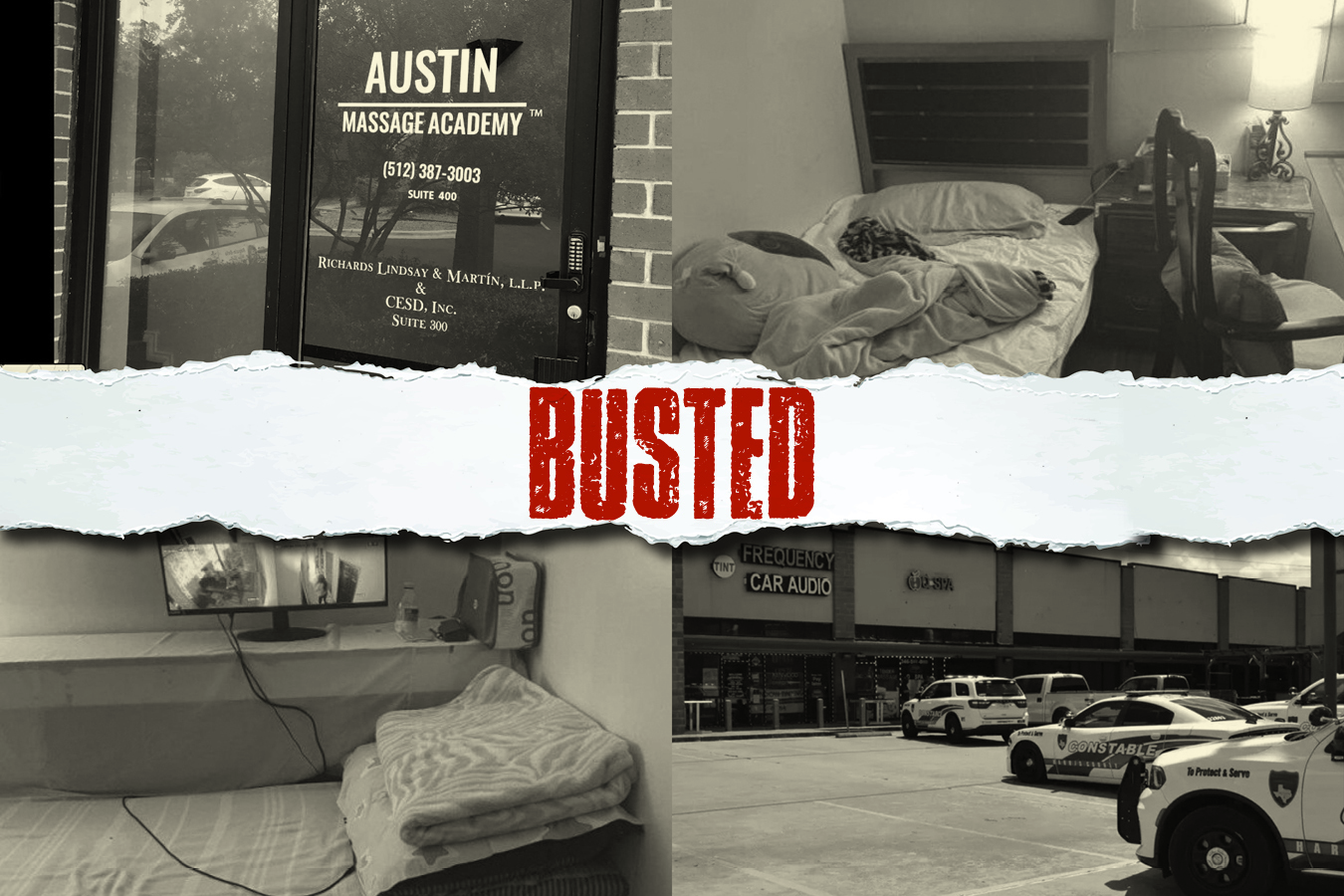
Austin Massage Academy was one of two massage licensing schools closed by the Texas Department of Licensing and Regulation in 2025.
Google Earth
To tally the illicit massage traffic, Crotty got an assist from a small nonprofit founded by former military intelligence and CIA officers. The Network aggregates information from illicit massage parlor advertisements, customer reviews, and owner and property records. A Texas assistant attorney general sits on its board.
Organization staffers helped build and install the hidden cameras recording massage customers, Crotty said. They needed to be constructed specially to include battery-powered fans to keep them operating in the Houston heat, he recalled.
The Network also “has been a game-changer when it comes to understanding the businesses,” said Elizabeth Wiggins, who as director of the state licensing agency’s Anti-Human Trafficking Division, has used the company’s intelligence. “They’ve been instrumental in identifying many of these establishments.”
For Crotty’s second study, the cell phone data tracing customers’ movements was gathered with the help of the SIGHT Foundation, a mysterious company that procured and analyzed the massage parlor customers’ digital tracks. It pinpointed each man’s location within a few feet, Crotty said. (Both studies did not identify individuals and were cleared by an academic review board.)
Article continues below this ad
Another organization, TraffikCam, crowdsources millions of pictures of individual hotel rooms and uses machine learning to help police identify the precise locations of online ads published by suspected traffickers based on visual clues in the backgrounds. A particular pattern on a bedspread, for example, or a series of objects can lead police to a specific hotel.
ROADSIDE SURVEILLANCE: Texas traffic stop reveals pitfalls of police surveillance intel
The similar-sounding Traffic Jam uses artificial intelligence and facial recognition to index and analyze missing children photos, tens of millions of sex ads and information contained in them such as phone numbers. The company’s algorithm combs through them to draw connections between traffickers, suspects and locations.
Developed by a nonprofit called Thorn, Spotlight ingests hundreds of thousands of commercial sex ads posted daily, including identifying information such as phone numbers, emails and locations. It applies artificial intelligence and facial recognition technology to create profiles of girls under the age of 18 to help law enforcement trace their movements and locations.
In a recent lawsuit it filed against several Central Texas illicit massage businesses, the Office of the Attorney General gave it a shoutout. “During the investigation, (the Human Trafficking Unit) used Spotlight … to assist law enforcement in prioritizing leads when addressing sex trafficking,” court documents said.
Article continues below this ad
A booming Texas sex industry
Quantifying sex trafficking in the massage business is imprecise. Researchers must identify the illegal operations out of the more than 3,500 licensed establishments in Texas. Some illicit businesses may advertise massages but be unlicensed. And not all sex workers are victims of human trafficking, in which women are forced or coerced to work.
The standard method of counting has been to scrape websites that advertise sex services at massage businesses, as well as those where customers post candid reviews. Those can be linked to phone numbers and addresses of state-licensed establishments. Researchers also may note words or other clues indicating women are being trafficked.
Based on those counts, between 2020 and 2025, the number of Texas massage parlors offering sex services grew 47%, according to the Office of the Attorney General, which receives its information from The Network, among other private intelligence organizations. Last spring, the agency identified just under 1,650 illegal massage businesses statewide — approximately three times the number of Walmarts in Texas.
A cash register sits in the lobby of a Texas massage parlor investigated by the state Department of Licensing and Regulation. At right, internal surveillance cameras monitor massage parlor customers and employees.
Case files from the Texas Department of Licensing and Regulation
Not surprisingly, most are concentrated in large cities. Houston and Dallas each have about 600, according to The Network.
Article continues below this ad
Yet dense groupings pop up in other areas, as well. Per capita, Odessa, Beaumont, Killeen and Plano all have higher concentrations of the parlors than the state’s large metropolitan areas.
In 2023, Lewiston, northeast of Dallas, sent a delegation to Austin to lobby state lawmakers for stricter laws to help fight the trend. The police chief testified that one third of the city’s massage businesses were illicit.
“I don’t know what’s going on in our districts,” said state Rep. Ben Bumgarner, R-Flower Mound, who sponsored the legislation. “But we have a serious human trafficking issue going on in the city of Lewisville.”
The success of the businesses isn’t a mystery. Experts say the main barrier for customers is fear of getting caught. Massage operations are a near-perfect vehicle for someone looking to avoid scrutiny.
IMMIGRATION: Here’s who’s making money from President Trump’s deportation push in Texas
Like electricians, plumbers, lawyers and other trusted professions, massage therapists and parlor owners are licensed by the State of Texas. The government approval provides illicit establishments with an instant veneer of respectability.
The businesses have cultivated respectability in other ways. In his research, Crotty determined most were located in common commercial sites alongside legitimate businesses in well-traveled areas. Many adopt legitimate-sounding LLC names, using words such as “health” and “wellness.”
An analysis by the nonprofit Children at Risk noted the large number of the businesses located near schools. During a recent police raid, in Midland, a woman tried to escape by crawling through an HVAC vent to the next-door tenant, a childcare center.
“It’s brilliant,” said Ian Hassell, the former CIA agent who founded The Network. “The storefront as a venue for buying sex is the safest place in the U.S. for avoiding risk.”
Why illicit massage parlors thrive
Illicit establishments also have thrived because of a misperception that massage therapists offering sex are doing it voluntarily so it is victimless. While that can be true, “We have not seen an instance in which prostitution was happening at a massage business and there were no signs of human trafficking,” said Wiggins, of the Texas licensing agency. That includes evidence women live at the parlors, or are being frequently moved between locations.
While experts caution against racial profiling, reports by advocacy groups have found that, for complex economic and cultural reasons, human trafficking victims working in illicit massage businesses are predominantly Chinese, with smaller numbers from Korea and Thailand. Most came to the U.S. because of financial pressures at home; many are older women with families. Managers use debt and the fear of deportation to prevent them from leaving.
ICE agents conducted worksite inspections at Baton Rouge massage parlors in June 2025.
U.S. Immigration and Customs Enforcement
Regulators say there is compelling evidence the growth of massage sex businesses in Texas is supported by widespread cheating on the state licensing exam.
In recent years, nearly two-thirds of all Texas massage exams have been taken by Chinese students. While regulators note the number is far disproportionate both to the state’s population and the observed customer base, it alone is not worrisome. In fact, in 2023 Texas began offering its test in Chinese.
What has concerned the licensing agency is the number of Chinese students taking the Texas exam from out of state, specifically in places linked to trafficking. In 2024, out of 3,500 students taking the test, 40 applicants — all Chinese — took it from outside the state.
Last year, the number grew to nearly 1,200, 99% of whom were Chinese. More than three-quarters were in California and New York, a pattern “which suggests coordinated activity, not individual applicant behavior,” the agency said. Alarmed, late last year Texas stopped offering the exam in Chinese. It also stopped offering the test to students in other states.
In the past six months alone, the Department of Licensing and Regulation has shut down four massage schools – three in the Dallas area, one in Austin – for acting as suspected diploma mills feeding Texas’s booming illicit massage sex business. According to court documents, the schools also had graduated students who the agency discovered working at illicit parlors.
Enforcement without police
In 2023, a team of 17 local, state and federal law enforcement agencies began investigating a string of illicit massage parlors in and around the Texas Panhandle. Over several months, court documents show the group gathered evidence that the businesses run by Shaoping Wen and her son, Xu Wang, moved women from California into Texas and New Mexico and then between the parlors.
Police conducted 10 undercover visits. The Texas Department of Public Safety installed a tracking device on Wen’s SUV to trace her movements and placed hidden cameras outside her parlors. More officers staked out the businesses in person and tracked Wen to a California casino, where records showed she laundered illegal massage profits.
Confronted with the overwhelming evidence, Wen pleaded guilty. In March 2025, she was sentenced to one year in prison. Her son was credited for his one year being held while the case was adjudicated, and then he was released.
PARLOR BUST: Austin massage therapist arrested in sexual assault case; police seek other victims
For years, the enforcement playbook for massage sex businesses was modeled on police vice busts. Undercover officers posed as customers to prove sex work. Even after days and weeks of police work, it produced minor legal consequences.
Arrests tended to focus on the individual massage workers, who were charged with low-level prostitution offenses. Many were victims themselves. Those who ran the operations, often connected in a loose support network of owners, frequently skated, insisting they knew nothing of their workers’ illegal activities.
The stings themselves could be legally dicey. Between 2022 and 2024, a Lewisville police operation targeting massage parlors produced dozens of criminal charges. But the Denton County District Attorney’s Office rejected all of them after learning police engaged in “inappropriate physical contact.”
In the end, police raids — and even lengthy investigations aiming for owners — made little impact. “If you close down one location, it’s not uncommon for it to pop up in a different location in a few days,” said Kirsta Melton, who led the Texas attorney general’s human trafficking section before founding the Institute to Combat Trafficking.
So regulators have pivoted, focusing instead on throwing administrative obstacles in front of the businesses. Unlike police, who must gather enough evidence to prove a case “beyond a reasonable doubt,” administrative investigators need only show “reasonable cause” to take action.
RELATED: 3 arrested after Houston prostitution probe at massage parlor, records show
In recent legislative sessions, lawmakers have made such enforcement quicker and simpler. Since mid-2024, the Department of Licensing and Regulation has obtained nearly five dozen emergency orders to immediately shut down massage businesses because of signs of illicit activity – beds, ATMs, pregnancy tests and condoms. It has revoked nearly 70 licenses. The State Office of Administrative Hearings, which adjudicates the cases, has had to establish a special docket to handle the workload.
Some operations never even involve police, said Melton. “I know TDLR has found good evidence of human trafficking and turned it over to law enforcement, and nothing happened,” she said.
Meanwhile, working with Spotlight and The Network, the Office of the Attorney General has focused on landlords who rent to massage sex businesses. In 2024, it sent eight letters threatening a civil nuisance lawsuit if they didn’t evict the massage tenants. Last year, the office sent 150 of the or-else letters.
“Of all the states, Texas has led the way,” said The Network’s founder, Hassell. Even so, the most recent figures from his organization indicate the number of Texas massage businesses promoting sex work grew by nearly 10% last year.
Tracking massage sex business nationwide
Hassell said he worked in operations for the CIA in the Middle East for a decade. “I loved it; I would still be there today,” he said.
But his career detoured after he attended a talk from a human trafficking advocate at his Virginia church. “That’s what I’m going to do for the rest of my life,” he remembers thinking. Also: “I would do this totally differently.”
Along with a friend who was a West Point graduate working in military intelligence, Hassell quit to form The Network to focus exclusively on illicit massage businesses. “The goal was to rescue victims and arrest traffickers,” he said. But an early operation in New Orleans provided a reality check.
Hassell had gathered a team of volunteers to stake out massage businesses there. “What we knew was how to collect data,” he said. “We thought, if we could infiltrate that business model and map it, get profit and loss, (then we) could disincentivize human trafficking as a business.”
While the team learned plenty – who the customers and owners were, how much money flowed in – they quickly realized such work couldn’t be scaled. Instead, they turned to mapping the businesses’ digital footprints, hiring software engineers and data analysts and staffers – including more former CIA and FBI officers – to start creating a profile of every massage sex business in the country.
Since then, The Network has made its regularly updated illicit massage business data available to regulators and police, and worked directly with local and state agencies around the country, Hassell said. “We’ll never arrest our way out of it; we’ll never rescue our way out of it.”