
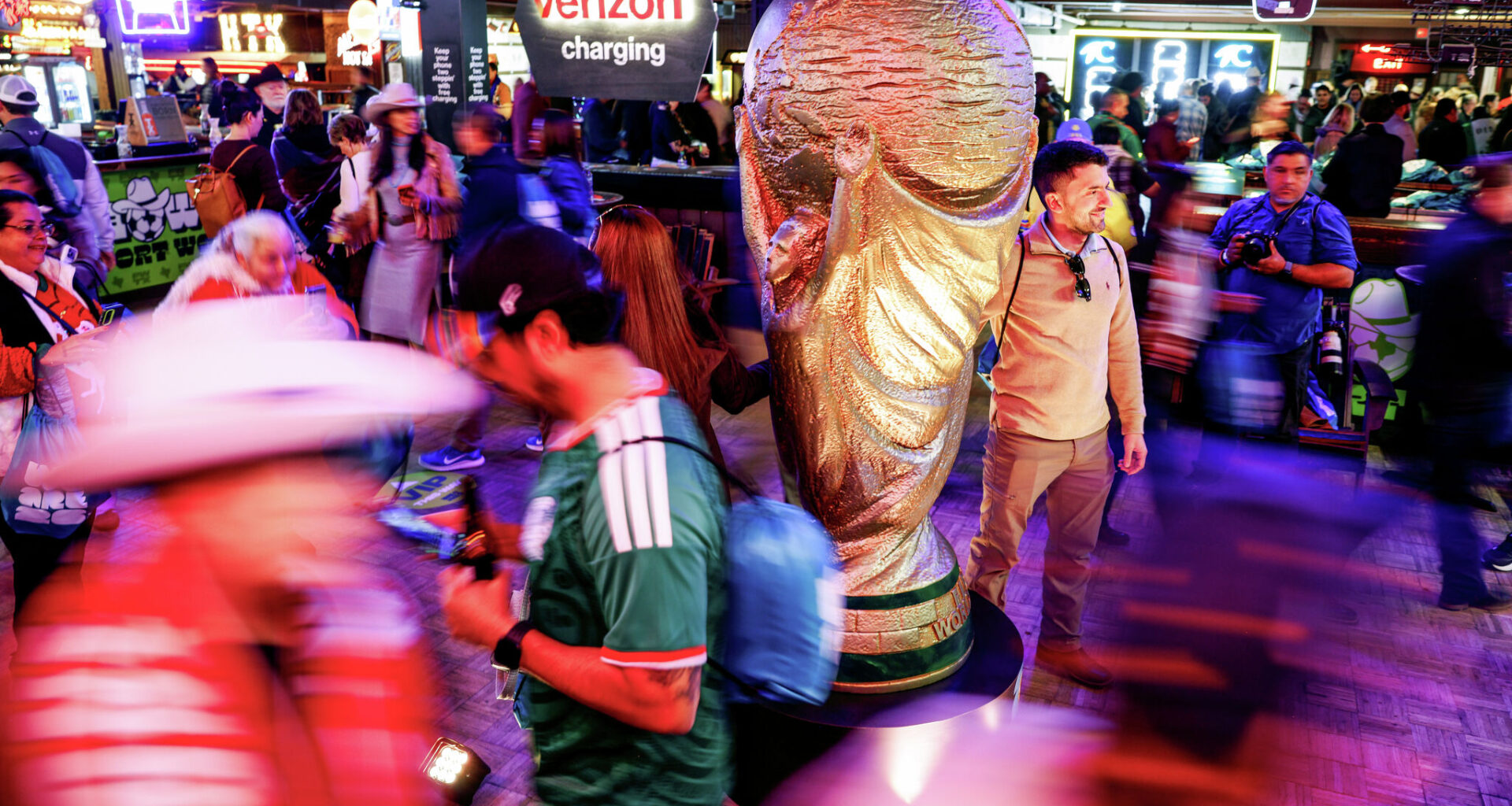
Fort Worth resident Federico Robles, 34, takes a photo with the World Cup trophy statue during the draw watch party on Friday, Dec. 5, 2025, in Fort Worth.
Christine Vo/The Dallas Morning News
It may be the biggest sporting event in the world, but the economic boost for host U.S. metro areas — including North Texas — from this year’s World Cup will be relatively muted, according to a recent report from Oxford Economics, a leading economic advisory firm based in the U.K.

“It’s a modest bump,” said Barbara Denham, the economist at the firm who authored the report, that comes primarily from a temporary boost to the local leisure and hospitality sector.
Article continues below this ad
“It’s not as significant as people think,” Denham added, “because people come for the games, spend a lot of money, then they leave. So you’re talking about nine days of extra tourism, maybe 10.”
North Texas is scheduled to host nine tournament games in this year’s tournament, which will be split between the United States, Canada and Mexico and include a field of 48 teams, the largest ever. All of those games will be held in Arlington at AT&T Stadium, which is being rebranded for the tournament as Dallas Stadium, while the city of Dallas will also host the tournament’s main broadcast hub at the Kay Bailey Hutchison Convention Center and a fan festival at Fair Park.
Throughout the event, hundreds of thousands of international tourists, including from England and Argentina, are expected to fill hotels and short-term rentals across D-FW. Local bars and restaurants are counting on increased traffic from visitors as well as locals, and retail shops and certain ancillary businesses are also expecting an uptick.
Make Dallas News a preferred source so your search results prioritize writing by actual people, not AI.
Add Preferred Source
All of that will, in fact, add up to some notable regional economic gains, in the form of increased tourism spending and even some related jobs. For 2026, greater Dallas is forecast to see a leisure and hospitality sector GDP increase of 2.6%, according to BLS figures cited in the report, and a jobs growth rate for the sector of around 1.2%. Both of those figures represent higher than average growth, although it’s unclear how much of those projected increases can be attributed to the tournament, Denham said.
Article continues below this ad
Dallas will also see added benefit compared to other host cities simply because it will host the most matches: Of the 11 U.S. host cities, a few other cities will host eight games, while others will host seven or six. AT&T Stadium is the only location to host nine.
But the positive effect of the rush of international soccer fans is somewhat muted, Denham said, because North Texas is already home to high numbers of business and other foreign travelers.
She also points to another broad World Cup effect: While the famous sporting event attracts certain visitors, it also repels others, who are wary of the crowds and chaos and will choose to delay or skip trips to metro areas hosting the tournament. The same is true for corporate conferences.
“There’s a lot of displacement of tourism,” Denham said.
Article continues below this ad
And while recent World Cup hosts, including Qatar, Brazil and South Africa, built multiple new stadiums for the event, this year’s tournament has included essentially no major investments in infrastructure or transport, the report notes, further limiting any longer-term economic benefits. As of late last month Downtown Dallas, Inc., a nonprofit that receives city funding, had spent nearly $1 million on dozens of local initiatives ahead of the tournament, ranging from upgrading road medians to tree planting efforts, The News reported, although the region is not executing any high-profile infrastructure projects.
American host cities also relied on existing infrastructure in 1994 — the last time the U.S. hosted the tournament — the report notes. That year’s tournament is credited with helping grow the popularity of soccer among American fans. But of the nine host cities, only a few saw measurably higher leisure and hospitality job growth for the year. Most also experienced similar or higher job growth in the sector the following year, the report notes, “which suggests that the 1994 job growth was driven as much by the healthy economy as it was by the World Cup.”

By signing up, you agree to our Terms Of Use and acknowledge that your information will be used as described in our Privacy Policy.
This year’s tournament is also not projected to do much to alter host cities’ overall GDP. For 2026, according to Bureau of Economic Analysis figures the report cites, greater Dallas is expected to see a roughly 3% GDP increase — roughly the same as estimates for 2025 and 2027. Greater Dallas is also expected to add jobs at a rate of less than 0.5%, according to BLS figures, a slower growth trend than estimates for 2025 or 2027, with the region’s overall economy impacted much more by larger macroeconomic forces such as consumer spending, fuel prices and immigration policies.
Article continues below this ad
Some host metro areas, especially Kansas City, the smallest region to host games, will see relatively more job gains from the tournament, while some larger, more tourism-heavy metros, including New York and Boston, are projected to actually see lower leisure and hospitality job growth this year than last year, according to the report.
Still, the report notes that not everything can be measured with broad quantitative analysis. “The economic statistics say nothing about the morale boost that hosting the World Cup games bring to the local population,” it says. That’s in addition to a short-term local spending surge driven in part by “the euphoria from visiting fans of winning teams,” the report adds. D-FW business owners are hoping those fans have deep pockets.