
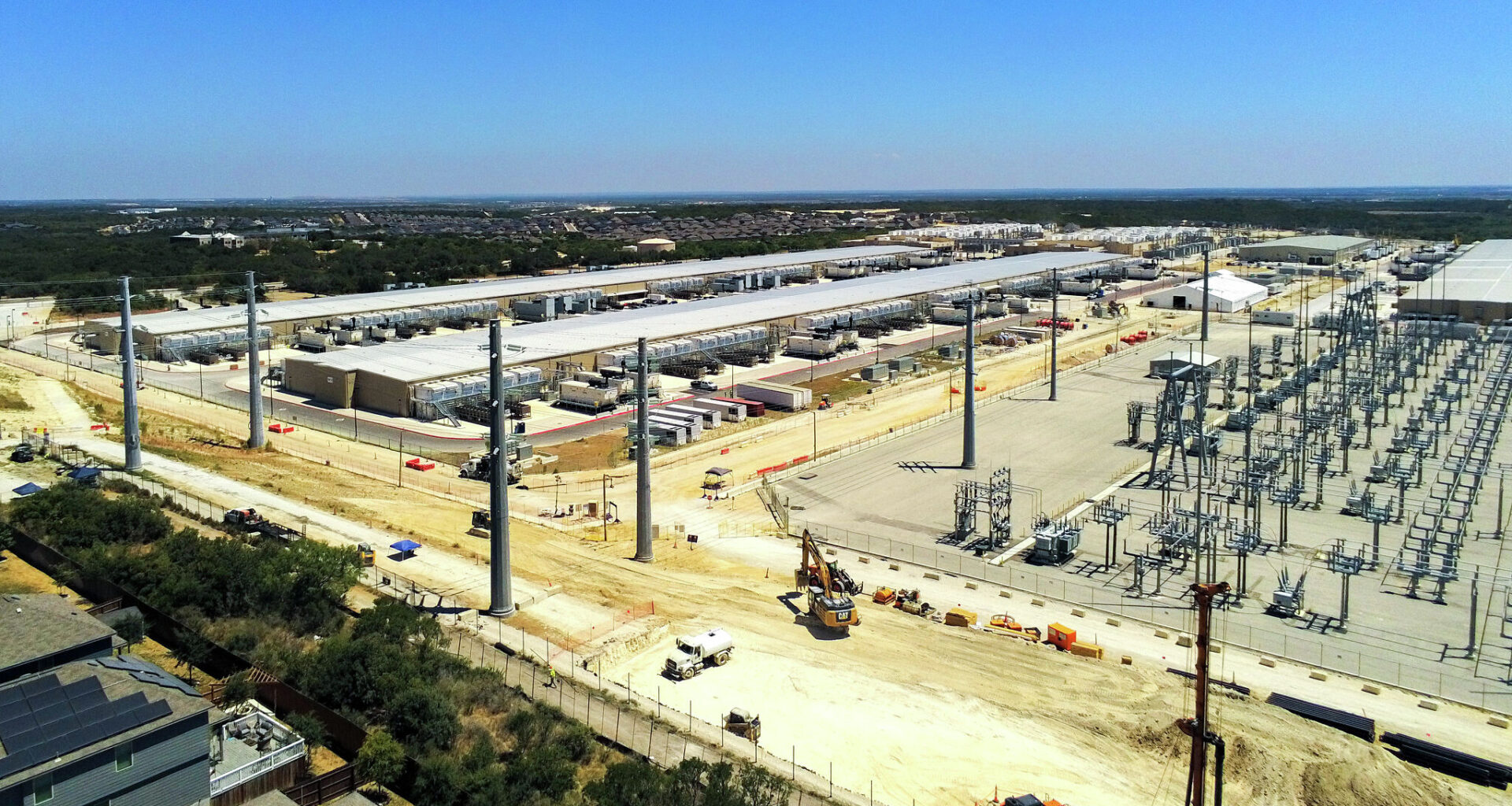
A data center is seen under construction in 2023 on the far West Side, an early magnet for such development in San Antonio. The growth of data centers in San Antonio is a major boon for local budgets, our guest columnist writes.
San Antonio Express-News file photo
The CyrusOne San Antonio Data Center is on the far West Side along Lambda Drive near Omicron Drive, an area where data and tech centers are proliferating. Nearly every aspect of modern life is supported by a vast but largely invisible network of data centers that constitute the physical backbone of the digital economy, our guest columnist writes.
Billy Calzada/Staff photographer
When you run for office and win, you’re elected to make hard, informed decisions. When our representatives react to the most recent scare without doing their homework, we end up with bad decisions that hurt all of us.

Given that, let’s take a real look at data centers.
Article continues below this ad
Nearly every aspect of modern life is supported by a vast but largely invisible network of data centers that constitute the physical backbone of the digital economy.
Retail, health care, education, financial services, transportation and government services all rely on data centers. Even industries that once seemed purely physical such as construction, manufacturing, hospitality and agriculture now depend on cloud computing and real-time data to operate efficiently.
San Antonio is not just a consumer of digital services. We are strongly positioned to be a leading hub for data centers in Texas, which is projected to become the largest data center market in the world by 2030.
RELATED: Inside San Antonio’s AI-driven data center boom and what it means for CPS Energy
Article continues below this ad
Our city has an important responsibility to set an example for our state and nation by embracing smart, sustainable data center development to enhance our economic and national security for generations to come.
As home to the largest joint military installation in the U.S. Department of Defense and a nationally recognized cybersecurity ecosystem, San Antonio cannot separate its military mission from the digital infrastructure that supports it.
Cyber defense, intelligence analysis, logistics coordination and artificial intelligence-enabled defense technologies all depend on robust, locally anchored computing capacity.
The growth of data centers in San Antonio is also a boon for local budgets. An economic analysis released last year found that San Antonio already hosts about 4.2 million square feet of data center space representing $5 billion in real estate investment, with those facilities generating $147.6 million in local tax revenue in 2024.
Article continues below this ad
Even more striking, the San Antonio region is expected to see an estimated $841.3 million in new local revenue as data center development grows in the coming years.
For San Antonio homeowners, small businesses and families, that revenue can be transformational. A stronger commercial tax base means local government can fund schools, roads and public safety without leaning as heavily on residential and small business taxpayers.
EDITORIAL: Texas needs to fund its 2027 State Water Plan before our wells run dry
Data centers generate more than $54,000 in local government revenue per direct job, a figure that dwarfs most other development categories. The city collects roughly $15.2 million annually in property tax revenue from current data center facilities, with an additional $11.1 million flowing to CPS Energy’s general fund.
Article continues below this ad
Public servants are also acutely aware of concerns about straining resources, particularly water and electricity prices, and those concerns deserve a factual response.
Independent research has found that data centers in Texas accounted for less than 0.5% of state water consumption last year. San Antonio Water System has not publicly identified data centers among its top-tier water users and has indicated that San Antonio data centers are increasingly using recycled water — up to 75% as of March 2026.
CPS Energy indicated during a recent City Council meeting that although large-load customers like data centers account for about 9% of customers, they generate more than 50% of the utility’s revenue and fund the infrastructure required to serve them. This ensures that residential and small-business customers are not subject to increased costs from new utility infrastructure build-out.
In addition, a single large hyperscale facility can generate more than 4,800 construction jobs, with payroll for a single project easily exceeding $1 million for a local skilled trade contractor.
Article continues below this ad
We’ve expanded our economy while investing in water security. We’ve supported military expansion while strengthening neighborhoods. We can, and should, apply that same disciplined approach to the digital infrastructure that data centers bring to our city and region.
Kevin Wolff is a former Bexar County commissioner for Precinct 3.
Have a response? Send us a letter to the editor.