
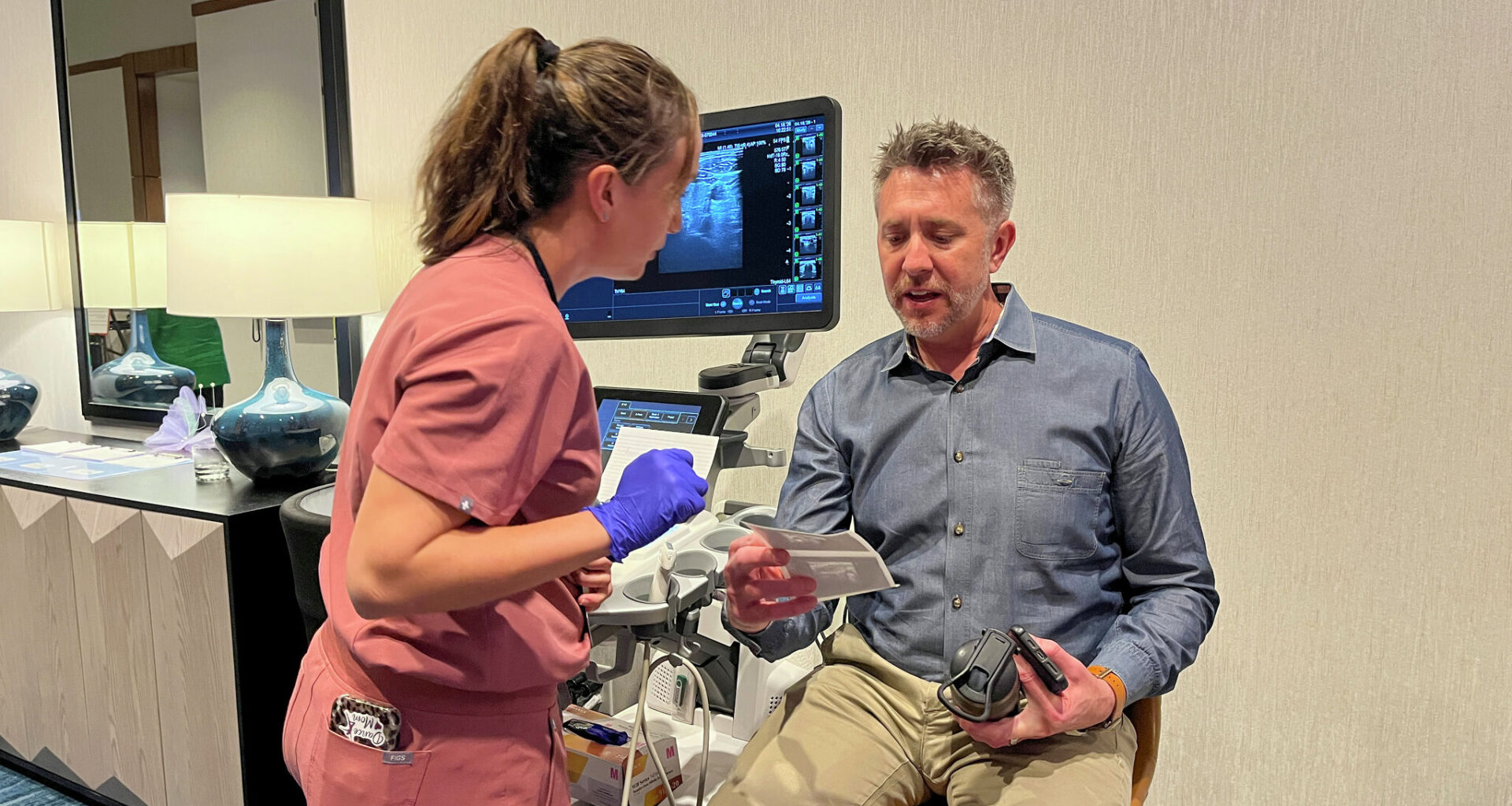
Benjamin Baronet, 48, shows the photos of his ultrasound at the Mom2.0 conference in Austin. An ultrasound technician from Clayman Thyroid Center in Florida found that he had fluid-filled cysts but no cancer.
Austin American-Statesman
Last month, hundreds of women and men at the Mom2.0 conference in Austin had their thyroids checked for cancer. On the first of two days, 310 people were screened by ultrasound and about 2.5% had indications of a thyroid tumor that looked cancerous. A biopsy would need to be done to confirm.

Mom2.0 is an annual conference that brings women from around the country to network and build their businesses. The demographic was exactly what Dr. Rashmi Roy, a thyroid surgeon at the Clayman Thyroid Center in Florida, wanted to reach. Thyroid cancer is almost three times more common in women than men, according to the American Cancer Society. It is the fourth-most common cancer diagnosis in women. Each year, about 45,000 people are diagnosed with this cancer, and about 2,300 people die from it. The deaths are spread evenly between men and women.
Article continues below this ad
Roy and her team offered a quick 30-second ultrasound in the hallway of the JW Marriott during the conference. She said, however, that even if someone is screened and it looks suspicious, the tumor could end up being benign.
“Thyroid cancer is most concerning when it is large and you can also see abnormal lymph nodes on the ultrasound,” Roy said. It doesn’t always spread, she said, but when it does, it can be a more aggressive type.
The thyroid is a butterfly-shaped gland in the neck that secretes hormones to regulate metabolism. When it is working too fast, people have too much energy and can lose weight rapidly. When it is working too slowly, people feel tired and gain weight. It can be regulated by taking replacement hormones. Because of medications, you can easily live without a thyroid.
Article continues below this ad
Benjamin Baronet, 48, shows the photos of his ultrasound at the Mom2.0 conference.
Austin American-Statesman
Thyroid cancer is difficult because it doesn’t show up in blood work and doesn’t have any symptoms in its early stages. Most people don’t find it unless they have X-rays, CT scans or ultrasounds of their chest area or carotid arteries that accidentally show the tumor. Or the cancer spreads to the lymph nodes in the neck and they feel or can see the swelling.
By the time that happens, a cancer that is curable with a quick surgery to remove the side of the thyroid with the tumor can become more complicated and requires surgery to remove at least half the thyroid and lymph nodes, as well as a radioactive iodine pill and isolation for a few days after the radiation.
Article continues below this ad
If it further spreads throughout the body, it becomes more complicated to treat. Instead of having a more than 90% survival rate, people who have thyroid cancer that has spread far have survival rates in the 50% to 71% range, depending on the type, according to the American Cancer Society.
Roy has been advocating for thyroid screening ultrasounds for people ages 30 to 60, especially women. Those are the prime ages for thyroid cancer to develop. In a study published this year in the Annals of Endocrinology, Diabetes and Metabolism, Roy gave screening ultrasounds of the neck to more than 500 women ages 30 and older who had no known thyroid condition. Some 54% had a small thyroid nodule, 16% had a larger, more suspicious nodule that underwent biopsy and 2.4% received a cancer diagnosis.
That might not sound like much, but one study found that of the women who get regular mammograms, only 0.5% end up with a cancer diagnosis.
Ultrasound technician Darya Bushuev of the Clayman Thyroid Center in Florida screens Priya Thakker, 45, for thyroid cancer during the Mom2.0 conference in Austin in April. Thakker had no signs of thyroid cancer.
Austin American-Statesman
These 13 thyroid cancers found in the study were caught early, before they had spread to the lymph nodes. The half of the thyroid gland with the cancer was removed. None of the people screened needed radioactive iodine treatment, which can have adverse side effects such as causing a secondary cancer, obstructions in the nasal ducts, inflammation in the salivary glands or infertility.
Article continues below this ad
At the Mom2.0 screening, Ann Eagleton, from Houston, discovered she had a small nodule that she’ll need to keep an eye on to make sure it doesn’t grow, which would make it suspicious for cancer.
“It’s nice knowing I need to be aware of it and make sure there’s no change every year,” she said.
Roy has treated people as young as 8 and as old as people in their 80s, she said.
The goal, she said, is early detection.
Article continues below this ad
While there are no current recommendations for regular ultrasound screenings of the thyroid, Roy is hoping to change that. Her study was the first step.
Even without those recommendations, doctors should regularly check patients’ necks for swollen lymph nodes that could indicate a variety of conditions, including thyroid cancer.