
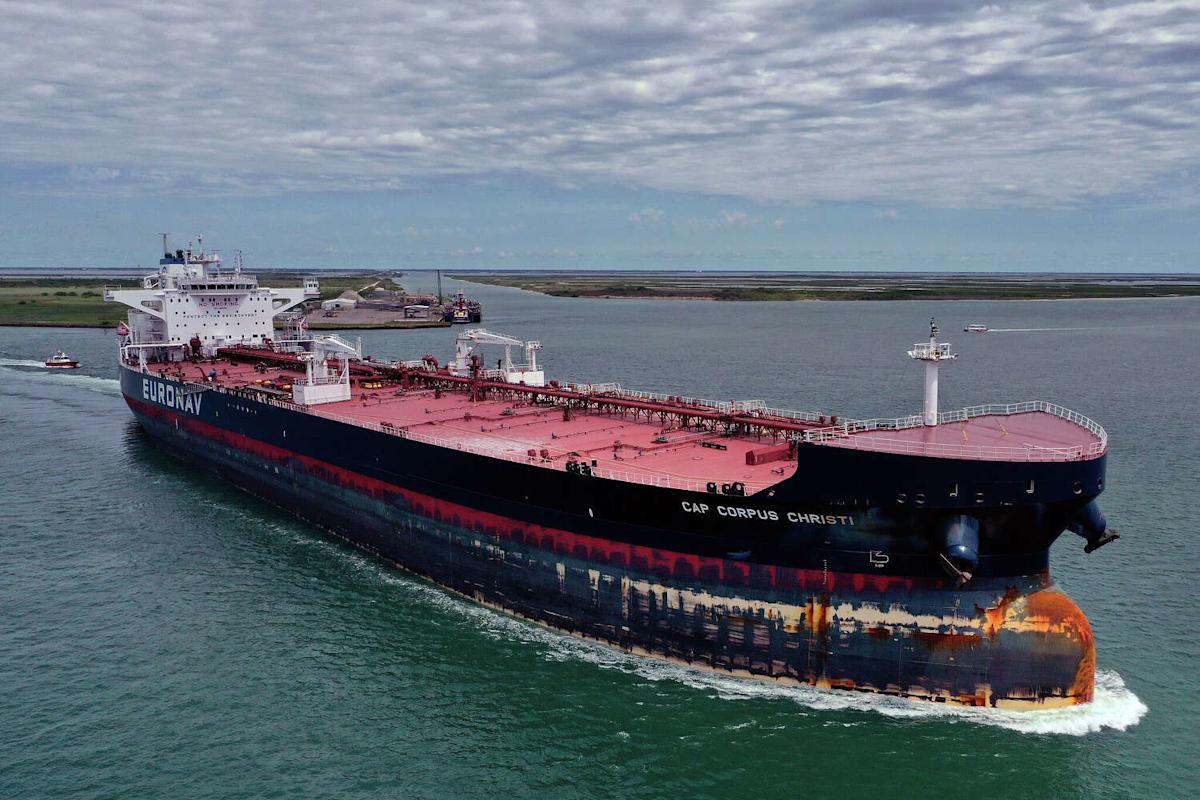
 In this aerial drone view from a drone, a petroleum tanker ship passes through the Aransas Channel to the Gulf of Mexico after departingt the Port of Corpus Christi on May 26, 2020 in Port Aransas, Texas. Curde oil exports from the Port of Corpus Christi have surged amid the war in Iran. (Tom Pennington/Getty Images)
Crude oil exports through the Port of Corpus Christi-the world’s third-largest oil export terminal-have surged amid the war in Iran. As uncertainty continues over Middle East oil production and exports, all eyes have shifted to Texas.
The Port of Corpus Christi had the strongest first quarter in its history this year, according to an April news release from the maritime hub. While primarily driven by liquified natural gas, farm exports, refined products and dry bulk, crude oil shipments rebounded sharply in February.
In March alone, crude oil exports topped 2.4 million barrels per day, marking one of the market’s highest monthly totals.
“It’s a constant parade of tankers coming in and out,” Port CEO Ken Britton told CNBC.
 Men work atop a vessel in the Corpus Christi Ship Channel on March 11, 2019, in Corpus Christi, Texas. (LOREN ELLIOTT/AFP via Getty Images) A surge in exports
In the last three months, crude oil exports from the Port of Corpus Christi rose by about 300,000 barrels per day.
“Since the Iran conflict began, crude oil exports moving through the Port of Corpus Christi have increased to 2.5 million barrels per day (mbpd), compared with 2.2 mbpd in 2025,” Omar Garcia, Chief External Affairs Officer for the Port of Corpus Christi told Chron in a statement Monday.
Britton said the shift is further evidence of the region’s importance in the global energy supply chain.
“The dramatically higher shipment levels seen since the start of the conflict in Iran are a testament to our customers’ ability to maximize their operations and quickly respond to changing market conditions,” Britton said in the April release, attributing the port’s safe, efficient operations to more than $1 billion in improvements and modernization over the past decade.
Kpler data reported by CNBC shows that Corpus Christi accounted for about half of all U.S. crude oil exports in April, while Houston accounted for most of the rest. Many of the tankers are coming from Asian countries that imported their oil from the Middle East before the war, Matt Smith, director of commodity research at Kpler, told CNBC.
Nearing pipeline capacity
While the Port is well equipped to handle the shipments, officials say the pipelines bringing crude there are close to full capacity.
“Current pipeline infrastructure at the Port limits crude export capacity to 2.6 mbpd,” Garcia said. “The Port has plenty of terminalling capacity but is constrained by pipelines.”
With Middle East supplies under pressure and no clear end to the war in Iran, Corpus Christi has emerged as a critical pressure valve for global oil markets. As exports climb toward pipeline limits, the port’s growing role raises questions about what infrastructure expansion may be needed if the surge continues.