
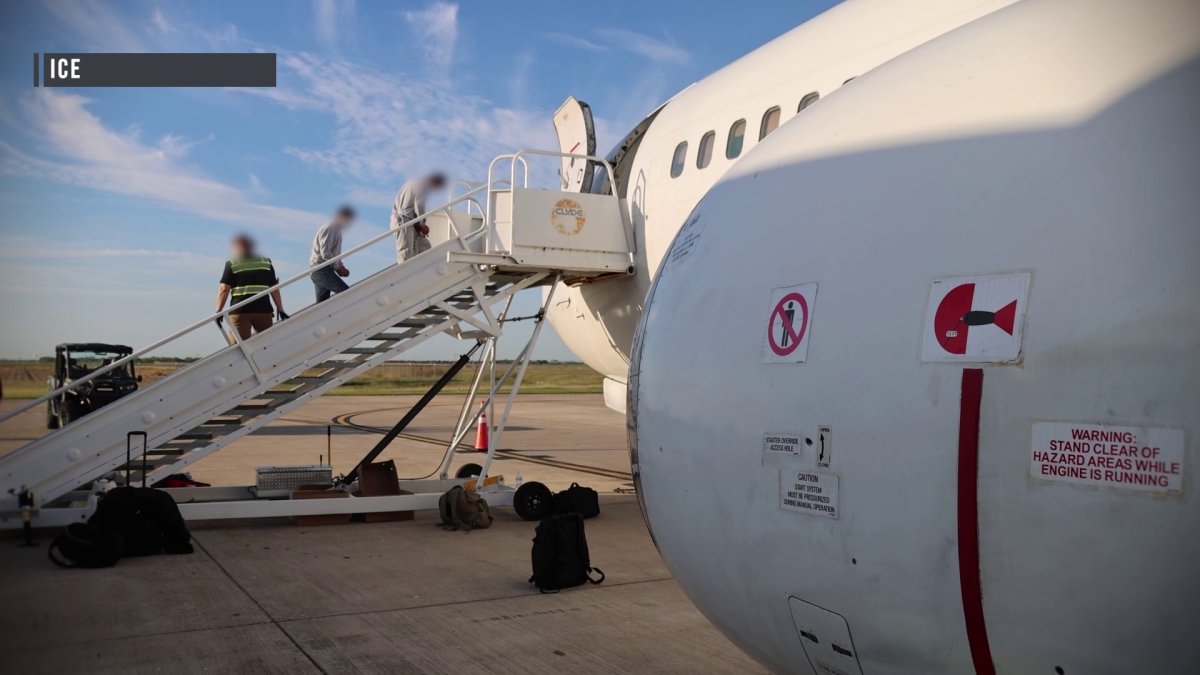
An NBC 5 investigation reveals a significant increase in ICE transfer flights moving immigrants within the United States with Texas receiving about one in every five flights. The data is raising questions about why Texas has become such a major destination. Some immigration attorneys believe these transfers may put immigrants at a disadvantage as they fight legal battles to remain in the U.S. Senior investigative reporter Scott Friedman breaks down the findings.
New data reviewed by NBC 5 Investigates shows ICE transfer flights have surged in the last year, moving thousands of detained immigrants across state lines, with Texas among the top destinations.
ICE said the transfers are about bed space, but immigration attorneys who spoke with NBC 5 Investigates said the consequences can be far bigger, sometimes keeping people locked up longer and far from home while they fight legal battles to remain in the U.S.
Data collected by the ICE Flight Monitor project, a group that uses flight-tracking tools and other public information, showed a 132% increase in transfer flights in the first year of the current Trump administration compared with the final year of the Biden administration.
From January 2025 to March of this year, the data showed more than 12,000 flights shuttled immigrants between states, and more than 2,500 of those flights were destined for Texas airports. That’s a rate of about one out of every five flights being bound for the Lone Star State.
Hundreds of flights came to Texas from cities like Phoenix and Alexandria, Louisiana, a major ICE transport hub. Dozens more came from Miami, San Diego, Jacksonville, Seattle, Newark, and Minneapolis.
The data showed 78 transfer flights from Minneapolis to Texas, most of which occurred during a Minnesota ICE crackdown known as Operation Metro Surge.
When ICE agents flooded Minnesota last winter and arrested thousands of migrants, many were taken to the Minneapolis airport, loaded onto planes and flown more than 800 miles to Texas.
Nearly three times more ICE flights flew into Texas than left in the last year
The chart below breaks down incoming and outgoing ICE flights to and from Texas cities from Jan. 20, 2025 to March 31, 2026.
Jonathan Suruy Lopez, an asylum seeker from Guatemala, said ICE agents arrested him on his way to work at a Minnesota shopping mall. One day later, he said, he was placed on an ICE transfer flight from Minneapolis to El Paso.
“They handcuffed both our hands and our feet,” Suruy Lopez said.
On the day Suruy Lopez was loaded onto the Texas flight, his daughter was born in Minnesota.
“It was a very difficult,” Lopez said in Spanish. “It was a very difficult thing, because I was in detention.”

NBC 5 InvestigatesNBC 5 Investigates
Jonathan Suruy Lopez, left, and his daughter, right. She was born the day after he was taken into ICE custody.
But that was only the first difficulty, he said. In Texas, Suruy Lopez discovered what his attorney described as a situation that often delays cases and extends time in detention.
“That’s really unfortunate and not how our system should work,” said Minneapolis immigration attorney Morgan Twamley.
Twamley said some of her clients have waited months for court hearings in Texas that might happen in weeks in Minnesota.

Edward Ayala, NBC 5 InvestigatesEdward Ayala, NBC 5 Investigates
Minneapolis immigration attorney Morgan Twamley.
Texas has the nation’s second-largest immigration court backlog, with more than 300,000 cases, according to the Transactional Records Access Clearinghouse (TRAC), a non-profit research group that tracks immigration court dockets. Texas federal courts have also seen a massive increase in habeas petitions filed on behalf of immigrants seeking release from detention, with more than 7,500 cases filed in Texas since the start of the Trump administration, according to a ProPublica analysis.
Twamley believes ICE is using jammed Texas courts to its advantage, hoping immigrants stuck in detention longer will lose the will to fight.
“I would bet a lot of money on it being the strategy that people will give up and are giving up,” Twamley said.
Twamley represented a 19-year-old Minnesota college student who spent three months in ICE detention in El Paso. The student asked that NBC 5 Investigates not use his name because his case is still pending. He said he came to the U.S. from Ecuador with his parents as a minor.
“I was getting sad. I didn’t want to eat. I lost 25 pounds,” the student said, describing his time in detention.

Edward Ayala, NBC 5 InvestigatesEdward Ayala, NBC 5 Investigates
A 19-year-old Minnesota college student who spent three months in ICE detention in El Paso spoke to NBC 5 on the condition that we not reveal his identity because his case is still pending.
When ICE flew him to Texas, he said he never imagined waiting months for release on bond so he could return home and continue pursuing an application for legal status. He said the hardship of detention, far from home and separated from his parents, felt like pressure to force him to give up.
Suruy Lopez said he also felt pressure after being flown to Texas.
“I feel that they do it in such a way as to scare you and to wait for you to make a decision to leave,” Suruy Lopez said.

Edward Ayala, NBC 5 InvestigatesEdward Ayala, NBC 5 Investigates
Jonathan Surury Lopez’s family.
NBC 5 Investigates asked the Department of Homeland Security why ICE transfers so many detainees to Texas. The agency did not answer directly, but said, “ICE conducts flights throughout the U.S. on a daily basis. For operational security purposes, ICE will not discuss ongoing or future operations.”
ICE said it makes custody decisions “based on bed space” and that all detainees “…have opportunities to communicate with family members and lawyers…” and that all detainees “…receive full due process.”
During the Minneapolis surge, the agency said it did not have enough local detention space. But when ICE chooses Texas as the transfer destination, attorneys said it often makes it easier for ICE to hold immigrants longer than in other parts of the country because the federal appeals court with jurisdiction over Texas has ruled many immigrants can be held without bond.

Edward Ayala, NBC 5 InvestigatesEdward Ayala, NBC 5 Investigates
Attorney Becky Wolozin.
“Now it is slightly more difficult to bring a habeas petition in Texas,” attorney Becky Wolozin said.
Wolozin is a court-appointed monitor representing immigrants from across the country flown to the Dilley ICE family detention center near San Antonio. She said many have a harder time communicating with their attorneys back home and accessing the paperwork they need to build their cases.
“When a family is removed from their community, from their support system, it’s very difficult,” Wolozin said.
For Suruy Lopez, time in detention and concerns about the cost of his defense were too much. He gave up on his case and agreed to be deported. He called it a frustrating end after entering the U.S. with permission from the U.S. government under an asylum application program that the Trump administration later discontinued.

NBC 5 InvestigatesNBC 5 Investigates
Left: Jonathan Suruy Lopez and his wife. Right: Suruy Lopez’s wife and children.
Suruy Lopez, who was originally flown to Texas from Minnesota, said in March he was loaded onto an ICE deportation flight from San Antonio to Guatemala.
The ICE Flight Monitor data showed ICE flew 857 deportation flights from Texas to other countries, with most headed to Honduras, Guatemala and Mexico.
Meanwhile, the flights into Texas continue. The data shows more than 220 transfer flights into Texas in March alone, leaving attorneys concerned that more families will face tougher decisions.
“Sitting in a detention center day after day, kind of ruminating on the situation, it’s really difficult for folks to try and hold out and fight their case”, Twamley said.

ICEICE
According to ICE, the average cost of a transport flight is about $8,500 per hour. Under President Trump’s Big Beautiful Bill, ICE will receive more than $14 billion for transportation and removal operations over four years. DHS told NBC 5 Investigates that the agency is looking for ways to trim costs and make the best use of public funds.
“Under new leadership, DHS is assessing all our resources, including aircraft, to maximize efficiency,” the agency said.
DHS Secretary Markwayne Mullin took over the agency last month and the agency said he is “…focused on ensuring the needs of our Department are met while being the best possible steward of taxpayer dollars…”
NBC 5 Investigates will continue tracking whether ICE keeps flying as many detainees to Texas in the weeks ahead.