
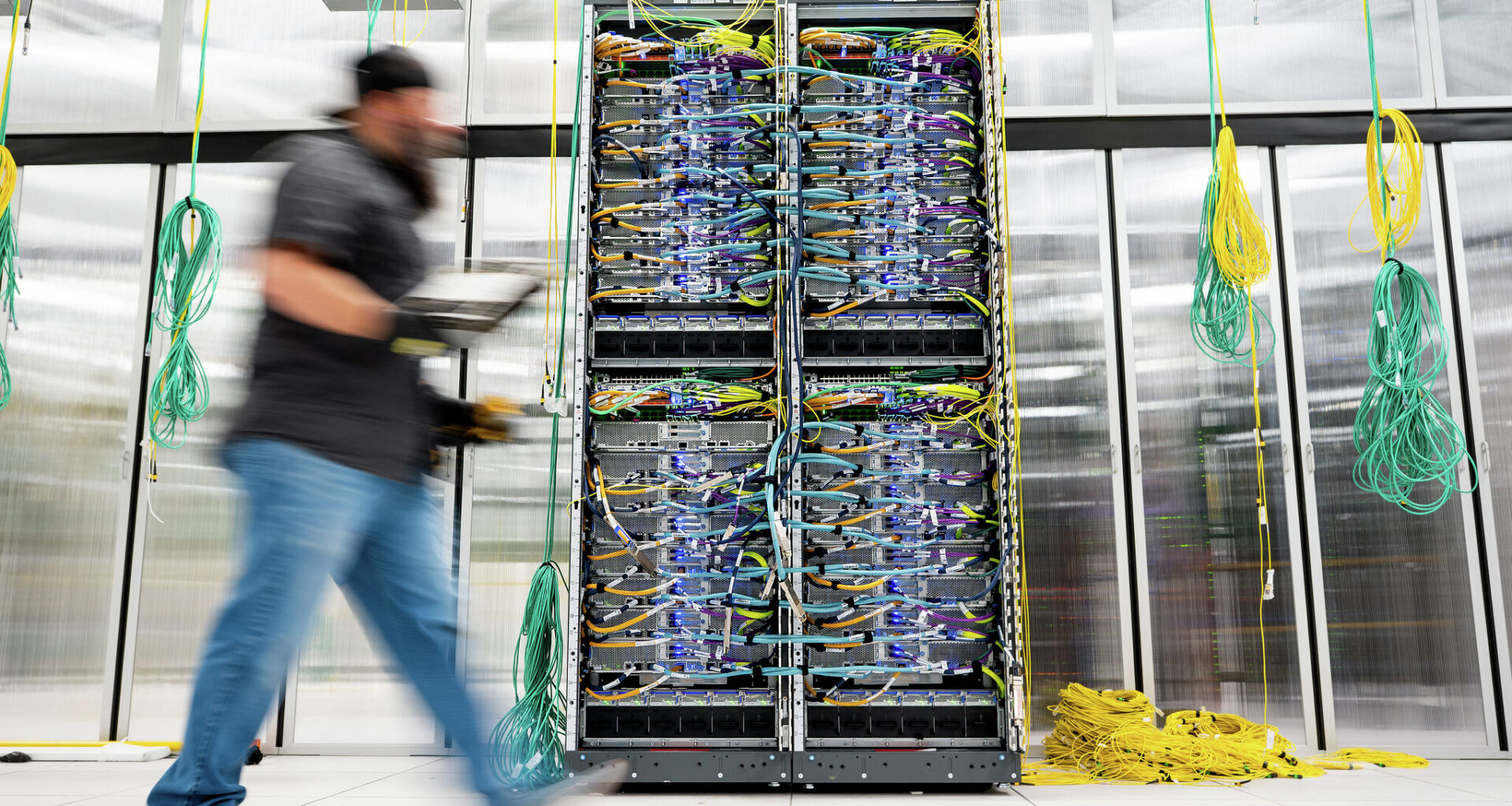
An Amazon Web Services technician passes an AWS UltraServer at a facility in Austin. Nearly 87% of the large-load interconnection requests that ERCOT is tracking come from data centers.
Handout/Getty Images
The Texas House Committee on State Affairs recently held an interim hearing on the explosive growth of data centers. Officials with the Electric Reliability Council of Texas, the state’s main power grid operator, testified they are tracking roughly 410 gigawatts of large-load interconnection requests, almost five times more demand than ERCOT’s record peak — with nearly 87% coming from data centers.

Lawmakers pressed hard on the obvious question: Who pays? As Rep. Chris Turner asked the Public Utility Commission chairman during the hearing, “Is it the goal of the commission to make sure the data center activity does not increase the electricity cost for our constituents?”
Article continues below this ad
That question cuts to the heart of the challenge facing Texas families. Energy bills are already squeezing household budgets, and the status quo makes the problem worse. Right now, it is nearly impossible for a third-party power generator to quickly set up an independent grid and sell directly to technology customers. As a result, most tech firms are forced onto the ERCOT grid, where they compete head-to-head with Texas families for the same power supply from the grid. That competition can drive up costs, lengthen queues and leave Texas ratepayers — families, homeowners and young people — on the hook for expensive transmission upgrades that may or may not be needed.
There is a better way: Bring Your Own Power.
This straightforward policy would simplify off-ERCOT grids for new developments. These systems would operate completely independently of the main grid. Tech companies, other large nonresidential users and third-party power developers could finance, build and operate their own power system using their own private capital and funding their own infrastructure. No drawing from the ERCOT grid. No socializing upgrade costs onto residential ratepayers. No reliability burden on the families and small businesses who already pay the bills.
SIGN UP FOR THE AUSTIN ANGLE and get Statesman commentaries in your inbox
Article continues below this ad
The savings would be immediate and substantial. According to Texas energy developers we spoke with, businesses that bring their own power plants would avoid the process of navigating complex public utility rules — potentially saving $500,000 to $1 million in attorneys’ fees and six months to a year of lag time. They would still be subject to other state regulations addressing air and water quality, as well as workplace safety rules and fire and building codes.
If a data center’s grid later wants to interconnect — to sell excess power or participate in wholesale markets — it would then fall under normal ERCOT and Public Utility Commission rules, which can take seven years to allow the connection. Early deployment happens fast; full oversight kicks in the moment the system touches the broader grid.
The risk of forcing all data centers into the existing grid is real: more demand could raise costs. The Dallas Federal Reserve recently offered a stark analysis that “Even a modest data center boom could substantially raise retail electricity prices.” The Cato Institute’s recent briefing, which one of us co-authored, makes the case plainly: by creating a parallel pathway for private power outside the traditional monopoly model, these systems protect households that are already struggling with energy costs, while also relieving grid congestion and accelerating the very investment that keeps prices in check.
Other states are already showing how it can work.
Article continues below this ad
New Hampshire’s House Bill 672 (2025) was the first to authorize fully off-grid electricity providers to generate and sell power without being regulated as public utilities — but subject to safety and siting laws. Utah’s SB 132 (2025) allows facilities with large power needs (more than 100 megawatts) to build closed, independent systems so customers pay their own way and existing ratepayers are shielded.
Oklahoma’s SB 480 (2025) expanded behind-the-meter and private generation options for big users, relieving pressure on long transmission lines and cutting grid congestion. The result has been faster deployment of new power, billions in private capital attracted, and — crucially — no added costs passed on to families.
The House State Affairs Committee has now heard the data and the concerns. The next step is simple: pass Bring Your Own Power legislation next session. Texas families deserve relief from rising energy costs, and responsible tech growth deserves a path that doesn’t come at Texas ratepayers’ expense. Private capital, private risk, and private power — that’s how we keep the lights on for everyone.
Article continues below this ad
Glen Lyons is a retiree from Exxon Mobil Corporation and former member of the ERCOT Board of Directors. Nicole Nosek is the chair and founder of Texans for Reasonable Solutions, an advocacy group focused on affordability solutions for Texans.