
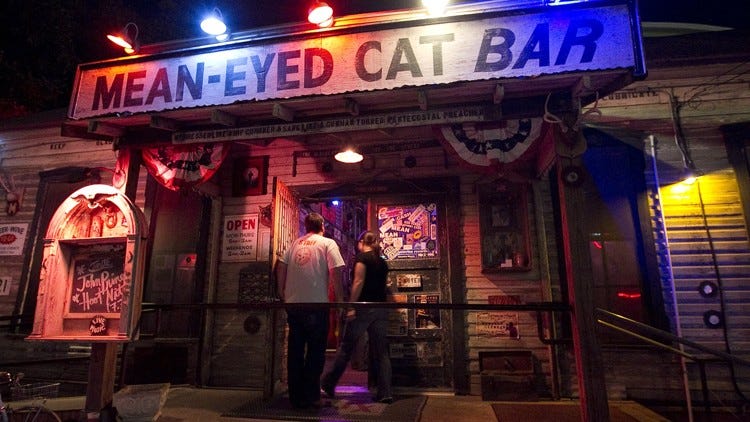
This week in “Jim Duncan’s Austin,” we adapt several of his histories of dive bars, which he defines by atmosphere and attitude — not by genre of music. “The music can be anything — jukebox, rock, blues, country,” says Duncan, a retired city planner. “Cheap drinks, low-key, dim lighting, unpretentious, no frills.” In the coming weeks, expect more short histories of Austin dives and, in a separate category, honkytonks. — Michael Barnes

1947: Cut-Rite / Mean Eyed Cat
The Mean-Eyed Cat combines Johnny Cash, a movie location and an ancient tree.
Austin American-Statesman
It is not often you will find a business that has been in the movies, been dedicated to a legendary country singer, and been saved from the wrecking ball by a tree, but that summarizes the history of the Mean-Eyed Cat.
Article continues below this ad
In 1947, when Claude Farrington Bush Sr. opened his Cut-Rite Shop at 819 W. 12th St., he could not have imagined that it would still be around decades later, mixing margaritas rather than sharpening saws.
The West Austin bar is best known for having been a setting for the sequel to the cult film, “The Texas Chainsaw Massacre,” starring Dennis Hopper.
Its homage décor reflects an admiration for the “Man in Black,” country singer Johnny Cash.
And it would not even be here today had it not been for a 300-year-old oak tree in its backyard.
Article continues below this ad
During the mid-1960s, the shop was moved to 1621 W. Fifth St. When the site was proposed for redevelopment in the early 2000s, bar owner Chris Marsh and the city-protected heritage tree convinced city officials to preserve both the building and tree, which he then converted to the Mean-Eyed Cat in 2004.
In 2013, Marsh sold the bar to Matt Luckie, Max Moreland and Jed Thompson. In 2023, the owners announced the opening of a second Mean-Eyed Cat in suburban Kyle. Bush died in 1998.
1951: Deep Eddy Cabaret
Deep Eddy Cabaret remains a low-key dive bar. AMERICAN-STATESMAN 2006
Austin American-Statesman
Named after a popular swimming hole that was once part of the Colorado River behind the bar, Deep Eddy Cabaret is a time capsule from the 1950s. As one of Austin’s oldest dive bars, it still possesses many of its original furnishings.
Article continues below this ad
Located at 2315 Lake Austin Blvd., the structure was built by Walter Wooten Johnson in 1915 and occupied as a grocery store and bait shop until World War II. Tillett Clifford “T.C.” Hendrix and his wife, Pansy, managed the grocery store during the 1940s.
In 1951, Raymond Reed Hickman bought the building and opened the Deep Eddy Café, a beer bar and fishing supply store. After Hickman died in 1963, his wife, Mickey, assumed ownership of the business. Seeing that they did not serve food, she changed the business name from “café” to “cabaret” in 1971.
She also featured exotic dancers during the 1970s. In the 1980s, it was back to being a neighborhood beer and wine bar.
In 1996, Mickey Hickman turned the business over to their son, Raymond Reed “Butch” Hickman, and his wife, Patti, who operated it until 2014, when they sold it to Robert and Will Bridges.
Article continues below this ad
Except for the addition of mixed drinks to the bar menu, nothing much has changed in the past eight decades. In 2024, the city of Austin designated the bar a historic landmark. Johnson died in 1955 and Hendrix in 1956.
1951: Halo Haven / 04 Lounge
Yep, The 04 Lounge still has a pool table.
Aaron E. Martinez/American-Statesman
For more than 70 years, a nondescript, concrete, windowless, easy-to-miss structure at 3808 South Congress Ave. has served neighborhood dining and drinking desires. Its newest occupant, the 04 Lounge, has been described as a “no-frills neighborhood spot decorated with flea market finds” and “no windows, no overt signage — nothing fancy. Just one of Austin’s best dive bars.”
Article continues below this ad
During the 1950s, the building housed Halo Haven, a steakhouse that allegedly did double duty as a brothel. Four different cafés and beer bars occupied the building during the early 1960s — Barnett’s Café, Russell’s Drive-in, El Zarape Café and Cid’s Lounge.
Occupant stability finally arrived in 1965 when Donna Pearl Bai opened Donna’s Lounge. For the next 40 years, the business was operated by either Bai or her daughter Nadine “Dee” Meeks.
In 1982, a fire damaged much of the building, and newspapers reminded readers of its scarlet past.
After Bai died, Meeks and her husband, James Edward Pierce, continued to operate the lounge, changing the name to Dee & Jim’s Bar. Every Thanksgiving, they treated their regulars to a turkey dinner.
Article continues below this ad
In 2008, they sold the business to Italo Benedict “Benny” Pezzi, who secured a liquor license and changed the name to 04 Lounge. Bai died in 1993 and Meeks in 2020.
1955: Continental Club
Over a century ago, the building that is now home to one of Austin’s premier music venues was occupied by one of its first automobile paint shops. Before it found its destiny as the iconic Continental Club, 1315 South Congress Ave. was also home to an oil reclamation company, a restaurant, a laundromat and an appliance store.
In 1955, Dorsey Otto Weir and Morin Montagu Scott converted the building into a membership nightclub with live entertainment and named it The Continental. Since then, it has remained a music venue but switched owners and genres often: Pop in the 1950s, Dixieland in the mid-1960s, burlesque in the late 1960s, country/folk in the 1970s, and blues in the 1980s.
Article continues below this ad
After Stephen Aaron Wertheimer bought and refurbished the club in 1987, it became a premier venue for blues, soul, country, rock, rockabilly and garage rock. It is the only club that has been designated an official venue in every South by Southwest Festival.
The Los Angeles Times wrote about the Continental Club: “If it’s not on your list of great American music venues, that list might need some work.” In its August 2010 issue, Playboy magazine listed the club in its “Guide to America’s Greatest Bars.”
Three more stories in this series
Article continues below this ad
Please send tips and questions to mbarnes@statesman.com.