
Austin’s affordability crisis is often the center of discussions about home ownership and the real estate market. While many prospective buyers remain priced out of the capital city, they may be surprised to find that in the rental market, they have a distinct advantage thanks to the historic abundance of rental units available to them.
As Austin’s population surged in the early 2010s, so too did rent prices — and eventually, the need for more housing. Between 2015 and 2024, Austin added roughly 120,000 units to its housing stock, representing a 30% increase, according to the Pew Research Center. That’s more than triple the national growth rate.
Now, that wave of construction is reshaping the market. The median asking rent for a one-bedroom apartment fell by nearly $300 between August 2022 and March 2026, according to Apartment List data, as new complexes opened and population growth slowed.
Apartment List estimates median asking rents for one- and two-bedroom rentals by combining U.S. census data with trends from its own listings. Its estimates do not include discounts or concessions from property owners, but the company says using census data helps avoid overrepresenting luxury apartments.
To be included in Apartment List’s data, a city must have enough new activity on the platform, and census estimates must have a narrow enough margin of error.
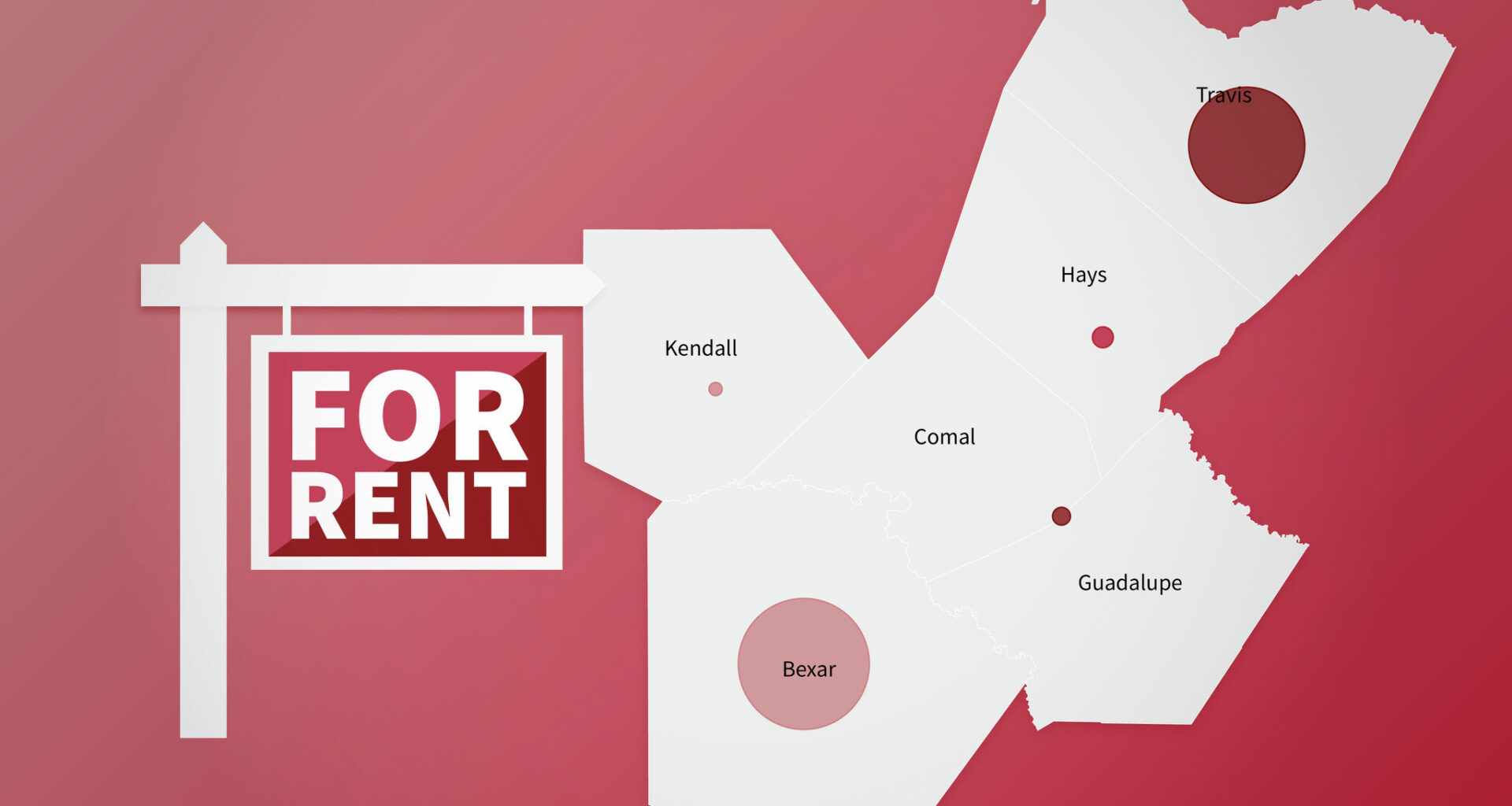
The charts below show estimated one-bedroom rent trends since 2017 for Travis County and nearby counties, as well as some of Texas’ largest cities and the U.S. overall.
Estimated median one-bedroom rent prices, from 2017 onward
Christian Leonard / DevHub • Source: Apartment List
The pandemic and the rise of remote work reshaped Austin’s housing market in ways that are still playing out. An influx of new residents during the early pandemic years, including many relocating from higher-cost states, helped stabilize rents as developers kept building to meet demand.
But as migration slowed and thousands of new apartments opened, the market shifted. Vacancy rates climbed to some of their highest levels in 2024, prompting landlords and property managers to compete more aggressively for tenants through discounted rents, free months of leasing and other concessions.
Construction has started to slow, and vacancy rates have begun to dip. But rental prices have not yet responded, according to Israel Linares, CoStar’s senior market analyst for Austin.
“We’re going to continue to see those dynamics play out, where we’re going to see a slowing supply pipeline,” Linares said. “Pair that with pretty strong demand and you’ll start to see that eat away at this surplus, where we can start to see that excess dwindle.”
Even with recent declines, Austin remains one of the most expensive rental markets in Texas. Median rents in Travis County still outpace those in places like Bexar County, where housing costs are generally lower.
Nearby counties, including Hays and Williamson, have seen tighter inventory and continued population growth, drawing renters willing to accept longer commutes for lower prices.
Nationally, rent growth has plateaued over the past year, signaling that the market is stabilizing after a volatile post-pandemic period.
Still, broader economic pressures could complicate that recovery. A recent study by Construction Coverage, a data firm for the homebuilder industry, shows that monthly mortgage payments in Austin are 117% higher than rent. Nationally, the median mortgage payment is 20% higher than rent, making Austin’s gap one of the largest in the country. Elevated mortgage interest rates have also kept many would-be homebuyers in rentals longer.
Though Austin-area home prices have cooled from pandemic-era peaks, higher borrowing costs can keep monthly payments high, sustaining rental demand.
The table below shows estimated median rents for one-bedroom and two-bedroom rentals in every city where Apartment List has data. It also includes the percentage change in overall rents over the past year.
Estimated median rent prices, by city and bedroom count
“One-year change” reflects the overall trends for both one- and two-bedroom units, which in Apartment List’s data are nearly identical.
Christian Leonard / DevHub • Source: Apartment List
CreditsReporting by Julianna Duennes Russ/Austin American-Statesman. Editing by Katey Psencik/Austin American-Statesman, Danielle Rindler/Hearst DevHub and Dan Kopf/San Francisco Chronicle. Data analysis, visuals and development by Andrew Williams/Hearst DevHub and Christian Leonard/Hearst DevHub.