
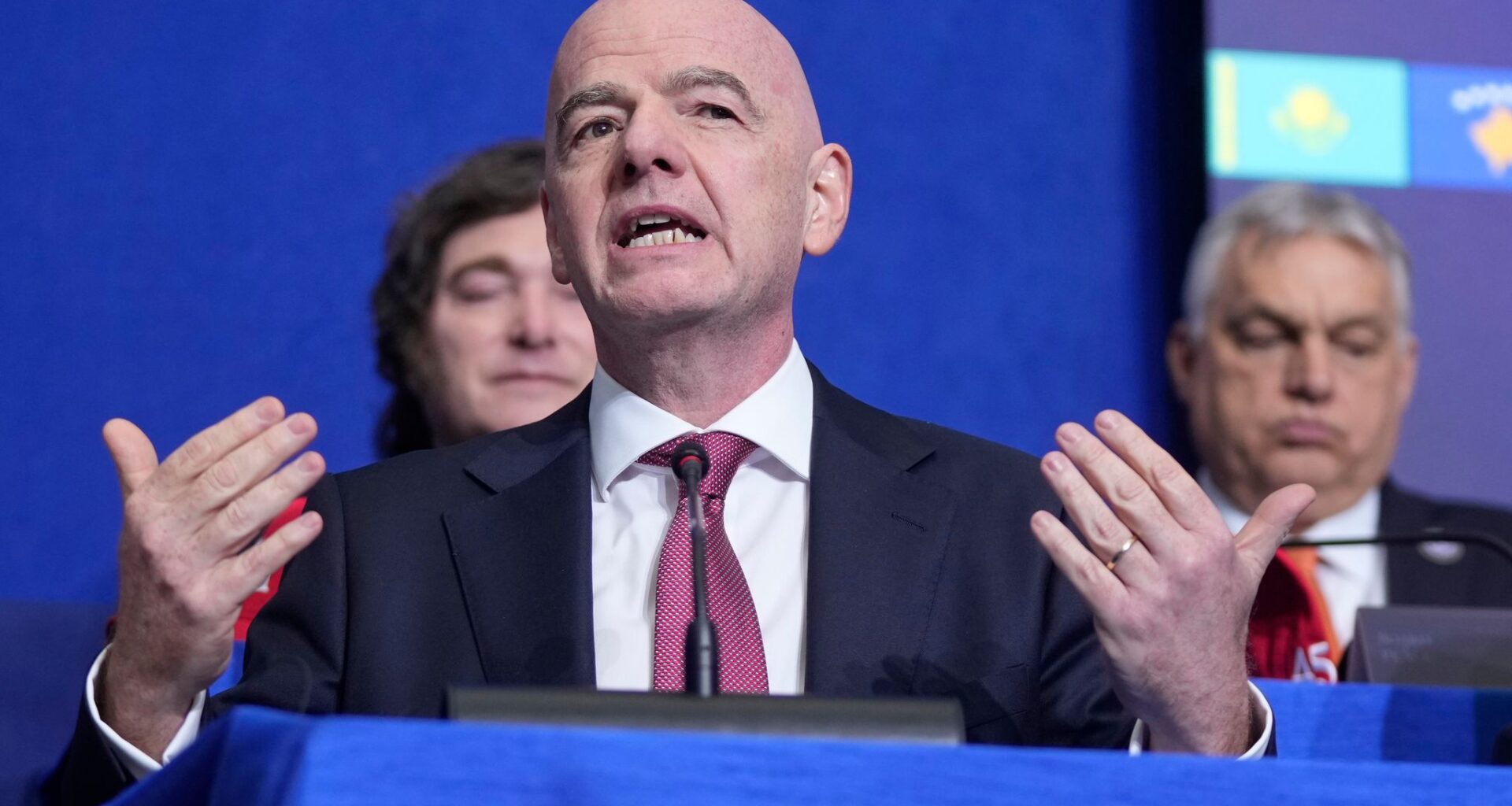
FIFA President Gianni Infantino speaks during a Board of Peace meeting at the U.S. Institute of Peace, Thursday, Feb. 19, 2026, in Washington. (AP Photo/Mark Schiefelbein)
Mark Schiefelbein/AP
When lifelong soccer fan Dennis McGowan and a friend won FIFA’s ticket lottery a few months ago, they purchased four World Cup tickets in the second-highest price category and figured, at worst, they’d be assigned seats in the middle tier of AT&T Stadium.

Article continues below this ad
The bad news came a few weeks ago when McGowan, the vice president of an FC Dallas fan club, received a profane text from his incredulous friend: Despite paying $350 per ticket, their seat assignments are in section 408, row 24 — the upper reaches of the upper deck, toward the corner, just a few rows from the top of the stadium.
Months after purchasing World Cup tickets, some fans are just now finding out where they will be seated, leaving many gobsmacked that their seats are much farther away than expected. It is igniting a fresh wave of blistering criticism toward FIFA, the Zurich-based governing body that controls every aspect of the ticketing process for the first World Cup in North America in 32 years.
“It is verging on fraud,” McGowan of Royse City told The Dallas Morning News. “There should be a class-action [lawsuit] against FIFA. This is a scam — an out-and-out scam. If this weren’t FIFA, if this were some rinky-dink organization locally, they would be sued into oblivion. But because it’s FIFA, and cities and governments are making trillions of dollars behind this, nobody is going to do anything.”
Make Dallas News a preferred source so your search results prioritize writing by actual people, not AI.
Add Preferred Source
The North Texas World Cup Organizing Committee referred all ticketing questions to FIFA. In response to questions from The News, a FIFA spokesperson provided a lengthy statement that sought to clarify aspects of the ticketing process but failed to address any broader criticism surrounding transparency or allegations of ticket manipulation.
Article continues below this ad
FIFA said color-coded stadium seating maps, whose composition changed during the ticketing process, served only as “guidelines” rather than a precise map for where seats would be in each price category. In a subsequent phone call, a FIFA spokesperson said no price category changes (other than supporter group areas) were made to the seating maps during the ticketing process, but a comparison of the maps tells a different story.
The issue is especially important in D-FW because AT&T Stadium is hosting nine matches, the most of any of the 16 North American cities. Many longtime soccer stakeholders and fans call this FIFA’s least transparent World Cup despite the organization’s stated intent to be as open as possible. The widespread criticism is playing out as FIFA anticipates generating $13 billion in the current cycle (2023 through 2026).
The ticketing process, a lightning rod from the start, has further devolved into a dizzying blur of old price categories and new price categories; old ticketing phases and new ticketing phases; old color-coded stadium maps and new color-coded stadium maps — and plenty of unhappy ticket buyers. Even for long-entrenched soccer aficionados, it can be an enigma wrapped in a riddle.
Danny Navarro is a Virginia-based social media influencer known as TravelFutbalFan who provides followers with World Cup travel tips. He has more than 100,000 followers on his platforms. He said it would be a stretch to say even 10 are happy with their seat assignments. He believes FIFA is vulnerable to lawsuits because of alleged manipulative and fraudulent practices toward consumers.
Article continues below this ad
He encapsulated FIFA’s ticketing process in four words: “Heist of the century.”
“This is straight up fraud,” Navarro said, “because they’re going to go ahead, and without any sort of transparency, move the seats around, move the categories around, announce that this row is going to be front row category 3 versus front row category 2. It is insane that they’re getting away with this. This is one big scam and people are absolutely furious about it.”
He called FIFA’s ticketing strategy “absolutely shameful,” adding, “rather than being a good steward of the sport, FIFA saw dollar signs in their eyes. It’s really the most egregious process fans have seen.”
FIFA rolled out its ticketing process in several phases, and navigating them is akin to solving a puzzle. The organization has been widely lambasted for a process characterized as convoluted and opaque, framed by sticker shock that prices out a large group of long-entrenched or would-be fans.
Article continues below this ad
This latest criticism surrounds fans finally learning exactly where they will be sitting in the 16 stadiums after the color-coded seating charts early on were shrouded in mystery, or merely a rough guide of where seats would be for each pricing category, or inexplicably changed during the process.
In FIFA’s ticketing model, fans who won the lotteries had the opportunity to buy tickets in one of four price points — or categories — with those prices varying depending on the allure of each particular match.
Lottery winners could have purchased tickets that range from $220 to $600 for Japan-Netherlands on June 14; from $265 to $700 for England-Croatia on June 17; and from $265 to $700 to watch global superstar Lionel Messi and Argentina face Austria on June 22.
Article continues below this ad
But if you thought the highest-priced tickets (category 1) would guarantee top-tier seats in the stadium’s lower bowl, think again. According to the most recent AT&T Stadium seating chart for matches, those category one ticket buyers could be relegated to the 300 level.
If you thought the second-highest priced tickets (category 2) would guarantee mid-tier seats, think again. As McGowan found out, you could be relegated to the upper reaches of the upper deck.
“That price ($350) gets you lower sideline for a Cowboys game, right?” said McGowan, who will attend the Netherlands-Japan match. “This is a game that is supposed to be for everyone, and bringing it to the United States has only proven that we’re going to be as greedy as we possibly can. FIFA made out like a bandit on this and took advantage of everybody.”
But that’s not all. Category 3 tickets are only offered for a small portion of seats in the upper corners of the upper deck. And Category 4 seats barely exist at all, and can barely be seen on the color-coded seating chart.
Article continues below this ad
University Park’s Michael Peticolas has purchased tickets for every World Cup since Germany hosted in 2006. He’s never seen anything like this ticketing process, calling it “mind-blowing” and “insane.”
“It’s an example of hiding the ball, not being clear and upfront from the start,” said Peticolas, who owns Peticolas Brewing Company in Dallas. “When they say they want to grow the game and make it accessible, I mean, come on, you can say that, but your actions speak louder than your words.”
Peticolas logs on to the FIFA ticketing site every morning. His dream is to attend the semifinal at AT&T Stadium. But he sees the category 1 price tag: $11,130.
FIFA president Gianni Infantino this week defended the prices of World Cup tickets.
Article continues below this ad
“We have to look at the market — we are in the market in which entertainment is the most developed in the world. So we have to apply market rates …,” Infantino said at the Milken Institute Global Conference in California.
“You cannot go to watch in the U.S. a college game, not even speaking about a top professional game of a certain level, for less than $300. And this is the World Cup.”
FC Dallas season-ticket holder Dennis McGowan, 38, purchased two World Cup tickets through FIFA’s convoluted system. He is photographed at Germany Park in Dallas, January 14, 2026.
Tom Fox/Staff Photographer
FIFA is ‘gerrymandering these seats’
In a recent interview with The News, Alan Rothenberg, chair of the 1994 World Cup organizing committee, defended FIFA implementing dynamic pricing for this World Cup but bemoaned the fact that the U.S. Soccer Federation is not in control of ticketing strategy and other tournament elements.
Article continues below this ad
“FIFA is running this entire World Cup …,” said Rothenberg, president of U.S. Soccer from 1990 to 1998. “I wish the U.S. Soccer Federation was involved completely in everything — not just the ticketing strategy. I think it would actually have been smoother and easier for the host cities, because FIFA basically has to deal directly with 11 different American cities besides the Mexican and Canadian cities. They still would have called the shots. It’s still theirs.”
Martin Endemann, head of policy at Football Supporters Europe (FSE), which represents the interests of supporters in European soccer, said it’s clear FIFA’s ticketing policy is to exploit the loyalty of fans as much as possible.
“They appear to see fans as customers to wring out for every cent, rather than as a valuable voice that contributes so much to the game,” he said.
FSE and Euroconsumers in March filed a lawsuit with the European Commission against FIFA, alleging that the football body has “abused its monopoly position to impose excessive ticket prices and opaque and unfair purchasing conditions.”
Article continues below this ad
In early January, FIFA declined to respond to The News’ multiple emails with questions about the stadium maps and ticketing process.
The color-coded stadium maps were first revealed only to fans who won a ticket “presale” lottery in October, according to The Athletic. It also reported that the maps were published two weeks later on a “Stadium Information” webpage, but never in a news release.
And here’s the kicker: In subsequent months, FIFA changed the color-coded maps altogether.
FIFA’s statement to The News read in part: “During the various sales phases preceding the current Last Minute Sales Phase, FIFA published indicative category maps to help fans understand where their seats could be located within a stadium. These maps were designed to provide guidance rather than the exact seat layout, and reflect the general extent of each ticket category within the stadium.
Article continues below this ad
“Following the Final Draw and the opening of the PMA Supporter sales phase, those indicative maps were updated to highlight the areas intended for PMA Supporters. By adding these details to the maps, FIFA aimed to help PMA Supporters identify sections where supporters of the same team could reasonably expect to be seated together, subject to availability and final allocation. These dedicated supporter areas are located in seating sections that, for the general public, correspond to Category 1 and Category 2 seating.”
When told FIFA said the seating maps were merely a guide, Navarro laughed hysterically.
“This idea of the seating maps being a guide, imagine that the atlas is telling you, ‘Hey, this roadmap is just a guide,’” he said. “You know, if the road ends here and you fall off the road, hey, sorry’… It is manipulation of the seat assignments and, in effect, fraud because they want to sell the sideline seats for a much higher price.”
A FIFA spokesperson stressed to The News by phone that the only changes made to the stadium seating maps during the ticketing process involved supporter group sections. But the AT&T Stadium seating maps tell a different story.
Article continues below this ad
Compare the stadium’s seating maps from early in the ticketing process to the most recent one. There’s a significant change.
Specifically, 16 different 300-level sections labeled category 2 seats in the earlier stadium map are subsequently designated category 1 seats in the more recent version, according to the stadium maps Navarro posted on his website. [Navarro said Football Australia, the governing body of Australian soccer, released the early seating maps.]
Even for those who were aware of the seating maps — and scores of fans were not — it left them thinking that seating assignments were a moving target.
“They changed those maps multiple times, because then at one point they included the supporter section,” Navarro said. “Then they removed those off the maps. And then they’ve been almost every, if not every week, every day, been very selective. ‘Oh, we’re going to now move not only a section of seats from one category to another, but within a section itself split it into, say, category 1 and category 2 or have it both category 2, category 3 seats.
Article continues below this ad
“They’ve been manipulating these maps. Look, I’ve worked in politics, and here in D.C., it’s almost like gerrymandering these seats.”
Seating maps for ‘guidance purposes only’
Do ticket buyers have recourse?
FIFA’s ticketing terms state: “Any visual representations of Ticket Categories on the Ticketing Website, such as Stadium maps and illustrations, are for guidance purposes only and may not reflect the actual layout and boundaries of a particular Stadium.
Article continues below this ad
It also states that the ticket holder “acknowledges that FIFA Ticketing or the relevant Stadium authorities may determine the Seat Location and change the Seat Location for a given Ticket at any time, including after a Ticket has been purchased and on the day of the Match, provided that the Seat Location is in an area applicable to the same Ticket Category or a Ticket Category of Tickets with a comparable or better value.”
No event as popular as the World Cup is going to be cheap and FIFA says it received 500 million ticket requests during the Random Selection Draw phase alone.
After conducting three phases for ticket sales, FIFA on April 1 opened the so-called Last-Minute Sales Phase, the fourth and final official ticket sales phase, to allow the general public to purchase tickets via FIFA.com/tickets. This sales window will remain open until the end of the World Cup.
Tickets are now sold on a first-come, first-served basis and are subject to availability.
Article continues below this ad
FIFA said in its announcement of the Last-Minute Sales phase, “Tickets will continue to be released on a rolling basis,” implying more tickets will come. FIFA won’t say when or how many.
“Now that the dedicated PMA Supporter sales phase has concluded and seats have been assigned, FIFA has transitioned to directly seated sales,” FIFA said in its statement. “Seats not taken up during the PMA Supporter phase have been released back into the general public inventory. Fans are now able to select a specific seat directly on the interactive map, with full visibility of the exact seat location at the time of purchase.
“In parallel, and to ensure clarity for fans who have already purchased tickets during earlier sales phases and have now been allocated a seat location, FIFA has uploaded ticket category maps without the indication of maximum potential supporter sections. These maps reflect the final reality of category zoning, without overlaying earlier planning assumptions related to supporter grouping that were no longer applicable once inventory was released more broadly.”
A 2026 FIFA World Cup soccer ball was displayed at the North Texas FWC Organizing Committee Official Draw and Match Schedule reveal press conference at AT&T Stadium in Arlington, December 9, 2025.
Tom Fox/Staff Photographer
Are good seats still available?
FIFA also reopened the official resale/exchange marketplace for ticket holders on April 2. The platform enables fans to sell their tickets to other fans in a secure and authorized environment, which FIFA says safeguards against invalid or unauthorized resale.
Article continues below this ad
In FIFA’s in-house resale marketplace, most tickets are going for thousands of dollars, including the nosebleeds of the nosebleeds. This is after you’ve paged through complicated price ranges, like category 4 for Japan vs. Sweden, which recently showed a range of $69.00 to $3,450.00.
Fans can also purchase tickets on the secondary market, although FIFA warns against buying tickets on any third-party site because of the risk of fraudulent tickets. Andy Swift, secretary of the Board of Directors for the North Texas World Cup Organizing Committee, echoed that sentiment, saying during a news conference that he recommends “extreme caution” when purchasing tickets outside FIFA’s official site.
But even on the FIFA market, many believe it’s a buyer-beware situation. Matches are not sold out, yet the FIFA ticketing process remains inscrutable. And there’s little indication of exactly what seats are being purchased for hundreds of dollars.
As of mid-April, almost 60% to 70% of tickets have been sold for the five group-stage matches at AT&T Stadium, said Noelle LeVeaux, the chief marketing officer for the organizing committee.
Article continues below this ad
Knockout-round matches, including two round-of-32 matches and one round-of-16 match, have sold about 55% of their tickets even though teams are not yet known. And 31% of tickets have already been sold for the July 14 semifinal, she said.
Michael Peticolas, brewer and founder of Peticolas Brewing Co.
A ‘slap in the face’ to fans
To date, LeVeaux said the top-selling match, in terms of number of tickets sold, is Netherlands-Japan, the first match in Arlington on June 14.
Article continues below this ad
As for who is buying tickets, about 26% to 35% are being purchased by international customers. Approximately 50% of tickets sold have been to customers in the United States outside of the region. Some 20% to 25% have been purchased by those in D-FW.
“Our planning is for very big crowds,” LeVeaux said.
Citing FIFA’s process, some longtime soccer fans are saying thanks, but no thanks. Peticolas has a friend in Atlanta who is a lifelong soccer fan and is so disgusted by FIFA’s ticketing model that he refuses to buy tickets.
Here is what Peticolas is planning: He connected with a Japanese supporters’ group. He’s going to ride a bus with 150 of them from D-FW to Monterey, Mexico, to watch a Japan match.
Article continues below this ad

By signing up, you agree to our Terms Of Use and acknowledge that your information will be used as described in our Privacy Policy.
“The idea probably sounds much better than the execution, riding the charter bus, watching the match, driving home,” he said. “We’re not even like staying the night. It’s like 10 hours, and it’s probably going to be awful, and I’m going to be on a bus with 150 people I probably can’t even communicate with. But I just thought to myself, what an experience.”
As for McGowan, he will be there at AT&T Stadium. He still plans to have fun at the game, even as he concedes he’ll likely be watching much of the match from the upper deck on the giant video screen. Forgive him if he sneaks a peek at the lower bowl.
“Who is actually sitting up in the lower bowl because every sale that we keep seeing, nobody seems to even know who has these lower bowl tickets?” McGowan said. “FIFA came out a couple of weeks ago with the super VIP category 1 A-plus or whatever they called it. It just feels like a slap in the face to everybody who has been trying to get tickets and jumped in as early as we did. For everyone I’ve spoken to, this has been an absolute nightmare.”