
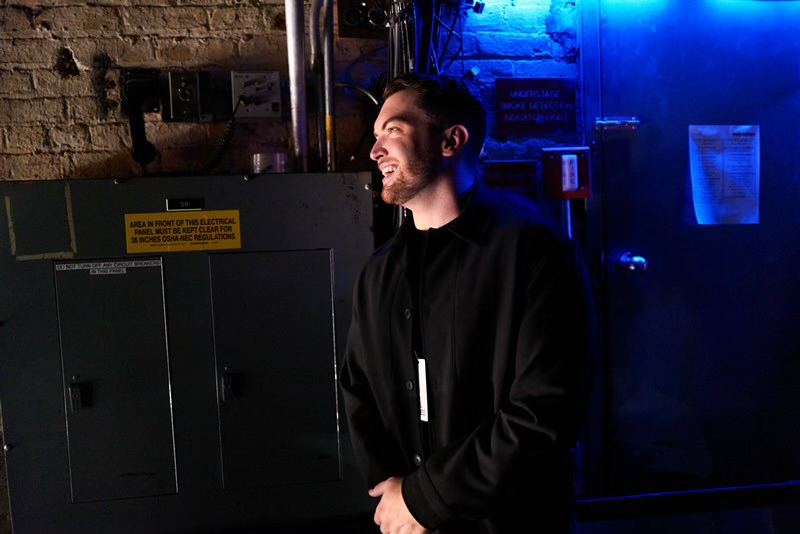
Austin-based Hunter Regian backstage during the 50th anniversary celebration of “A Chorus Line,” his first outing as a Broadway “lead producer.” Photo by Jenny Anderson.
Jenny Anderson/Motley Crew
When Austin-based Hunter Regian received his first Tony Award as co-producer of the radical Broadway revival of “Sunset Boulevard” on June 8, 2025, he was only 29.

Born and reared in the East Texas city of Tyler, Regian has always veered into the metaphorical fast lane. He has smashed some guardrails along the way, but, by trial and error, he is learning the theatrical rules of the road.
Article continues below this ad
As a youth, Regian trained in gymnastics during the summer alongside future Olympians at a gym in suburban Houston.
Lured by the rigor of his sister Erin’s cheerleading career, he joined the squad. Later, at the University of Texas, he would co-captain the Longhorns coed cheer team.
In Tyler, 12-year-old Regian, who had appeared in school plays since first grade, was cast in “Oliver!” at the Tyler Civic Theatre Center, a nonprofit community troupe.
His parents encouraged him to aim higher and audition in New York City for the 2008 North American touring revival of the musical.
Article continues below this ad
“If we are doing theater,” his parents stated, “we are really doing theater!”
He made it past two cuts to land in the final 12 candidates for the role of the Artful Dodger, but was not cast in the tour. He told a Tyler TV news reporter that auditioning was an invaluable experience, however, one that built his confidence and encouraged him to continue in the theater.
As a young adult, Regian took on the tough academic workload of Plan II, the longtime UT honors program. Meanwhile, he appeared in small roles at Zach Theater, and absorbed what he could about production. Later he worked in the Zach development department, which raises money for the company.
Behind the scenes in Austin, opportunities that originated here set him up for Broadway. Encouraged by New York producers for whom he interned or assisted, Regian learned more tricks of the trade.
Article continues below this ad
Before long, he signed on as a “co-producer,” an imperfectly understood role in commercial theater that includes bundling investments, sharing in profits — if they materialize, which is all too rare — and enjoying certain perks.
After tasting the thrill of opening nights as a producer, Regian was all in.
At one point, Regian was involved with 11 shows on Broadway and London’s West End. He raised most of that investment money here in Texas.
Back home in Austin, he develops theatrical projects. In various stages of evolution, there’s a Christmas show, and not one, but two Alamo musicals.
Article continues below this ad
His producing efforts reached another apex on July 27, 2025, when he served as a “lead producer” on the 50th anniversary celebration of “A Chorus Line” at Broadway’s Shubert Theatre.
That fabled musical premiered 20 years before the Texan was born.
‘I’m not paid until the investors get their money back’
Austin theatrical producer during a workshop reading of “Yellow Rose,” a musical set during the Texas Revolution. Photo by Myk Garcia.
Myk Garcia/Motley Crew
American commercial theater is not for the weak of heart. Only four out of 10 Broadway shows make a profit, or in theatrical lingo, “recoups investment.”
Article continues below this ad
Broadway musicals, which cost around $25 million to stage, and another $1 million a week to operate, are especially hard to turn into investor gold.
During the past few seasons, investors have not been happy with that situation.
Even during his short career at this high level, Regian has discovered workarounds, like investing in lower-cost nonmusicals, or concentrating on London theater, which is generally less risky than Broadway. Another workaround: Limited-run stagings with marquee stars that virtually guarantee a profit.
The right marquee actors help. He served as a co-producer for the Broadway revival of “Waiting for Godot” with Keanu Reeves and Alex Winter from the “Bill & Ted” franchise. Despite mixed reviews and complaints about high ticket prices, the project “recouped” in a matter of weeks.
“I used to have a lot of anxiety about money,” Regian, 30, admits. “Now, if there’s enough heart and intention and passion behind the project, the money will come. I’m not paid until the investors get their money back.”
Article continues below this ad
Portrait of a producer as a young man
Hunter Regian won his first Tony Award as co-producer of the radical revival of “Sunset Boulevard.” Here it sits atop the family piano in Tyler, Texas, with a photo of his grandmother, Evelyn Regian, in a photo by Lindsay Kelly.
Lindsay Kelly/Motley Crew
Hunter Regian was born Nov. 12, 1995 in Tyler, Texas, to Jeff and Nelda Regian, who ran a food brokerage. His mother was 41 when he was born; the eldest of his four siblings is 22 years older than Hunter.
He took to athletics at an early age.
Article continues below this ad
“I was always seeking the perfect, optimal form,” he says.
Fortunately, he incurred no major injuries during his gymnastics or cheerleading years.
A self-described overachiever in the classroom, Regian was elected as leader of extracurricular clubs, such as the National Honor Society, and was voted “most involved.” Naturally, he marched as the school’s drum major.
“Being creative and in gymnastics were not typical pastimes for young men from East Texas,” he says. “It’s all in the attitude.”
Article continues below this ad
Choosing UT proved something of a rebellious act, since his eldest sibling attended Texas A&M University.
“I wanted to be a cheerleader,” he jokes, “not a yell leader.”
Regian fell in love with UT and Austin and wanted to join the local culture. He studied acting, directing and business, among other interests. He graduated at age 21.
Part of the Zach ensemble for “Mary Poppins” and “Priscilla, Queen of the Desert,” Regian caught the producing bug during a UT workshop of the musical “Legally Blonde” in 2016.
Article continues below this ad
“I attended an investor meeting and brought lead producer Dori Bernstein coffee,” he recalls about the Tony Award-winning producer of “Thoroughly Modern Millie.” “I told her that I’d love to learn from her. My job was to bring my positive energy, which is what I do.”
Regian moved to New York City to intern in 2018 when Bernstein produced “The Prom.” A scholarship from UT paid for the room and board.
“I hit the ground running,” he jokes, “That means that I showed up with the coffee order. It was a small office, maybe four of us, so it was a crash course. By the second week, I was hired full time.”
Article continues below this ad
He had found his métier.
His favorite part: “There was always lots of stuff going on every day.”
Who wants to be a producer?
Hunter Regian, born and reared in Tyler, Texas, admits to being thrilled by Broadway opening nights and Tony Awards ceremonies as a producer. Photo by Cindy Ord.
Cindy Ord/Motley Crew
Austin has already generated its share of theatrical producers.
Article continues below this ad
At the top of the food chain are the “lead producers,” who can claim agency and hold the rights to the creative material, secure the theater, hire and fire the creative team and handle daily business operations.
Alongside the leads serve the “executive producers,” veterans who lay out the strategies for developing a particular show.
Several Austin producers have shined on Broadway: Charles Duggan (best known for the “Tuna” series), Bob Bursey (Tony Award winner as originating producer for the recent revival of “Oklahoma!” and now head of Texas Performing Arts at UT), and John Bernadoni (an independent producer working across various entertainment genres, who got his prominent theatrical start as one of the Austin leaders who saved the Paramount Theatre).
Another big shot from Austin is Elisbeth Challener, former managing director at Zach, who, since 2022, has worked with producer Lori Fineman to develop new musicals and other material from unexpected sources at FineWomen Productions.
Article continues below this ad
Among their high-profile projects have been “Every Brilliant Thing” — which Challener and Regian co-produced together — “Parade,” “Merrily We Roll Along,” “The Piano Lesson” and the Audra McDonald revival of “Gypsy.”
As for Broadway co-producers, or investors, among the most visible in Austin is Marc Seriff, co-founder of America Online and a Tony Award winner for “Hadestown” and “Tootsie,” who helps behind the scenes all over the Austin theater community. Another is Natasha Davison, an award-winning theatrical veteran and broadcast journalist who now teaches the business of entertainment in UT’s School of Design and Creative Technologies.
“I needed to learn so much as co-producer,” Regian says. “Then bring all that back here. Development and production costs are so high in New York, so why not bring that part back to Texas? That’s my goal.”
Recently, British super-producer Cameron Mackintosh — with more than 40 big shows to his name — indicated, for instance, that he will no longer produce shows on Broadway because of production costs. He might be bluffing.
Article continues below this ad
Why base in Austin instead?
“Austin has one of the largest Broadway audiences around for a city of our size,” says Bob Bursey of Texas Performing Arts, which partners with Regian on some projects. “I like to say that Broadway is the longest road in America, and it’s a two-way street. We have an ever-growing number of productions coming from New York to Austin, as well as more Austin folks involved in the theater community there. From Austinites performing on Broadway to UT alums like Hunter participating in new productions, Austin continues to grow as a great theater city.”
In addition to the top Austin producers and co-producers, between 80 and 100 theatrical producers concentrate almost entirely on local shows, most of them as part of the nonprofit world. They are bound together by ATX Theatre, a group that serves audiences and artists as well as producers.
Then there are the enormous touring shows, intricately linked through for-profit and nonprofit partnerships. They mostly play Bass Concert Hall these days. Open up any printed program and discover that as many as two dozen individuals or groups are credited as producers. How else are you going to spread out the risk on a project?
Article continues below this ad
Among newer musicals, “The Outsiders,” “MJ: The Musical,” “Gutenberg! The Musical,” “& Juliet” and “Six” proved the rare profitable new musicals on Broadway. “Merrily We Roll Along” and “Funny Girl” scored profits among the revivals.
Some producers might actually make a profit over the long run through a show’s touring editions — which these days are almost identical to their Broadway versions — as well as from royalties charged to schools and nonprofit theaters.
Many of the Broadway hits come authorized in age-appropriate “school” or “teen” editions for just that purpose.
Regian leans on his sunny personality to recover from the projects that left backers without much to show for their investments.
Article continues below this ad
“Three shows on Broadway that I contributed to are still playing.” he says. He also points to several recent “limited” runs, especially those with stars such George Clooney or Denzel Washington, as a strategy for ensuring full houses. “Limited runs force demand. Ticket buyers recognize the urgency, since inventory will not be available past a certain date. All these things help me cultivate positive feelings.”
Regian seems to pick the right horses, as least when it comes to Tony Awards. In the recently announced 2026 nominations, four shows that he co-produced — “Oedipus,” “Cats: Jellicle Ball,” “Every Brilliant Thing” and “Waiting for Godot” — received nods for a total of 19 nominations.
On-the-job training
Hunter Regian and Shari Wojta were more than ready for the Broadway opening of “Every Brilliant Thing” with Daniel Radcliffe, a show they co-produced. Photo by Natalie Powers.
Natalie Powers/Motley Crew
Regian admits that he loved the glamour of opening nights and the Tony Awards ceremony, but there was more.
Article continues below this ad
“I found meaning and joy in theater itself,” he says.
Working on projects in Austin, New York and London, Regian is based locally. He flies between Austin and New York every two weeks.
He had returned to Austin to live during the pandemic. At Zach, Elisbeth Challener and Charlie Frasier, former director of development, were among those who took him under their wings. That’s when he learned the “art of the ask,” the term for cultivating donations.
Yet once theaters reopened, Broadway called.
Article continues below this ad
“It was alive again.” Region says. He returned to New York to co-produce the short-lived new musical, “Queen of Versailles.”
Even as he stepped into the limelight on Broadway, he kept one foot in Texas, “Creative teams contact me to take a show from one step to another,” Regian says.
One such project, “Midnight,” a musical written, directed and starring Texas native Todrick Hall, already received a workshop staging thanks to a partnership with Regian. A recent independent workshop staging ran in London, and talks have started on a full New York staging with Regian aboard.
Another such project was cooked up by Rick Del Castillo of the Austin act Del Castillo.
Article continues below this ad
“This was his first time writing a musical,” Regian says. “Rick and his team work on the play and music in Austin. The subject is the Alamo, but it’s about who gets to tell the history. The villain might not be the villain after all. And the cost of war happens in real time and generationally.”
Another of Regian’s musical projects covers the subject of the Texas Revolution from the perspective of a female, mixed-race protagonist. “Yellow Rose” asks “what brought these people together to Texas.” After an Austin workshop in 2025, work on the script continued. “Now that the script is a better place, it’s time to get it on its feet again this summer.”
“I didn’t set out to be the producer of Alamo musicals,” he jokes. “But it’s nice to connect our support system to something that is so uniquely Texan.”
A fresh collaboration
Not long ago, Regian joined veteran producer Christopher Ketner to formalize their business partnership in Origin Stories Productions.
Article continues below this ad
In London and New York, they have backed “Waiting for Godot,” “Sunset Boulevard,” “Oedipus,” “Evita,” “The Tempest,” “Cats: The Jellicle Ball,” “Every Brilliant Thing,” “Much Ado About Nothing,” “Proof” and “My Master Builder,” among other shows.
“There is something incredibly meaningful about being a part of someone’s origin story,” Ketner said in a statement. “Recognizing exceptional talent in every facet of our business and providing a place for that talent to flourish — rebuilding community in the spirit of collaboration — is what we are committed to producing.”
Regian endorsed Ketner’s vision for their company.
Article continues below this ad
“Partnering with Christopher and formally joining forces felt like a natural evolution,” he said. “We share a belief in celebrating the next generation of theatrical voices while honoring the artists and producers who paved the way before us.
“We approach this work with deep respect for the legacy of this industry, and an equal commitment to building what comes next.”