
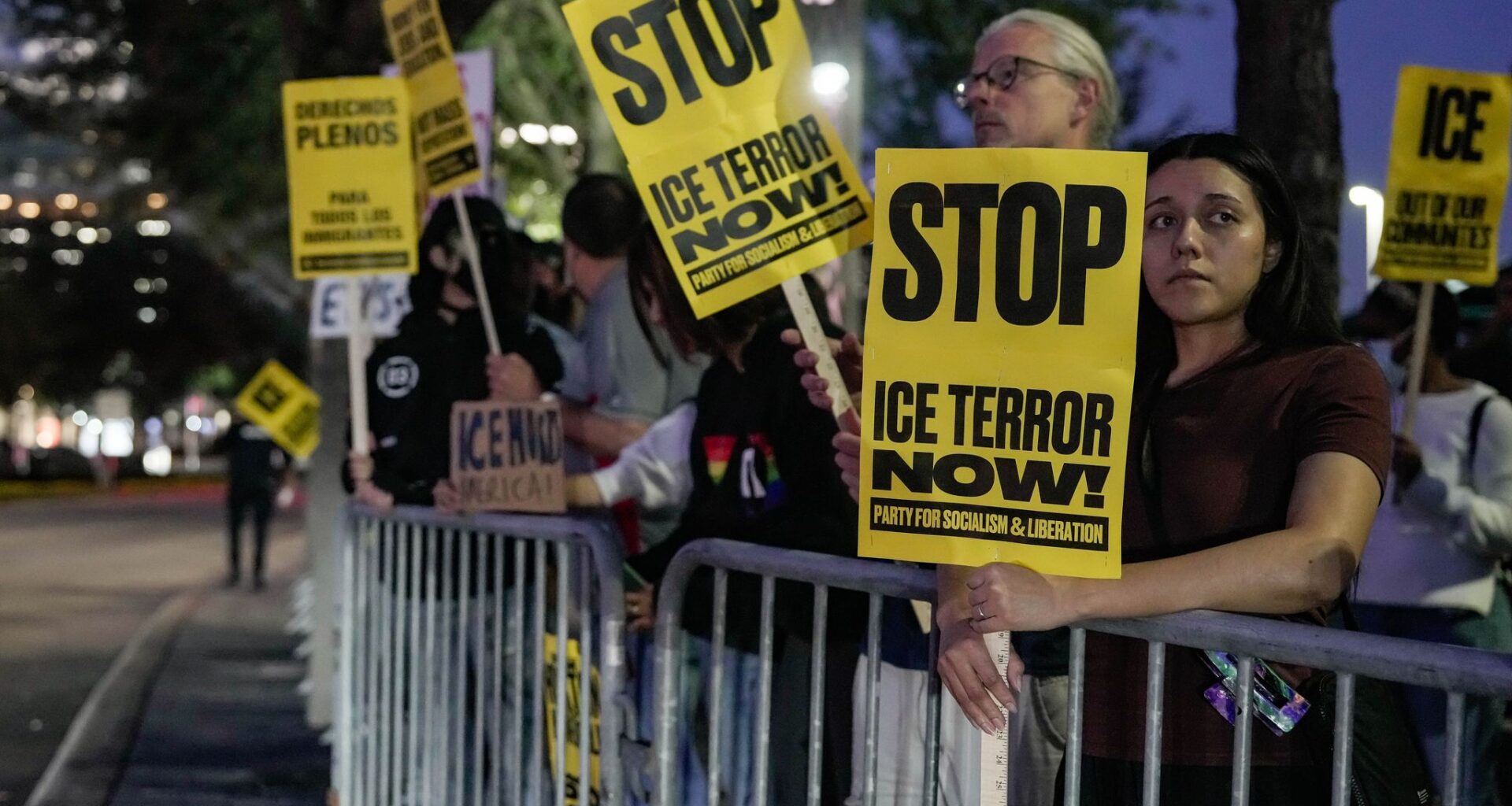
People gather to protest the killing of Renee Nicole Good in Minneapolis by an ICE agent, in Houston, Thursday, Jan. 8, 2026.
Raquel Natalicchio/Houston Chronicle

Roughly 70% of residents in the greater Houston area said they disapproved of how ICE is doing its job, according to the survey.
Article continues below this ad
Nearly two-thirds of residents said they don’t want their county sheriff to work with ICE, and roughly 59% were opposed to their local police department cooperating with the agency as well.
The study, which was conducted in April, comes on the heels of high-profile ICE campaigns in cities like Chicago and Minneapolis, where ICE agents fatally shot two U.S. citizens.
INSIDE SCOOP: ‘You’re going to burn this city down with this:’ The collapse of Houston’s ICE policy
Locally, heated debates at Houston City Council have placed a renewed focus on the role of local law enforcement in President Donald Trump’s mass deportation campaign. In just the last month, the city of Houston passed, and then revoked, an ordinance that would have limited how much the Houston Police Department can cooperate with immigration agents.
Article continues below this ad
“Houston is an immigrant community, there are lots of immigrants here … and they are the targets of these activities,” said Gail Buttorff, the associate director of the Hobby School for Public Affairs’ Center for Public Policy, which conducted the survey. “So, it makes sense there would be high disapproval in this area.”
Attitudes vary by race, location
The results of the Center for Public Policy’s survey come from 1,500 people across nine counties who make up the school’s SPACE City Panel, which researchers poll throughout the year for their opinions on the biggest issues facing the Houston area.
The spring poll focusing on Houstonians’ attitudes toward immigration enforcement found widespread disapproval of ICE tactics that spanned racial and geographic lines, though the extent of that opposition could sometimes vary significantly.
Article continues below this ad
More than three-quarters of Black and Hispanic residents denounced ICE operations, compared to 58% of white residents. Strong majorities in Houston, Harris County and Fort Bend County said they disapproved of ICE, while just over half of Montgomery County residents said the same thing.
Residents of the city of Houston expressed the greatest disapproval of local cooperation with ICE, with 70% of respondents saying they opposed having their police department work with the agency. Only 37% of Montgomery County residents said the same thing.
Attitudes about ICE also varied sharply by political affiliation. A third of Republicans said they disapproved of ICE operations, compared to over 90% of Democrats. Fewer Republicans opposed cooperation with their local sheriffs and police departments.
Article continues below this ad
Buttorff said that the public shift in opinion toward ICE could change how candidates in certain races approach the issue as the midterm election cycle heats up.
“If anyone running for office is unsure of whether or not this is a toxic political stance, it’s clear there’s pretty broad opposition to ICE,” Buttorff said.
How Houston compares
Despite the broad disapproval for ICE across the Houston area, a majority of residents did not believe that the agency’s tactics were negatively impacting their neighborhood’s safety.
Article continues below this ad
Those numbers rose, however, when residents were asked whether they believed ICE was making neighborhoods less safe across the rest of the country.
More than one in five respondents said they or someone close to them had encountered ICE in their community, suggesting that the raging debate around ICE tactics hits close to home for many in the Houston area, where roughly a quarter of the population was born outside the United States.
TIMELINE: How Houston police’s ICE policy fight unfolded, from Whitmire’s promises to Abbott’s threats
Still, the study noted that similar surveys in Chicago, which was the subject of a major ICE operation last fall, elicited far more negative responses regarding the impact of ICE on neighborhood safety.
Article continues below this ad
Researchers believe the absence of such an aggressive campaign in Houston has somewhat dampened fears in the Bayou City, despite the high levels of disapproval for ICE in the area.
“Although Houston has a lot of ICE activity, we didn’t have the federal government sending in the national guard or ICE officials for this very high-profile campaign like there were in Chicago and elsewhere, and I think that probably affects people’s perceptions of how active ICE is in this area,” Buttorff said.