
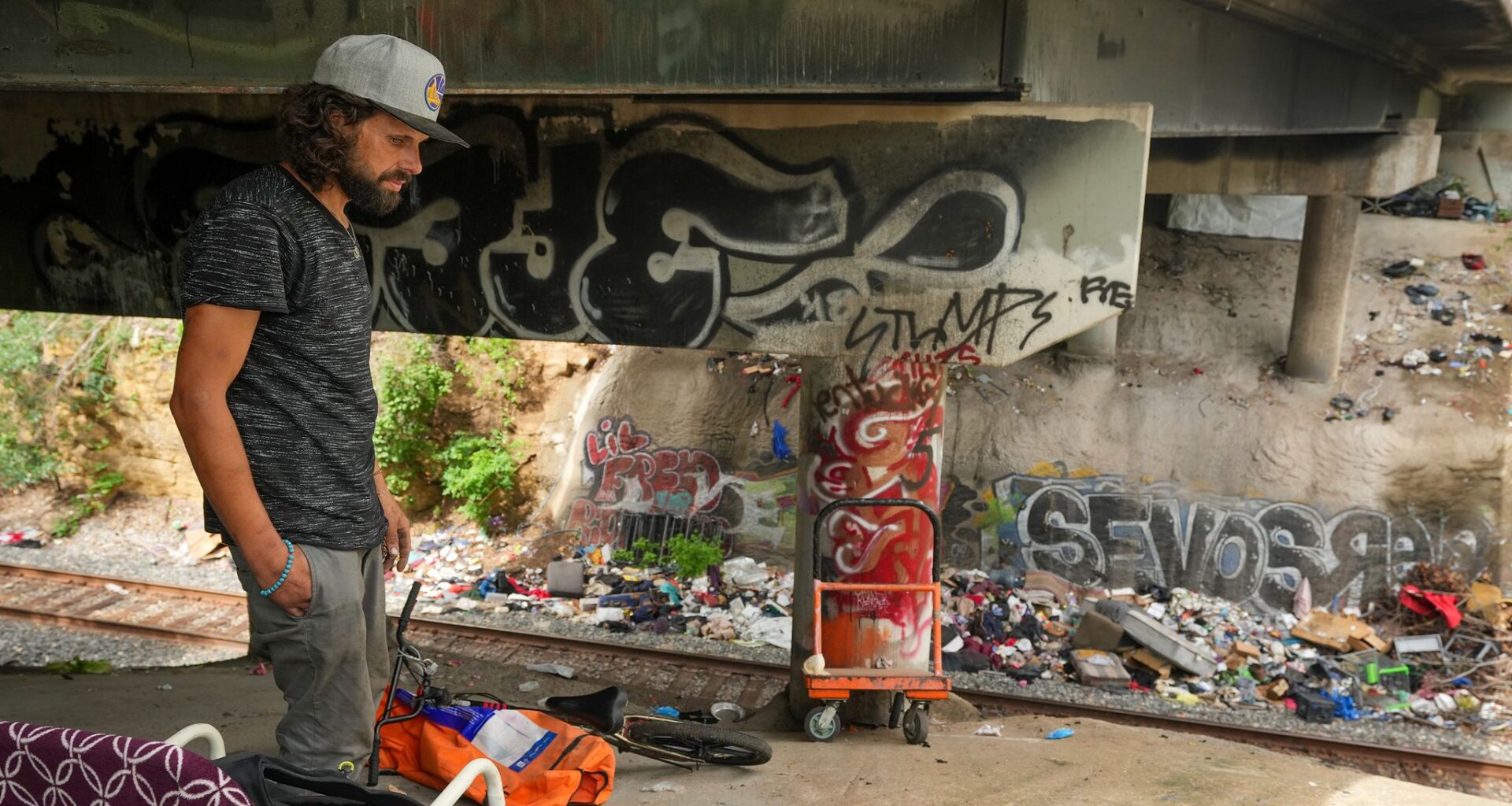
Rob Johnson, who is homeless, stands beneath the West St. Elmo Road bridge over railroad tracks last month. As Austin plans to ramp up homeless camp cleanups, the city must improve storage and coordination efforts to provide the help people need.
Jay Janner/Austin American-Statesman
During the targeted camp cleanups last fall, city crews logged 1,212 encounters with homeless people but connected just 181 to shelter — a stark reminder that sweeps upend far more lives than they stabilize. Hundreds scattered to other camps, losing vital paperwork, medications, clothing and cold weather gear in the process.

If the goal is to get people off the street, the solution is housing, not sweeps that set people further back.
Article continues below this ad
At the same time, the city faces competing imperatives: More than 700 requests coming in monthly from residents asking the city to clear encampments, in line with state law and an Austin voter-approved ban on homeless camping. Residents rightly expect public spaces to be clean and safe — even as displacement alone will never solve homelessness.
So it is not a question of whether Austin Homeless Strategies and Operations will continue or expand camp cleanups, as officials now plan to do. The question is how these efforts are carried out and whether they lead to help or cause further devastation for people already living in desperate situations.
Among other things, that requires more secure storage, deeper coordination with trusted advocacy groups, and seamless cooperation between the Homeless Strategies office and Austin police so officers are not conducting sweeps without outreach workers and support services present.
Article continues below this ad
Expand homeless storage
All too often, people experiencing homelessness lose essential items in camp cleanups: documents such as birth certificates and Social Security cards that are necessary for housing and employment; tools and musical instruments used to earn money; and sentimental items like family heirlooms and photos or ashes of loved ones.
“We have to start over,” Jennifer Miller, who has been unhoused for three years and lost documents and medications in two sweeps, told the Austin City Council on Tuesday. “It’s real hard on us.”
The city’s Violet KeepSafe Storage program provides free storage for hundreds of people to secure their belongings while they go to work or appointments. But the facility on East Seventh Street remains effectively out of reach for many unhoused people outside downtown, including some in encampments the city plans to target in upcoming sweeps. Expansion of this crucial storage service to other parts of the city is long overdue.
Article continues below this ad
Capacity is being added at the main facility, including 50 additional storage units that would be designated for people impacted by camp cleanups, Austin Community Court administrator Robert Kingham told us. But he said the city does not have any initiatives at this point to expand to other sites.
That must change. If the city is committed to helping more people out of homelessness, it must expand the Violet KeepSafe Storage program to the areas where it is needed.
Deeper coordination with service providers
The Homeless Strategies office conducts regular coordination calls with other outreach providers, but some of those organizations tell us they want a more integrated relationship with the city.
Article continues below this ad
Maggie Luna, executive director of Texas Harm Reduction Alliance, said she would be “100%” willing to leverage the trust her organization has with the unhoused community to help with the city’s outreach efforts.
“They don’t have the relationships like we do,” said Luna, whose organization is staffed entirely by people with lived experience. Their presence on the ground during campsite cleanups would help connect people with the services they need.
Homeless Strategies and Operations Deputy Director Christopher Anderson told us: “We welcome any people that want to help with the most important part, which is making that first touch with people in encampments.”
We urge them to, because that hasn’t always happened in practice. Texas Harm Reduction Alliance’s outreach team receives briefs on what the city plans to do, but their feedback and input are not taken into account to make decisions, Luna said.
Article continues below this ad
Megan Boyd, executive director of Heart of Texas Outreach, told us collaboration with the city is “the dream for everybody” in the homeless services sector, but the city has not reached out to her organization for help. She said many people she serves experience burnout from ineffective government assistance, and she hopes the new operations don’t add to their hesitancy to access services.
“Creating more distrust is going to be more challenging for us,” Boyd said.
Better cooperation between city agencies
The Homeless Strategies office routinely meets with people in other city departments — including police, Resource Recovery, watershed protection and public works — to coordinate camp cleanup efforts. Such collaboration is crucial to ensure advance notice and support services are provided to residents.
Article continues below this ad
Yet on some occasions, Austin police have not sufficiently coordinated with other departments before clearing out an encampment. That happened as recently as the March 31 cleanup along East Cesar Chavez Street in which people said they received no outreach beforehand.
The city cannot claim these operations are geared toward resolving homelessness if residents are sometimes displaced without warning or outreach. Anderson said the expanded cleanups will be better coordinated with other departments — but we have heard that before. So have too many residents who then lost important items in an unannounced sweep.
“Having all the city departments agree that this is the process, the HSO is leading the process, and that we’re dictating it in a repeatable fashion — that’s how I think we’ll really serve the community best, by avoiding off-script moments where things are being done in a non-coordinated fashion,” Anderson said.
People experiencing homelessness deserve to be treated with dignity and given the support they need to return to stability. And city leaders, facing a budget crunch in the wake of last year’s failed Proposition Q tax increase, must strike a balance between local and state laws, voter mandates, a growing backlog of service requests and the needs of the city’s most vulnerable.
Article continues below this ad
City officials point to substantial investments that added more than 400 shelter beds since 2023, and hundreds more to come with the expansions of the Esperanza Community. A six-fold increase since 2024 in permanent housing units for those exiting homelessness will help meet some of the demand — but not nearly enough of it.
City leaders cannot measure success simply by the number of camps cleared or complaints resolved. Success must also be measured by whether people are connected to shelter, housing and stability — without losing the documents, medications and personal belongings they need to survive.
Austinites deserve confidence that their city can address homelessness with competence, coordination and basic humanity.
Article continues below this ad