


EL PASO, Tx., May 8, 2026: Voters in El Paso will be going to the polls on May 26 to vote on several runoff elections. Among the runoffs includes the controversial race for Justice of the Peace Precinct 5 between the incumbent Lucilla “Lucy” Najera and her opponent Dora Oaxaca. The latest controversy to arise in this contentious race is the incumbent’s use of artificial intelligence (AI) for her latest mailer going into the runoff.
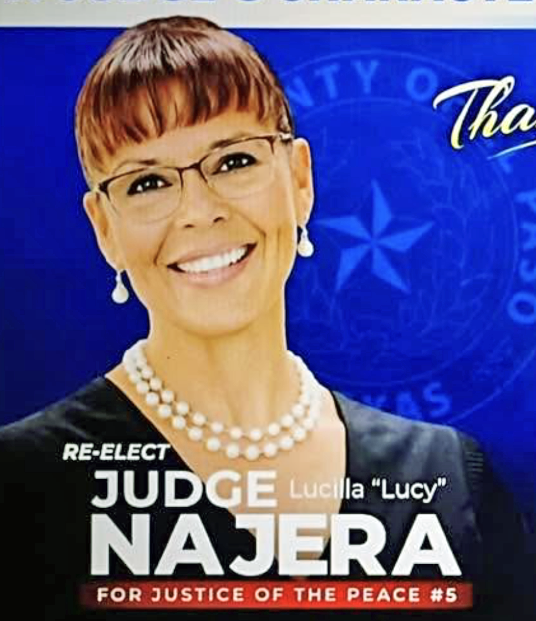 Picture snippet from Lucilla “Lucy” Najera campaign mailer, May 2026, Martín Paredes/El Paso Herald Post.
In her latest campaign mailer, Najera used an AI generated picture of herself on the mailer raising ethical questions over the use of AI in political campaigns.

At first glance, the image of Najera may seem like it was doctored with computer graphics programs to enhance her picture. But a careful review of the image shows that it was generated by AI. Looking closely at the image, there are several “hallucinations” in the image that betray its source as AI. In images created by AI there are elements that leave inaccurate, distorted or fabricated content that real images, even those processed through computer image software, do not have. These errors in the images are known as “hallucinations.”
In the case of the Najera AI picture there are several “hallucinations.”
Why The Najera Picture Is Likely AI Generated
There are several indicators in the picture that show it was likely AI created. Among them are the symmetry of her pearl earrings. In addition to the earrings hanging at odd angles, the way they are attached to her earlobe is not possible in a real picture. Additionally, her eyeglasses appear to merge into her ear on the left side instead of resting above the ear, as they should.
The biggest giveaway to the picture that shows that it is likely AI generated is the pearl necklace. Looking at the individual pearls shows that many of them lose definition and appear to merge as a blob of pearls. The county’s logo in the background also suffers from a common AI problem, AI’s inability to replicate branded backdrops correctly leading to nonsensical content in the images. The logo’s blurring is not a design feature but rather AI’s inability to correctly interpret the fine lines used in the original county logo.
Because of the concerns over the potential abuse of AI, most AI tools imbed hidden information that show the content was generated through AI, and what AI tool was used. Access to the original image used in the mailer would be needed to find what AI tool was used to create it. Nonetheless, the likely use of AI to create the mailer to the voters raises ethical questions about AI in political campaigns.
Ethics In AI Use in Political Campaigns
The rise in the use of AI in political campaigns led the Texas House to approve legislation last year requiring political campaigns to be transparent about their use of AI in their campaigns. The legislation was intended to control abuse by campaigns misusing AI-generated content to misinform voters about opponents. However, the Senate did not take up the legislation, leaving it in limbo.
The Najera Campaign did not disclose the likely use of AI in its recent mailer.
The primary concern over the use of AI in political campaigns is its potential to mislead voters through fake content leading voters to believe a lie about a candidate.
Privacy is another concern. Because AI requires the use of large, often intrusive voter information, its use in political campaigns exposes voters to unwanted surveillance and further invasion of their privacy. AI also allows campaigns to manipulate and micro-target voters through tailored political messaging that relies on the anxieties and fears of the voters the AI targets.
In communities of color, the use of AI in political campaigns carry with them the inherent bias of language models used to create AI content. AI models have been shown to contain racist and sexist biases along with ideological biases that discriminates or unfairly represents minorities further depressing minority voters.
Research has also shown that AI can influence a voter’s decision when it comes to voting by the way the voter perceives the information provided through AI as the definitive answer to an issue.
Other concerns about the use of AI in political campaigns center around transparency and disclosure. The question is, should voters be informed when AI created the materials they use to make ballot decisions? Do the voters in the Najera versus Oaxaca election want to know that Najera likely used an AI picture in her mailer to them? Would they care?
Another concern for the use of AI in political campaigns is the human factor. AI displaces human workers and diminishes their wages, but it also replaces human accountability in the campaign’s materials. Responsibility over authenticity and avoiding harm shifts towards AI leaving the human decision out of the production.
It is not known if the Najera campaign was looking to quickly create a mailer at the last minute or was looking to avoid paying fees to photographers and graphics designers for her campaign, but this is not the first time the Najera campaign has made mistakes in her campaign this election cycle.
In February, Najera mailed a campaign mailer to voters incorrectly using the wrong logo for an endorsement she did not receive from the Paso del Norte Tejano Democrats. The Tejano Democrats sent her a cease-and-desist letter to stop misrepresenting their endorsement. Najera apologized for what she described as “an unintentional error in production.” This was in addition to sending another campaign material with runoff misspelled as “runoof.”
The use of AI is not limited to campaign logos, graphics and candidate pictures. Campaigns have started to embrace the use of AI to create copy, write campaign speeches and write talking points designed to target voters for their votes. Not only is job displacement a concern in political campaigns but labor concerns have been brought up across the nation.
The Academy of Motion Picture Arts and Science, who awards the Oscars, recently banned the use of AI in its coveted Oscars award because using AI displaces creative workers that help produce the films. It is estimated that by 2030, up to 30% of the jobs performed by humans today will be replaced by AI and automation.
In addition to the Oaxaca-Najera race there are several other runoff elections on the ballot. In Precinct 1, Denise Butterworth is running against Octavio Dominguez. In Precinct 2, incumbent Brian J. Haggerty is hoping to hold on to his seat from Christie Saiz’s challenge. For Precinct 6, Place 1, Ruben Lujan is facing off against Dora H. Aguirre and incumbent Enedina “Nina” Serna faces challenger Rosalie Dominguez for her Precinct 6, Place 2 seat.
Also on the ballot is the Republican runoff between Adam Bauman and convicted felon Manuel Barraza for the District 16 congressional seat currently held by Democrat Veronica Escobar.
Election Day is May 26. Early voting gets underway on May 18 and runs through May 22.
Like Us and Follow Us On Our Social Media!
Visited 28 times, 28 visit(s) today