
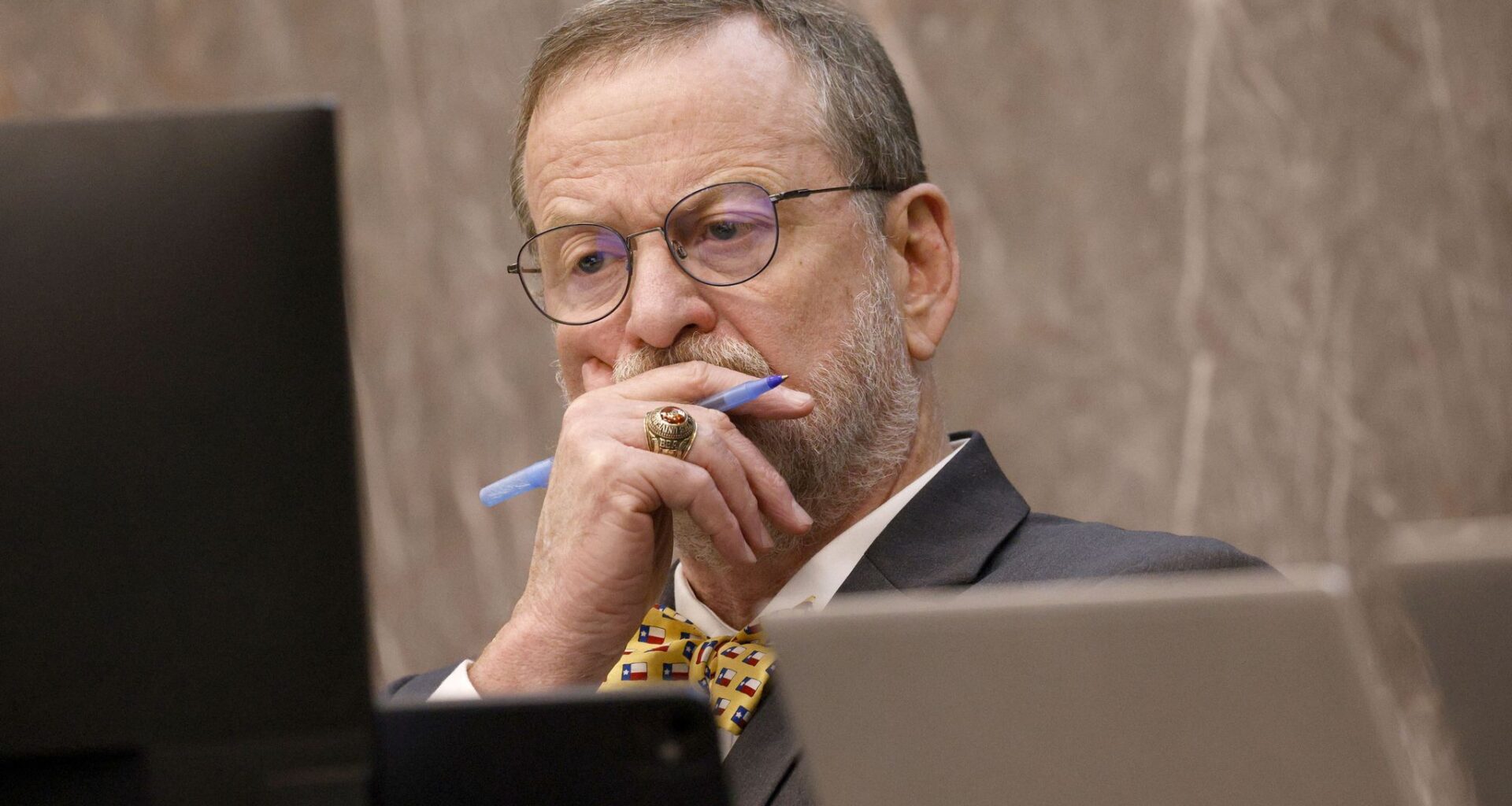
Judge Bill Whitehill is seen during a hearing concerning the Dallas Mavericks and the Dallas Stars lawsuit over control of American Airlines Center in the Texas Business Court at Karcher Hall on the SMU campus, Friday, March 6, 2026, in University Park.
Chitose Suzuki/Staff Photographer
Barring an appeal, the Mavericks-Stars legal skirmish over control of American Airlines Center won’t play out in a high-profile trial, after all.

That’s because the Mavericks defeated the Stars in every significant Texas Business Court pretrial ruling, including three this week, and thus the six-month-old case won’t proceed to the jury trial that was scheduled to start Tuesday.
Article continues below this ad
According to an update posted Friday in the Texas Business Court’s Mavs-Stars case portal, the trial has been cancelled.
The only unresolved issue for presiding Judge Bill Whitehill is the apportioning of attorney fees — $3.6 million per team, according to a court document filed Thursday. A person familiar with the case told The Dallas Morning News that Whitehill has indicated he’ll likely rule that each team pays its own fees.
Whitehill likely won’t issue his final judgment on the dueling suits until next week, but the overall verdict is a formality because he has ruled in the Mavericks’ favor in all the major legal questions raised in the NBA team’s 253-petition, and the Stars’ countersuit, filed last Oct. 28.
Make Dallas News a preferred source so your search results prioritize writing by actual people, not AI.
Add Preferred Source
Whitehill has ruled the Mavericks had a legal right to declare the Stars in breach of both teams’ 1998 franchise agreements that required them to maintain their principal headquarters in Dallas.
Article continues below this ad
Although the breach occurred in 2003, when the Stars moved their headquarters to Frisco, Whitehill ruled the Mavericks also were within their right to enact a $110 redemption claim for the Stars’ 50% interest in Center Operating Company, which controls AAC.
Will the Mavericks’ likely Texas Business Court victory mean the saga between Dallas’ NBA and NHL teams is over? No. Far from it. Six months after the dueling lawsuits were filed, and well into the thousands of pages of documents filed, the result is an imminent legal win for the Mavericks, but important issues left to address.
A person familiar with the case told The News the Stars have strongly indicated they plan to appeal once Whitehill renders his final judgment. The Stars’ legal team, led by Joshua Sandler of Winstead PC; its appellate team includes former Texas Supreme Court chief justice Wallace B. Jefferson.
In fact, one of Whitehead’s rulings earlier this week, according to court documents, was to deny the Stars’ request for an interlocutory appeal – which is an appeal of a court ruling before a case’s final judgment is issued.
Article continues below this ad
From all indications, neither the Mavericks nor the Stars want a drawn-out appeals process. The Mavericks signaled that April 8, when they dropped their damages claim for tortious interference with contract.
“The Dallas Mavericks organization is taking this step as an important and proactive demonstration of good faith,” the franchise said that day in a statement to The News.
The most effective means to avoid a Stars appeal is for the teams and their counsel to mediate compromises before, or soon after, Whitehill issues his final ruling.
His two other rulings this week were on motions the Stars’ attorneys, led by Joshua Sandler, had hoped would pave the way for the jury trial to commence.
Article continues below this ad
The Stars argued that in the Mavericks’ original 253-page petition and other early filings, the hockey franchise’s parent company should have been named in the suit, not DSE Hockey Club. But Whitehill ruled that the Mavericks adequately clarified the correct defendant in subsequent filings.
The Stars also asked Whitehill to reconsider his April ruling that the Mavericks did not exceed the statute of limitations when they cited the Stars’ breach more than two decades after it occurred, but Whitehill reiterated that ruling.
What’s next?
Although Whitehill’s rulings appear to give the Mavericks an edge in mediation bargaining power, there are significant issues that seemingly have room for compromise. Among them:
Article continues below this ad
— Now that the Mavericks, barring a successful Stars appeal, seemingly have operational control of COC and thus American Airlines Center, what will become of both teams’ monthly AAC disbursements that have been held in escrow for about a year?
As of October of last year, Stars CEO Brad Alberts told The News his team’s escrowed disbursements were in the tens of millions of dollars.
— Then there is the immediate and long-term future of AAC. Both teams’ leases to play games there expire in July 2031, but the Mavericks are exploring options to build a new basketball-specific arena in Dallas, while the Stars have been negotiating with Plano for a potential arena at the Willow Bend Mall site.
Might the Mavericks-Stars mediation compel the teams to renegotiate what both say was the root cause of their October 2024 falling out?
Article continues below this ad
Documents show the Mavericks and City of Dallas believed they and the Stars had agreed to a $300 million refurbishing of AAC, at no cost to the Stars.

By signing up, you agree to our Terms Of Use and acknowledge that your information will be used as described in our Privacy Policy.
The Mavericks and Dallas officials also believed the Stars had agreed to remain in AAC through 2061.
In an October 2025 interview with The News, Alberts strongly denied a deal had been reached. He said the deal the Stars thought was on the table was for the Stars and Mavericks to remain in AAC through 2036.
Article continues below this ad
Now that the Mavericks are on the precipice of a victory in Texas Business Court, perhaps they and the Stars can hammer out a win-win for both franchises, and for NBA and NHL fans in North Texas.