
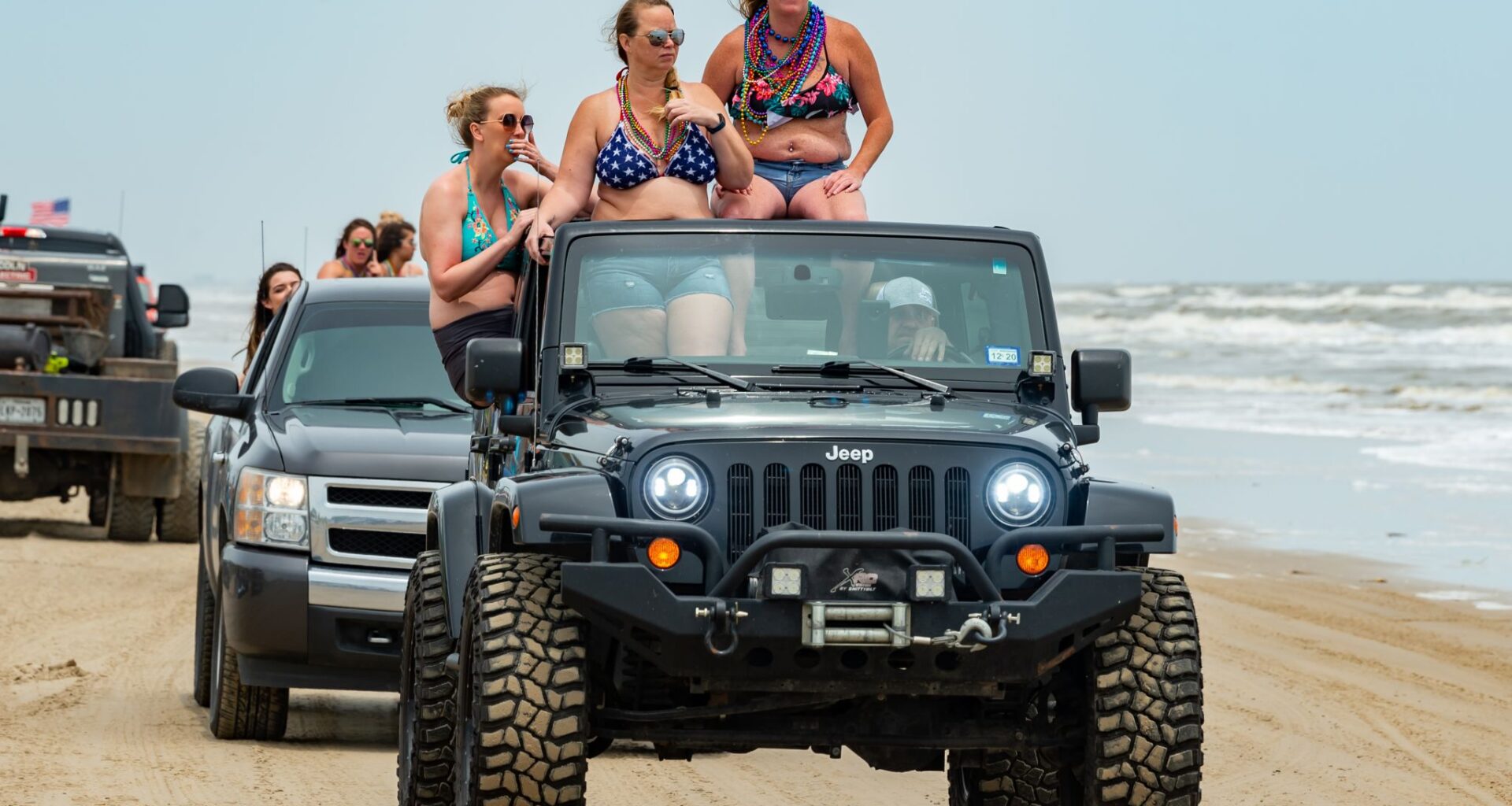
Few consecutive words send a shudder down the spine of Galveston County residents more than ‘Jeep Weekend.’ Some roll their eyes, some stock up the fridge, and sheriff’s deputies’ eyes brighten at all the overtime they’re about to see.

Traditionally held on Bolivar Peninsula the weekend before Memorial Day weekend, Jeep Weekend is (at least nominally) a gathering of four-wheel-drive vehicle owners that, in years past, has overwhelmed the retiree-heavy unincorporated community of Crystal Beach with estimated crowds up to 100,000 people, plus all the chaos such hordes tend to bring.
The event’s many critics call it little more than a license for drunken, lewd, and sometimes downright criminal behavior. There is ample evidence (and arrest reports) to support this idea. Not surprisingly, Jeep Weekend has also evolved into a favorite annual bugaboo for Houston media, trigger words signaling Uh-oh, trouble’s brewing. So are ratings; better send a camera crew.
Article continues below this ad
But how much that still holds is an open question.
‘Zero tolerance’ for Jeep Weekend
For the second year in a row, the Galveston County Sheriff’s Office reportedly plans to enforce its ‘zero tolerance’ policy by stationing more than 500 officers along the Bolivar beaches, partnering with law enforcement agencies from across the region. A DWI task force will also be patrolling for early birds this weekend in preparation for the main event.
Jeep Weekend started as a small weekend event for Jeep lovers in Crystal Beach but has grown to a large gathering of hundreds of vehicles including Jeeps, UTV’s, 4-wheelers and more on the beach. Photo made on May 16, 2020. Fran Ruchalski/The Enterprise
Fran Ruchalski/The Enterprise
Despite complaints the department had grossly overreached, the sheriff’s crackdown last year—which, among other things, banned ATVs, golf carts, dirt bikes, parking, and bonfires on the beach during the event—had the desired chilling effect. According to one report from Beaumont’s KFDM-TV, law enforcement personnel outnumbered partygoers for at least part of the weekend. The Galveston County Daily News noted the event seemed “tamer by far” than past years.
Article continues below this ad
History of Jeep Weekend
According to a Daily News article from 2019, when the event was at its height, what came to be known as Jeep Weekend began as far back as 2008. The automaker helped promote a modest gathering on the beach, urging Jeep owners to “Go Topless” to celebrate the symbolic transition from winter to summer; i.e., the moment Jeep owners remove the roofs, and sometimes the doors, from their vehicles. (Jeep, the brand, wants little to do with Jeep Weekend these days.)
After Hurricane Ike wrecked the peninsula a few months later, the crowds crept back. A trickle in the first few years became a flood by the late 2010s. Jeep Weekend’s unsavory reputation was fully in place by the time COVID-19 arrived, but the pandemic barely slowed the event’s momentum. Attendance quickly equaled and then surpassed pre-COVID levels.
Article continues below this ad
The Stratton family from Cypress enjoys the day barbecuing and playing games after weeks of isolation due to the COVID-19 outbreak on Sunday, May 17, 2020, in Bolivar Peninsula. When the family arrived to the beach they realized it was Go Topless Jeep Weekend.
Marie D. De Jesús, Houston Chronicle / Staff photographer
So did the chaos. An impaired driver struck a sheriff’s deputy in 2022, critically injuring him; a woman was allegedly kidnapped and sexually assaulted the next year. In 2024, officers made nearly 300 arrests on 430 criminal charges, a 30 percent increase over the previous year. Two shootings were reported, one fatal.
Recent changes
Everyone, chief among them Galveston County’s voters, knew something had to change. Within hours of taking office in January 2025, new sheriff Jimmy Fullen had secured permission from the Texas General Land Office to close the Bolivar beaches and implement his zero-tolerance rules. The plan worked: despite a significant drop in attendance, police made slightly fewer arrests than 2024 and confiscated almost 50 firearms.
Article continues below this ad
But the overall vibe was noticeably subdued. Analyzing arrest reports a week or so after the event, the Houston Chronicle found that drug possession accounted for more than a third. Vehicle-related infractions, such as invalid licenses or expired insurance, far outpaced disorderly conduct or public intoxication. But it was all worth it, Fullen said, because no one died.