
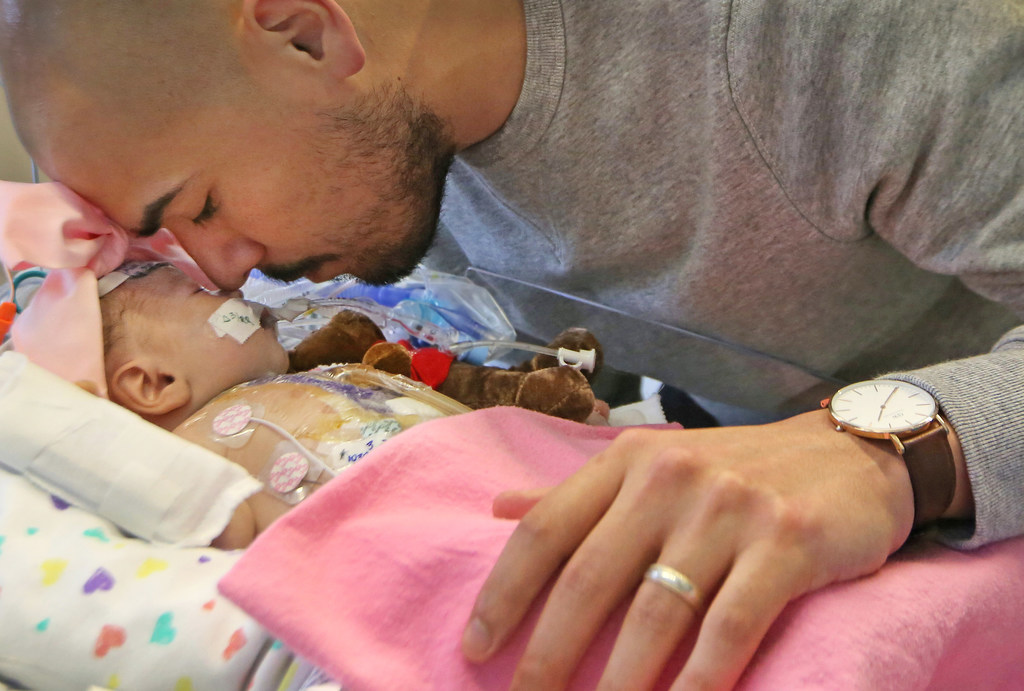
It’s almost impossible to put into words what it does to you to watch your newborn fight for her life while she waits for a heart transplant. Every breath feels borrowed. Every monitor beep carries the question you are trying not to ask.
Eight years later, she is a healthy, thriving second grader with dreams of becoming a doctor herself. The years have gone by in a flash, but one memory and lesson from the ICU never lost its grip.
First, the memory. Early in Olivia’s journey, I learned I could not will her heart to hold on. I could only hold her in my arms and pray that love could somehow stand in for what medicine had not yet delivered.
I also learned that I was not alone in that helplessness. Down those halls were dozens of parents and children from across Texas and neighboring states, all caught in the same brutal arithmetic of hope and time.
But presence was not distributed evenly. While I could stay morning, day and night with Olivia, most parents had to leave to keep a paycheck and the insurance that made their hospital stay possible. Some had other children to raise. Others lived far from Dallas. All were trying to balance crisis and survival. No parent should have to choose between staying with their child and keeping the job that pays for their child’s care. And yet too many do.
Into that gap step volunteers in blue vests, ordinary people doing an extraordinary thing: showing up so a child is not alone, and a family can breathe for a moment. One afternoon, wandering the halls, I glanced into a room and recognized a colleague from my time as a teacher and trustee in Dallas ISD, Michael Gagne. I had known Gagne for years, yet I had no idea he volunteered at Children’s until I saw him there, doing a basic, powerful thing: holding a baby so she wasn’t alone. It had never occurred to me that this kind of presence was a way a person could serve others.
When I asked Gagne why it matters, he said something that has stayed with me: “My hope is that precious baby finds some reprieve from being a patient in a room and instead feels comfort and care in their most basic human element.”
A child who is seen and held gets to be a baby again, not a diagnosis. And a family stretched to its breaking point is given a small but sacred gift: the reassurance that while they are gone, their child is still being held. The act still brings tears to my eyes.
Now, the lesson. This is Dallas at its best. Not the Dallas of slogans or skyline photos, but the Dallas that shows up quietly, in the places where fear lives, and does not look away.
We tend to measure cities by what can be counted. We tally skyscrapers, awards, corporate relocations. But a city’s true character is revealed in what it does when no one is watching, and in who shows up when nothing can be fixed. Sometimes greatness is measured in service and presence, in whether ordinary people will sit with a stranger in the hardest moment of their life, not because they have to or will be recognized, but because they know it is the right thing to do.
There is an old idea, simple and demanding: Love is not only a feeling. It is a verb, discipline and practice — a choice made repeatedly. That is what makes a city world-class in the truest sense. Not the kind that can be bought or announced at a podium, but the kind earned quietly through repeated acts of love, when ordinary people decide that someone else’s suffering is not someone else’s problem.
We talk a lot about what is broken: loneliness, distrust, a public life that feels sharper and more exhausting than it used to. In North Texas, political and policy battles too often pit communities against each other with contempt. Sometimes it can feel as if polarization is permanent.
I’m not convinced. The ICU is one of the places where the purported rules of our public life do not apply. You do not have to share someone’s politics to sit with their child. No parent asks your stance on City Hall before accepting help. What matters is not your politics, but your presence.
The path to a healthier civic life starts by rebuilding the habits that make community possible: showing up, listening, serving and remembering that dignity is not theoretical when you are holding someone’s baby. Those volunteers in blue vests practice that kind of love.
While the doctors fixed Olivia’s heart, the volunteers fixed mine.