
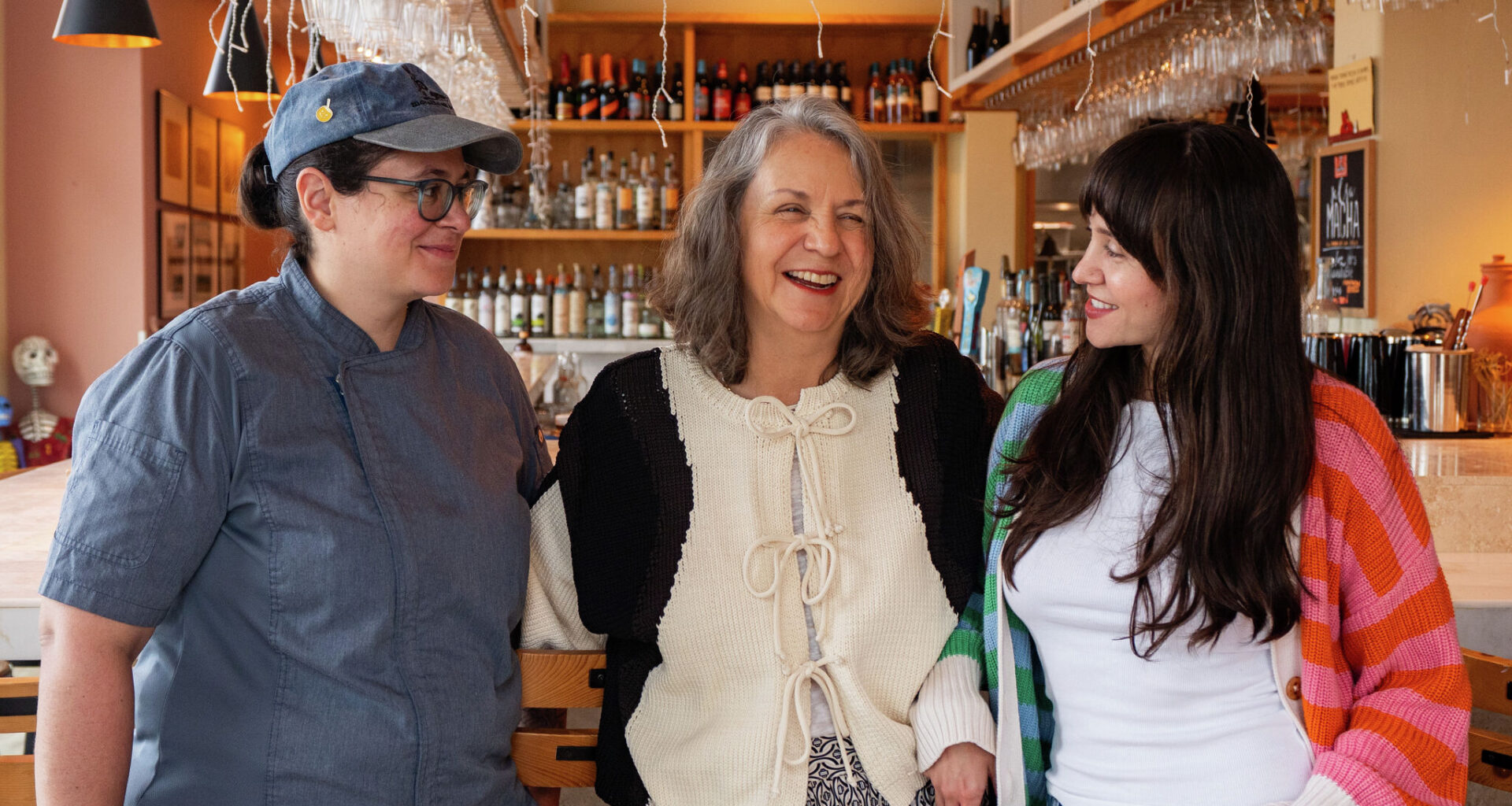
From left, Ana Torrealba, Iliana de la Vega and Isabel Torrealba at El Naranjo in Austin, Friday, May 1, 2026.
Mikala Compton/Austin American-Statesman
Memory, in this family, begins with sensation: the coolness of tile under bare feet, the echo of voices in a courtyard, the faint, citrus scent of a tree that never quite gave fruit.

Long before there was El Naranjo in Austin, before awards or menus or the language to describe what the family was building, there was a house in Oaxaca — 200 years old, arranged around an open-air courtyard with a fountain at its center. It was a sanctuary, a place where their cooking identity took shape.
Article continues below this ad
It was never just a restaurant. It was where they cooked, where a matriarch’s lessons lingered in the air, where afternoons stretched into evenings without anyone quite noticing the shift, where knowledge and tradition lived.
In Austin, that knowledge now takes shape on South Lamar Boulevard, where El Naranjo operates with respect for continuity. The dining room fills each night with plates that carry the weight of memory, adjusted just enough to exist here.
A legacy carried from Oaxaca to Austin through women, memory and food
Iliana de la Vega of El Naranjo was the first recipient of the James Beard Award for Best Chef: Texas.
AMERICAN-STATESMAN FILE, AMERICAN-STATESMAN FILE
When Iliana de la Vega won the James Beard Award for Best Chef: Texas in 2022, it underscored a broader shift in how Mexican cuisine is understood in Austin: as a collection of regional traditions shaped over generations.
Article continues below this ad
The dining room of El Naranjo in Austin, Friday, May 1, 2026.
Mikala Compton/Austin American-Statesman
From left, Ana Torrealba, Iliana de la Vega and Isabel Torrealba at El Naranjo in Austin, Friday, May 1, 2026.
Mikala Compton/Austin American-Statesman
From left, Ana Torrealba, Iliana de la Vega and Isabel Torrealba at El Naranjo in Austin, Friday, May 1, 2026.
Mikala Compton/Austin American-Statesman
Tables are set for dinner at El Naranjo in Austin, Friday, May 1, 2026.
Mikala Compton/Austin American-Statesman
Photography of Oaxaca from photographer Marcela Taboada is seen decorating the walls in El Naranjo in Austin, Friday, May 1, 2026.
Mikala Compton/Austin American-Statesman
Tables are set for dinner at El Naranjo in Austin, Friday, May 1, 2026.
Mikala Compton/Austin American-Statesman
“Historically and traditionally, women created Mexican cuisine,” she says. “The techniques, tools and knowledge were passed down generationally from one woman to the next.”
Her own education began at home, learning alongside her mother, Ana María, absorbing the rhythms of markets and kitchens, the kind of knowledge that is rarely written down. “Nurturing is loving,” she says. “That is what it means, cooking to me.”
Article continues below this ad
Her daughters absorbed it as atmosphere. For Isabel Torrealba, the restaurant in Oaxaca was an extension of home. “My sister and I basically lived at the restaurant,” she said. “We only really went home at night after they closed.” There was a room set aside for them, furnished with a bed, couch and a television, an improvised childhood unfolding between service hours.
Ana Torrealba remembers shaping dough, working with bread at 12, drawn first to pastry, then to food science, a path that ultimately led her into the kitchen at El Naranjo, where she now works alongside her mother as chef de cuisine.
Chiles en nogada are prepared at El Naranjo in Austin, Texas. The seasonal Mexican dish, featuring poblano peppers stuffed with meat and fruit and topped with walnut cream sauce and pomegranate seeds, reflects the restaurant’s focus on regional traditions passed down through generations of women.
Provided by Iliana de la Vega
What they inherited was not only technique, but a way of understanding food as an expression of care, a structure that holds even when other things fall away.
Article continues below this ad
That structure was tested in 2006. Just before Isabel’s 16th birthday, a teachers’ strike in Oaxaca escalated into something larger. The city, as she recalls it, was overtaken — barricades, burned buses, a slow unraveling of the tourism economy that had sustained families like theirs.
By September, there was no restaurant left to hold onto.
“We had six days,” Isabel says. Six days to leave, to compress a life into a suitcase, from a dining room that had held Christmas after Christmas. There are things you cannot pack: the corridors of a restaurant, the smell of chiles toasting, the sound of a market in the morning. These remain, if at all, in the body.
Article continues below this ad
A meal that became memory, and memory that became a way of staying together
A figurine of Saint Paschal Baylon, the patron saint of cooks, is seen on a shelf at El Naranjo in Austin, Friday, May 1, 2026.
Mikala Compton/Austin American-Statesman
In Santa Fe, the adjustment was abrupt and disorienting. The family arrived with little notice, pulled out and placed into a life that was still undefined. A new school, unfamiliar rhythms, a language they spoke but did not yet fully inhabit. The move was marked as much by what they left behind as by where they landed.
That first night, de la Vega cooked for her daughters.
Article continues below this ad
A simple meal: albóndigas. Meatballs simmered in a tomato-based broth, served with rice, beans and tortillas. The ingredients were not identical to what they had used in Oaxaca, but the structure of the meal remained intact.
As they rebuilt the routines of daily life, food became a kind of anchor.
For Isabel, its meaning is clearer in hindsight. “Food was very, and still is very much a part of our lives and how we show love to each other,” she said. “If somebody’s sick, we make each other food — it’s a big part in all different areas of our lives.”
Ingredients are laid out on a table during a cooking day in Oaxaca, Mexico, as part of a Culinary Traditions tour led by chef Iliana de la Vega and her daughter Isabel Torrealba. The hands-on experience is part of the family’s effort to share regional Mexican cooking techniques and culinary heritage with visitors.
Provided by Iliana de la Vega
In Austin, that instinct now plays out across both the restaurant and the family’s broader work.
Article continues below this ad
El Naranjo opened first as a trailer, then as a restaurant. The food remained rooted in what de la Vega had learned at home: moles that carry depth and time, dishes that resist simplification.
“That kind of food was reserved for houses,” she says. “And I tried to put it in my restaurant.” It is an act of reclamation, one that reframes domestic labor — traditionally women’s work — as expertise, as art.
Her daughters entered that space differently.
Chef Ana Torrealba prepares an octopus for a dish at El Naranjo in Austin, Friday, May 1, 2026.
Mikala Compton/Austin American-Statesman
Ana, now chef de cuisine, works within the structure her mother created, expanding it carefully. “If you’re gonna do a dish, you need to stay true to the dish,” she said. “Honor the dish.” She develops menus that move across regions of Mexico, researching, testing, adjusting — an evolution that does not break from tradition but extends it.
Article continues below this ad
Isabel, moving between Austin and Mexico City, built something adjacent: Culinary Traditions, a travel company that brings people into the spaces where these traditions live. Markets, home kitchens, street stalls, conversations that situate food within its cultural context.
“We use food as the conductive line,” de la Vega says of the tours. “To the learning experience.”
If the restaurant translates tradition for Austin diners, the tours bring people back to the source, situating dishes within their context. Still, the throughline remains the same. Together, they have created a system that mirrors the one they grew up in — knowledge passed down, then outward.
The dish that returns most often in their conversations is albóndigas.
Article continues below this ad
Chef Ana Torrealba prepares an octopus for a dish at El Naranjo in Austin, Friday, May 1, 2026.
Mikala Compton/Austin American-Statesman
For de la Vega, it is instinctual. “It feels very deep into me,” she says. For Isabel, it represents a moment when everything else had been stripped away and something essential remained. For Ana, it is desire in its simplest form. “Whenever she asks what I want,” she said, “I say albóndigas.”
Three versions of the same inheritance.
How care is practiced daily in the kitchen and beyond
Art from Oaxaca is seen on display in El Naranjo in Austin, Friday, May 1, 2026.
Mikala Compton/Austin American-Statesman
Mother’s Day, in this family, is not specially marked. “I think a mother’s day is every day,” de la Vega says. The work, she suggests, is continuous. The care, ongoing. The rituals they value are already embedded in daily life: the meals, the work, the conversations that unfold over both.
Article continues below this ad
Her daughters echo that sentiment as practice.
Iliana de la Vega and Isabel Torrealba speak to Ana Torrealba from the bar as they peer into the kitchen at El Naranjo in Austin, Friday, May 1, 2026.
Mikala Compton/Austin American-Statesman
In Austin, that practice is visible nightly on South Lamar, where plates move from kitchen to table carrying with them a lineage that stretches beyond the city. That lineage does not reside in a single place, or even a single dish.
Article continues below this ad
It exists in the act of cooking, of feeding, of showing up for one another — again and again — wherever the table happens to be set.