
Former University of Texas student Ammer Qaddumi, right, arrives at the federal courthouse in Austin on Monday, May 11, 2026. A federal judge this week is hearing Qaddumi’s claim that the University of Texas violated his free speech rights by arresting and suspending him after a 2024 pro-Palestinian campus protest.
Jay Janner/Austin American-Statesman
Former UT student Ammer Qaddumi and his university have two different versions of what happened on April 24, 2024.

To Qaddumi, April 24, 2024 is the day university police arrested him, resulting in a three-semester suspension for his advocacy against UT’s ties to Israel and companies supporting the war in Gaza. That day, a UT student group Qaddumi helped lead, the Palestine Solidarity Committee, planned a march and protest on the campus’ South Lawn.
Article continues below this ad
The resulting fracas saw more than 50 people arrested — and according to testimony in federal court on Monday — threats and physical violence directed at university staff.
For UT leadership, including former President Jay Hartzell, April 24, 2024 is the day a group of protesters sought to take over campus. Their planned demonstration mirrored the disruptive encampments that flourished at universities nationwide, derailing academics in the spring of 2024, university lawyers argued in court records.
This week, U.S. District Judge Robert Pitman will have to sort out whether that day was a protected protest that UT overreacted to by sending in law enforcement, or a planned campus disruption that UT lawfully managed.
Qaddumi sued the university more than a year ago to erase the suspension from his student record and prove UT engaged in viewpoint discrimination against pro-Palestinian speech. The former UT student served his suspension from August 2024 to August 2025 and is set to graduate in May, according to court documents.
Article continues below this ad
On Monday morning, the federal court began hearing arguments and testimony in the lawsuit. And for the first time at trial, the public heard UT defend its decision to preemptively cancel the protest and discipline the student.
Ammer Qaddumi, one of the protesters arrested on Wednesday, April 24,2024, participates in a chant outside the Main Building on campus. Professors, students, and supporters of UT-Austin demonstrated on campus on Thursday, April 25, 2024
Ricardo B. Brazziell/American-Statesman
UT says protest resembled national encampments
Darren Gibson, an attorney representing UT, argued Hartzell and UT chose to cancel the demonstration based on “reasonable” inference and connections. The student group was using the same rhetoric, imagery and at times identical social media posts of national groups that were setting up camps on college campuses across the country.
Article continues below this ad
The Palestine Solidarity Committee said it was going to set up a “Popular University for Gaza,” — a term used by some groups organizing encampments across the nation.
In his opening statements and later arguments, Gibson attempted to link Qaddumi to the melee that occurred after the student leader’s arrest.
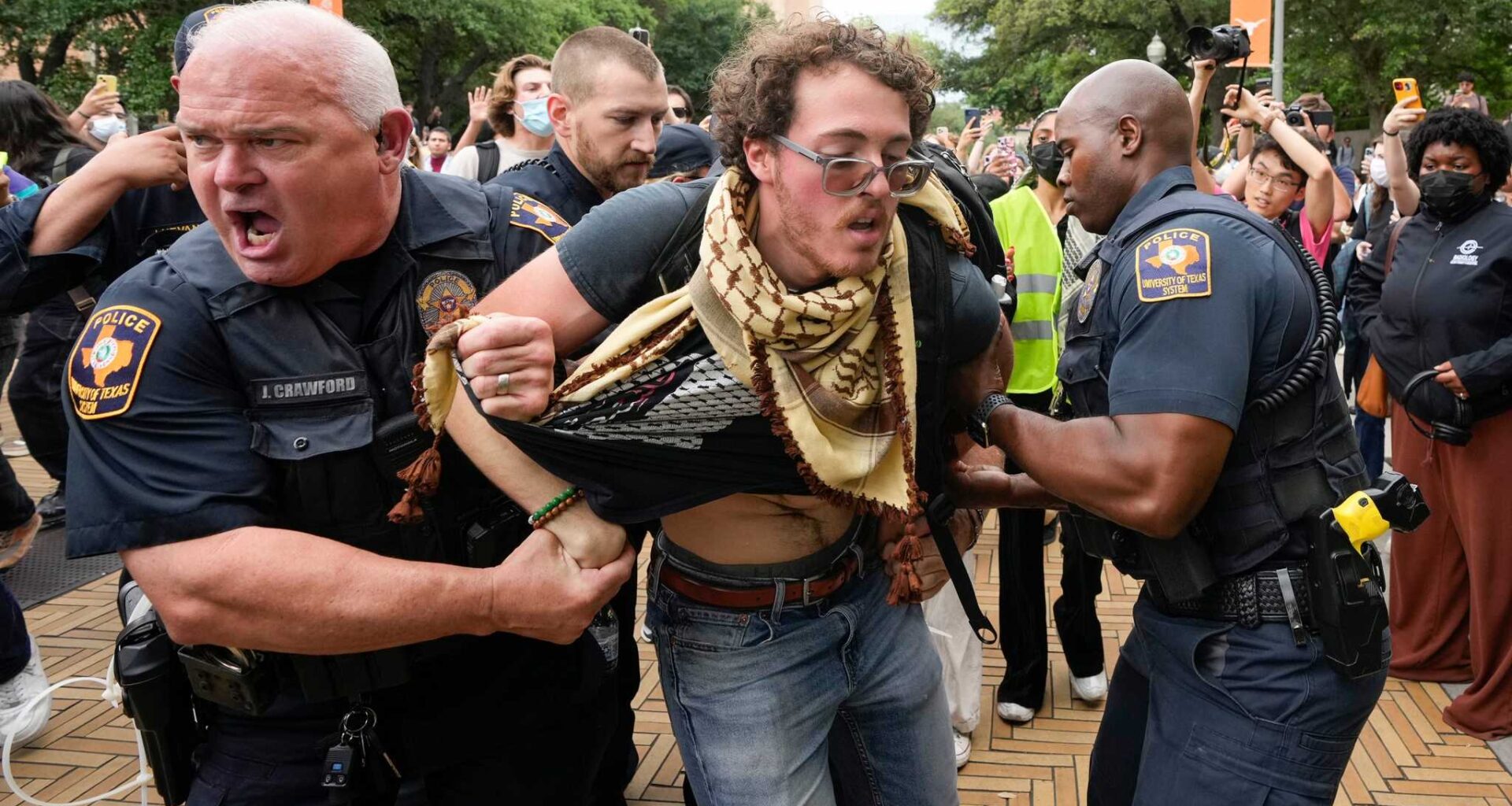
Qaddumi, who was working to facilitate a protest dispersal order with police, was the first person arrested for alleged criminal trespassing. The Travis County District Attorney’s Office dropped charges against him and other protesters the next day, citing lack of probable cause.
But as Gibson put it, “all hell broke loose” after Qaddumi’s arrest, with students turning on police, blocking emergency vehicles and setting up tents.
Article continues below this ad
Gibson referenced Tinker v. Des Moines Independent Community School District, the landmark 1969 case that enshrined students’ limited free speech rights. The case established that “substantial disruption” must be proven to allow for limitations on speech.
The lion’s share of that disruption seems to have occurred after Qaddumi was already in custody, according to lawyers’ descriptions of April 24’s events in court. UT’s attorney argued Qaddumi’s actions set the stage for what would come.
Katie McGee was just two months into an interim appointment as associate vice president and dean of students when the protest occurred. She played a large role in both the cancellation and the subsequent disciplinary action taken against Qaddumi.
She said Qaddumi’s message was not the issue, but the methods employed by the Palestine Solidarity Committee and the prospect of the last few days of the academic year ensnared by disruptive protests raised concerns.
Article continues below this ad
University of Texas police officers arrest UT student Ammer Qaddumi at a pro-Palestinian protest at UT Wednesday April 24, 2024.
Jay Janner / American-Statesman
Qaddumi argues UT targeted pro-Palestinian speech
Qaddumi’s attorney Sean Healey mapped out a series of emails and actions that implied UT’s protest cancellation was not content-neutral. He and others on Qaddumi’s legal team spent much of the first trial day highlighting the unprecedented nature of the university’s actions toward their client and his student group. Healey argued the university had never otherwise preemptively canceled a student protest.
The former student’s attorneys pointed to videos that showed Qaddumi trying to disperse the crowd, complying with police and university requests. They argued UT conflated the local Palestine Solidarity Committee’s messaging with that of national contemporaries and was motivated by an executive order issued by Gov. Greg Abbott to crack down on antisemitism.
Article continues below this ad
“Ensure that these policies are being enforced on campuses and that groups such as the Palestine Solidarity Committee and Students for Justice in Palestine are disciplined for violating these policies,” states one bullet of the three-page executive order.
Healey’s questions to McGee attempted to paint a picture of an overzealous administration that took an early adversarial position against student protesters while being responsive to pro-Israel students and community members. He said they neglected to meaningfully engage with the pro-Palestinian advocates ahead of the cancellation. Healey noted UT axed the protest in the face of protesters’ assurances that the demonstration would be a single-day event and not echo national protests.
Qaddumi’s lawyer also pointed to the fact that none of the small group of pro-Israel counter-protesters were disciplined despite also not dispersing.
McGee denied that Abbott’s executive order drove UT’s response, saying context was key to their decisions. She said the spring of 2024 was an unprecedented time as other universities dealt with protests around Israel’s invasion of Gaza, including at UT Dallas where student protesters took over a building.
Article continues below this ad
McGee testified that the Palestine Solidarity Committee had hosted dozens of events before the April 24 protest and was well known to the dean of students’ office. She said the student group had also recently exhibited more disruptive behavior at the Texas Hillel Block Party, which celebrated Israeli culture. UT had officially warned the group over its “disruptive” behavior.
The Palestine Solidarity Committee did not reply to that warning, which was sent not long before the April 24 protest was set to occur, McGee said. She agreed the situation was unprecedented, saying in her many years at universities, she had never felt as unsafe as she did that day.