
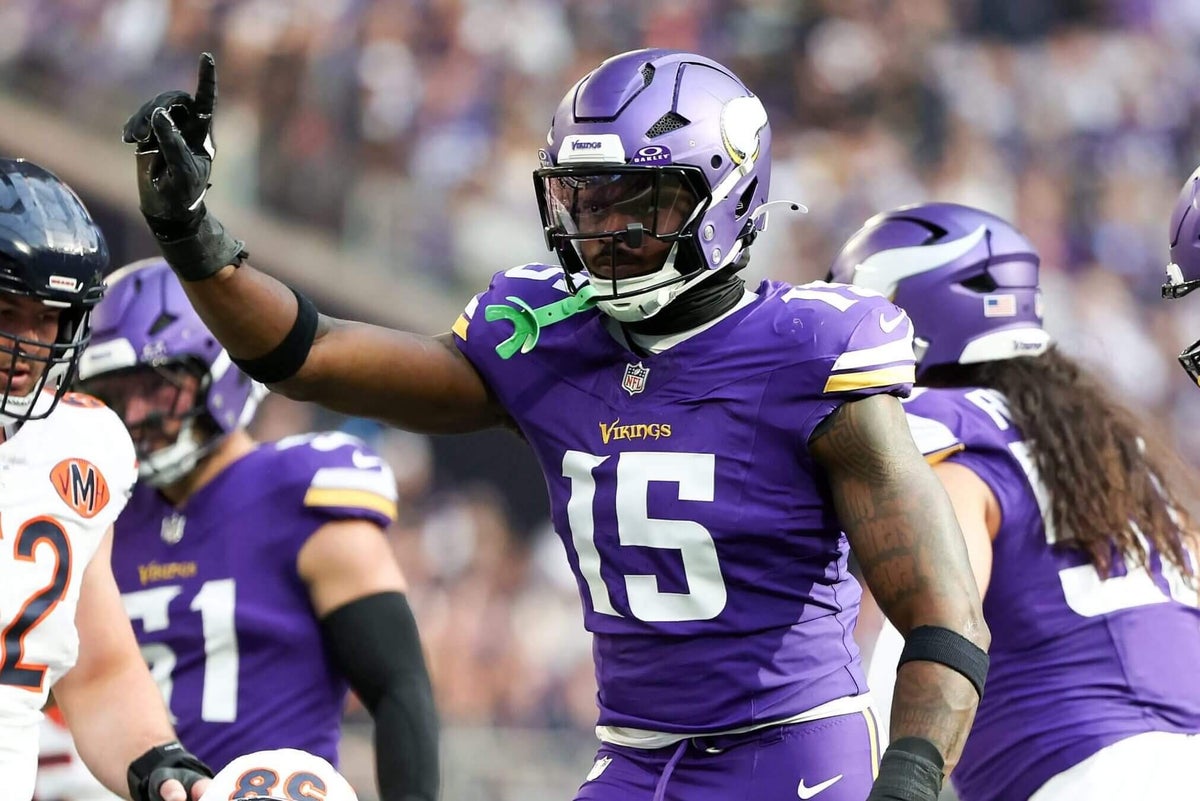
For the most part, the Minnesota Vikings’ offseason is complete. They reworked the finances. They made a quarterback splash with the Kyler Murray signing. The franchise still needs to hire a full-time general manager, but that process should wrap up in the coming weeks.
Before voluntary organized team activities and mandatory minicamp begin, we thought it’d be worthwhile to take a step back and assess the winners and the losers of the Vikings’ offseason.
WinnersRob Brzezinski
Ownership didn’t have a choice. When the Wilfs fired former general manager Kwesi Adofo-Mensah, they turned to Brzezinski to bridge the gaps in trust and respect between the front office and coaching staff. For the most part, Brzezinski aced the test. He navigated the team through a salary-cap cleanup, a quiet free agency, the controversial trade of Jonathan Greenard and a crucial draft.
Only time will allow for an accurate assessment of his effectiveness. At the very least, the Vikings proceeded through this period with a more realistic sense of alignment. Now, he is perhaps the favorite to become the team’s full-time GM — or a fixture in a new-look structure pairing him with an executive focused on personnel.
Keenan McCardell
Few NFL wide receiver coaches trot out to the practice field to work with this much talent. This was already the case for McCardell, but then the Vikings replaced Jalen Nailor with the rugged Jauan Jennings, and the rich got even richer. Consider McCardell one of the sneaky benefactors of a move that will improve the entire offensive operation.
McCardell’s role in the development of Justin Jefferson and Jordan Addison shouldn’t go unnoticed. They are willing blockers for a reason, and they approach the craft with a certain seriousness, instilled at the top. If anything, Jennings’ presence gives McCardell more time to see if he can transform former third-round pick Tai Felton into a contributor.
Dallas Turner
The path is now clear.
In his first two seasons, Turner found himself in a precarious position. The Vikings loved their starting edge rushers. Greenard and Andrew Van Ginkel meant too much to the defense’s overall success to be removed from the lineup. This limited Turner’s time.
But it won’t anymore.
Trading Greenard to the Philadelphia Eagles forces Minnesota’s hand. Defensive coordinator Brian Flores won’t just have to play Turner, but he’ll need Turner to shine. This means holding the point against the run. It also means ripping around the edge and affecting opposing quarterbacks. Turner came alive down the stretch this past season after Greenard underwent surgery to repair a shoulder injury. Now, nothing is impeding his continued ascent.
Blake Brandel
The Vikings could have selected a center in the early rounds of the draft, but they didn’t. Instead, the team doubled down on its long-held belief in Brandel. For years, coaches felt he had the physical traits to play center. They thought he could thrive if he ever got the full-time job.
Brandel validated some of those opinions in 2025, when the Vikings tossed him into the fire against the Cleveland Browns’ vaunted front. He didn’t sink. He swam. His 6-foot-7, 315-pound frame offers a sturdy barrier in the middle. Because Brandel has played every position on the offensive line, he has the pre- and post-snap understanding to handle whatever coach Kevin O’Connell throws at him.
As long as he doesn’t suffer a summer injury, he should enter training camp with a clear path to the starting job.
Matt Daniels
Special teams play isn’t sexy, but it matters, especially with the advent of the dynamic kickoff. NFL teams need explosive athletes to make plays, and the Vikings’ unit netted a few of them via the 2026 NFL Draft. Linebacker Jake Golday, safety Jakobe Thomas, cornerback Charles Demmings and fullback Max Bredeson all have elite special teams potential. This is a boon for Daniels, who has had to make lemonade out of undrafted lemons for multiple seasons.
The change at punter could be a plus, too. Johnny Hekker brings stability via experience, and undrafted signing Brett Thorson provides long-term upside.
LosersPeople who expected a definitive answer at quarterback
Hoopla defines the Vikings’ quarterback situation of late. It’s not likely to disappear any time soon, either. The Vikings are viewing Kyler Murray’s addition as a platform for premium competition between him and young quarterback J.J. McCarthy. The noise may be exhausting come August, but Minnesota believes it will also serve as fuel to lift both Murray and McCarthy.
How Murray jells with his new teammates and how McCarthy looks will dominate the Minnesota football airwaves well into the fall. Because these are the Vikings, don’t expect much dullness.
Thad Bogardus
If there is one obvious hole on the Vikings’ roster, it’s at edge rusher. The Vikings don’t have many reliable options behind Van Ginkel and Turner. Former undrafted signings Bo Richter, Chaz Chambliss and Tyler Batty have shown flashes of solid play, but it would be understandable for Bogardus, the team’s outside linebackers coach, to push for another addition or two.
Van Ginkel’s injury history adds to the concern here. The versatile cyborg missed five games in 2025 due to neck pain and a concussion. Betting on him to stay healthy for the duration of the season — as well as Turner to take a big leap — is lofty, and it underscores the need for at least one more external signing.
Levi Drake Rodriguez and Tyron Ingram-Dawkins
Rodriguez and Ingram-Dawkins must stay ready for 2026. They’ll have snaps to play regardless of Caleb Banks’ health and Domonique Orange’s commitment level. However, those draftees could shrink their impact.
Banks, when healthy, will occupy the defensive end spot that Ingram-Dawkins backed up last season. Orange is more of a nose tackle, and that’s where Rodriguez did most of his work. That the Vikings targeted Banks and Orange as early as they did speaks to the potential ceiling of Rodriguez and Ingram-Dawkins. Conversely, these two draft picks could catalyze further development from two later-round picks with intriguing juice.
Walter Rouse
Last season’s quarterback carousel shifted attention away from the issues at the tackle position. Left tackle Christian Darrisaw’s up-and-down season factored prominently in losses, and right tackle Brian O’Neill missed three games with knee injuries.
As a result, O’Connell and the Vikings approached this offseason with a clear vision. Never again would they leave the tackle cupboard as bare.
Minnesota poached Ryan Van Demark as a swing tackle. The team also used a third-round pick on Northwestern tackle Caleb Tiernan. Each arrives higher on the depth chart than Rouse, complicating the 25-year-old’s path to more playing time.
Dwight McGlothern and Zemaiah Vaughn
In recent years, agents considered the Vikings a phenomenal landing spot for undrafted free-agent cornerbacks. Minnesota kept McGlothern two years ago. The team also gave Vaughn plenty of snaps last fall. Both will have to work hard to solidify roster spots over the next few months after the Vikings brought in additional depth.
Signing James Pierre as a free agent takes one slot. Drafting Demmings removes another. The Vikings tend to stockpile the safety room, which could further affect McGlothern’s and Vaughn’s chances at making an impression.