
AUSTIN (KXAN) — Should a portion of your utility bill go to your city?
For decades, Austin Water has given a percentage of what it makes off your water bill to the city’s general fund. It’s a common practice across the nation.

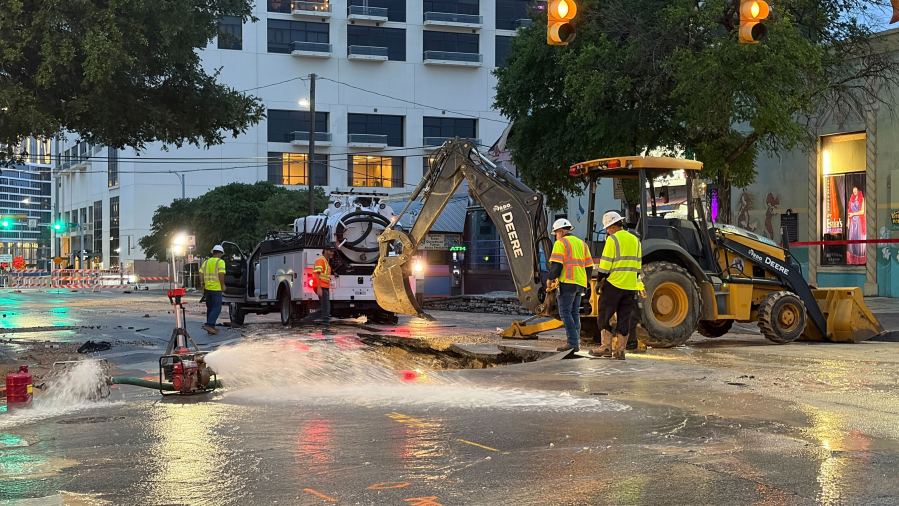
Water main break causes flooding at intersection of 6th and Red River Streets early the morning of Monday, April 13, 2026. (KXAN Photo/Todd Bailey)
But now, amid growing infrastructure needs, the state is exploring making a change.
What lawmakers are reviewing
At the Texas Senate on Monday, members of the Water, Agriculture and Rural Affairs Committee took a closer look at this policy across the state. Lawmakers did not focus on any one city during the hearing.
Officials testified that delaying infrastructure work can lead to system failures and sharp cost increases when projects are put off.
“Our perspective is that utility revenues should be used primarily for utility purposes, and the transfer should be transparent, justified and appropriately structured,” Perry Fowler with the Texas Water Infrastructure Network said.
Under current rules, cities can transfer utility revenue after covering operating costs, debt payments and bond obligations.
How Austin uses utility revenue
According to the City of Austin’s 2025–2026 budget, around $50 million in Austin Water revenue was transferred to the city in 2025.
Austin Energy also sends money this way. Together, these transfers account for about 12% of the city’s budget.
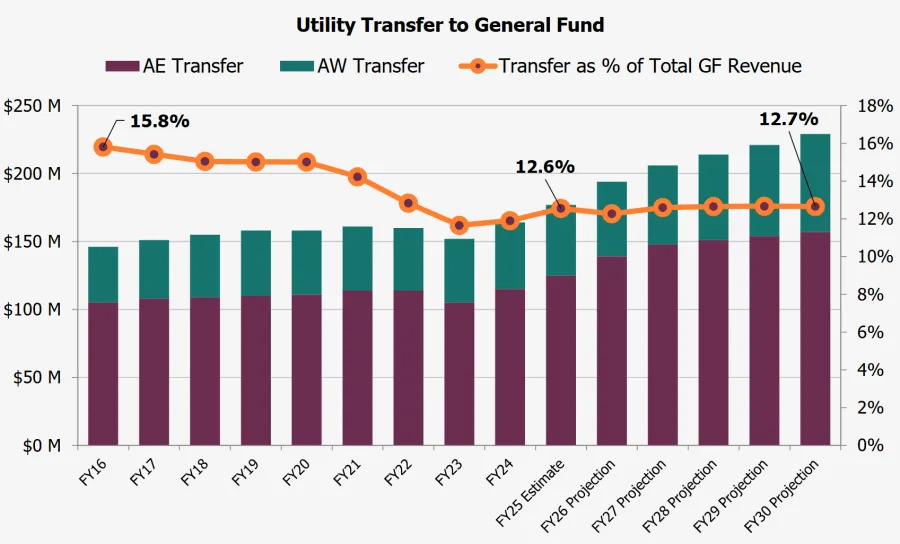
This chart, included in the City of Austin’s 2025-2026 budget, shows the amount of money Austin Water and Austin Energy have transferred to the City’s General Fund. The orange line shows how much of the City’s General Fund is comprised of this transfer. (Credit: City of Austin)
Austin Financial Services told KXAN that the funds they transfer “support the City’s primary operating budget or General Fund, which includes public safety, community services, neighborhood planning, and affordable housing.”
Why critics say the practice is a problem
Larry Levine with the Natural Resources Defense Council said these kinds of transfers are common across the country, but they come as water systems face increasing costs.
“Water rates, for really a decade or two, have been increasing faster than inflation around the country. And so there’s increasing attention to water affordability challenges, especially for lower income households,” Levine said.
Levine said the practice is often used for other city needs outside of utility operations.
“It’s a problematic practice if you’re transferring funds just to backfill a budget for needs unrelated to the utility needs,” Levine said.
Rising costs and aging infrastructure
Meanwhile, utilities are facing rising costs, and some systems are struggling to keep up.
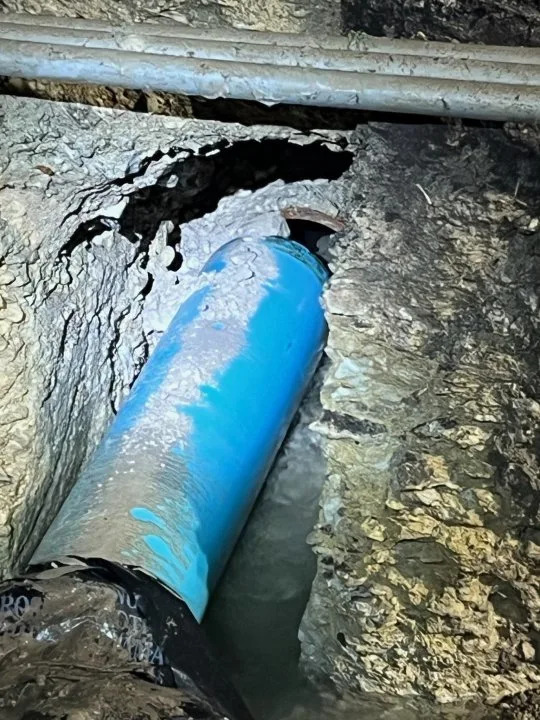
Water main break repair in Cedar Park near 183A and Brushy Creek Road (Photo: City of Cedar Park)
Only 57% of utilities surveyed by the Texas Water Infrastructure Network said they had enough funding, and aging systems are in need of repair. 43% said they did not have enough funding.
“One year of general fund transfer (in some cities) would cover the cost of their mitigation,” Larry French with the Texas Public Policy Foundation said at the Senate committee hearing.
What could change next
Lawmakers said the issue will require balancing infrastructure needs with how cities fund their budgets.
“We got to start looking at all of this and we’re big enough to do it, and we’re smart enough to do it,” Perry said.
Austin limits how much can be transferred from its utilities to the general fund. The city caps that transfer at 8.2%.
A decade ago, that utility transfer covered nearly 16% of the City’s General Fund.
Copyright 2026 Nexstar Media, Inc. All rights reserved. This material may not be published, broadcast, rewritten, or redistributed.
For the latest news, weather, sports, and streaming video, head to KXAN Austin.