
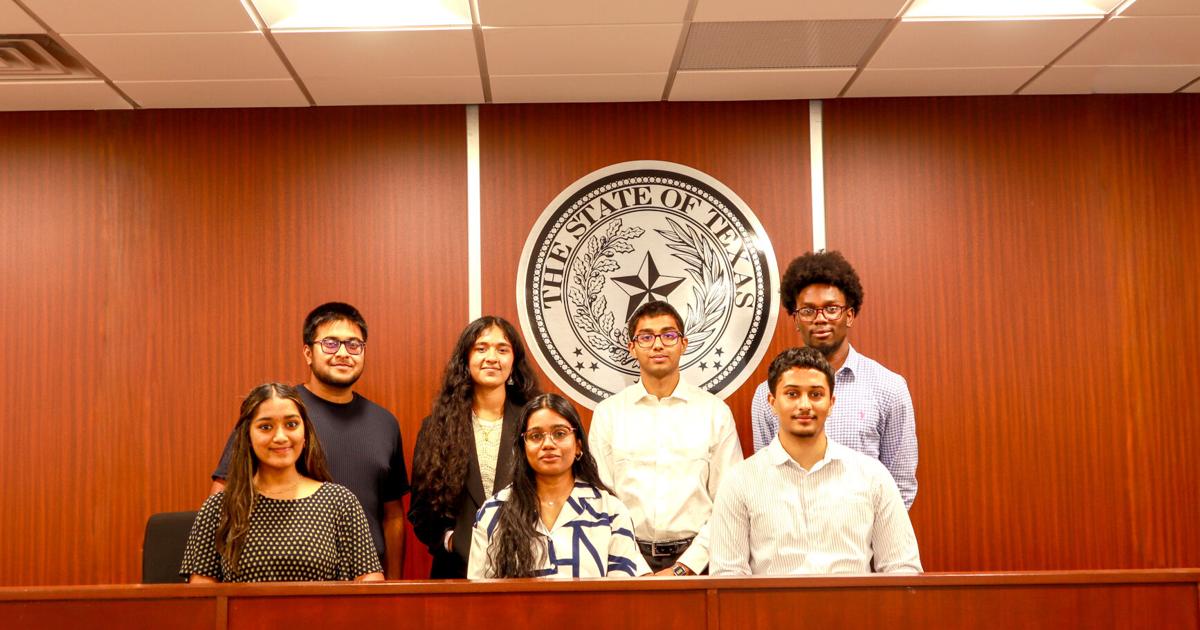

Photo courtesy of Eniola Ibidamitan
This summer, Sai Thatraju, chemistry junior and Model United Nations president, attended a court case involving a homeless man who couldn’t afford food.
Troubled by the case, Thatraju began researching legal precedents around aiding homeless people and discovered a United Nations General Assembly Resolution to make food a human right.
That moment sparked her mission: to reignite the Model U.N. at UTA after the club had been gone for a decade.
Model U.N. is an international global policy club where members conduct mock simulations and create policies for different countries to enact and maintain, she said.
During summer organization fairs, Thatraju began recruiting the first members of the new club.
Political science freshman Srinija Gundlapally said she met Thatraju while volunteering for the Student Government at a social event for organization presidents.
Gundlapally was a part of the Model U.N. club in high school and wanted to continue it in college, but was told there was no club at UTA. However at the event, Thatraju told her of her plans to start the club back up again.
“I told her I was really interested in it and I have experience,” she said. “And we just started working together.”
Gundlapally said it was tough starting the club because after ten years, they were not able to get guidance from club alumni. She said it felt like they were doing it all by themselves.
“It kind of made us feel lost,” she said.
At points, the officers questioned whether they were doing the right thing. Doubts like ‘What if we can’t go to conferences?’ and ‘What if we’re doing this wrong because we don’t have guidance?’ plagued their thoughts.
Through the help of advisers and officers from other clubs on campus, such as the Pre-Law Society and the Women in Law club, as well as Model U.N. clubs from other schools, they’ve managed to grow into the club they are today.
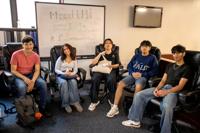
Photo courtesy of Eniola Ibidamitan
Model U.N. holds biweekly meetings, with two types: general body meetings and simulation meetings. General body meetings are social mixers where students introduce themselves.
Simulation meetings focus on diplomacy and research. During these meetings, students are assigned a country and given a hypothetical problem to solve, like world hunger. They are given several minutes to research their countries, and then must represent them as delegates, and together they create policies.
“I definitely see people developing that skill set and being clear and concise with what their argument is,” said Jaideep Singh, computer science junior and Model U.N. vice president. “It is Model UN, we are going to disagree, but you also have to say it in a very respectful yet very impactful way, and I’m seeing a lot of people just developing that.”
The club has had around five meetings so far, Singh said.
“I feel like we’re taking one step at a time, but it’s progressing,” Thatraju said, reflecting on the club’s journey from an undecorated table at the student organization fair to a thriving group of 41 members.
“I have the best officer team now,” she said. “I’m so happy, it came from ‘Oh, let me join your club,’‘Let me be an officer’ to ‘Oh, I can’t be a part of your club.’ Now, people are asking to be a part of the club, but we don’t have spots on the officer team left, but they can be a member.”
@tay._.sansom and @atclements03