
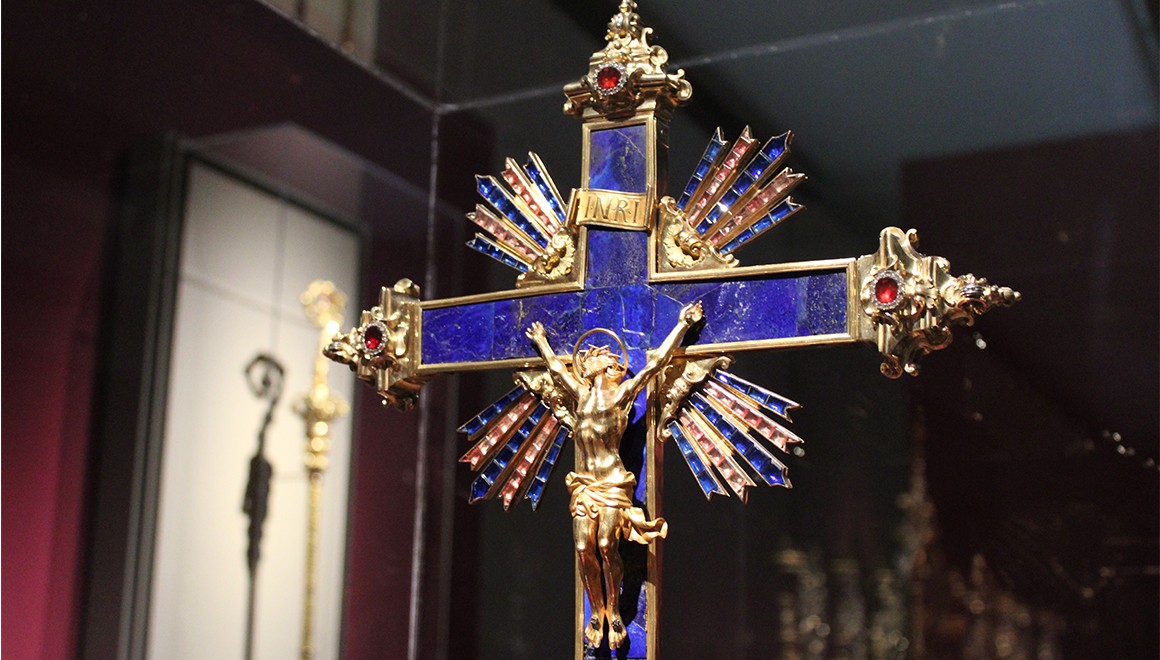
 Robert Landry, “Reliquary of the True Cross,” 1628-29, gilt silver, glass. Collection of the Terra Sancta Museum, Jerusalem. Photo: Charlie Milton
It is perhaps no surprise that the holiest site of the world’s largest religion is a wee bit packed. Built in iterative layers since the 4th century in Jerusalem, The Church of the Holy Sepulcher cradles the rock tomb Jesus was reportedly buried in and resurrected from. Travel sites advise that it can take up to an hour to get inside the tomb once inside the church, and then visitors are only granted about ten seconds before being shuffled along.
 Naples, “Crucifix,” 1756, gold, lapis lazuli, precious and semiprecious stones. Collection of the Terra Sancta Museum, Jerusalem. Photo: Charlie Milton
If a spiritual experience on a strict time limit doesn’t sound like your ideal engagement with the sublime, you’re in for a rare treat. Travelling to the U.S. for the first and likely last time, The Holy Sepulcher: Treasures from the Terra Sancta Museum, Jerusalem is stopping at only two venues, and the Kimbell Museum in Fort Worth is one of them. Tailored to the space by curator Xavier F. Salomon, who first designed it for the Frick, this show is actually a two-for-one taste of the art worlds of both New York and Jerusalem.This high honor is evident in the amount of care and fanfare the Kimbell has put into the show, as well as the presence of two Franciscan friars at the opening, one of whom brought some much needed joy into the world by riding a longhorn at the Stockyards.
 Probably workshop of Domenico Piola, “Cope of the Red Pontifical Set of Vestments of Genoa,” 1686–97, satin ground, silk thread, and painting on silk. Collection of the Terra Sancta Museum, Jerusalem. Photo: Charlie Milton
Far from being processed past the objects without time to soak them up, the Kimbell — especially on a weekday — grants a luxury through a rare degree of intimacy with these works. Low lighting both protects the delicate textiles in remarkable condition as well as recreating the experience of stepping into a contemplative candlelit church, complete with a bench facing the most show-stopping display of vestments like a pew in front of an altar. Rich jewel-toned walls bring out the pops of color amongst the gilt, all enhancing without distracting from the viewing experience.
 Antonio De Laurentiis, “Throne of Eucharistic Expression,” 1754, gold, gilt copper, precious and semiprecious stones. Collection of the Terra Sancta Museum, Jerusalem. Photo: Charlie Milton
I was not raised religious, but have long joked that because of my degrees in art history, I learned the events of the Bible the same way that a 16th-century illiterate peasant would have: through paintings, sculptures, and tapestries. Visiting The Holy Sepulcher gave me the same feeling I get every time I’m in an old European church, which is that if I was born several hundred years ago, I would have converted to whatever belief let me be around objects of this immense beauty. That might make me a strange candidate for “No. 1 Catholic Art Enjoyer,” but I’d argue that it is precisely that impartiality that leads to an earnest appreciation of its splendor.
Whether you are engaging with it as part of a spiritual experience, a religious tradition, or simply as an aesthetic appreciation, there’s likely something for you in this show. Even if one travels to the countries these objects hail from, their national collections by and large do not contain metalwork or textiles of this level of opulence. The complex divided stewardship of the six different Catholic denominations who share the Church of the Holy Sepulcher protected these works of art from being burnt or melted down during times of economic and political strife in Europe since the 17th century. So, while there are records of similar pieces, these are the only ones of their kind to survive.
 Spain or Middle East, “Humeral Veil,” late 16th or early 17th century, silk, gold and silver thread. Collection of the Terra Sancta Museum, Jerusalem. Photo: Charlie Milton
It can be difficult for an exhibition to balance accessibility for viewers unfamiliar with a topic while meeting the depth that the well-versed crave, but this show does so elegantly and effectively. While you can absolutely get something out of just coming and basking in the beauty surrounding you, the show rewards slow engagement. While their ornamentation is entrancing in its own sake, the stories behind each object’s creation and lifespan strings the works together to tell a larger narrative, like the Muslim fabric turned into a Christian liturgical cloak with a coat of arms transplanted from an earlier vestment. Its complex background echoes a culturally intricate region, and the stitches of visible mending speak to its years of wear; not intended for visual restoration, but durability.
 Palestinian craftsmen, “Model of the Church of the Holy Sepulcher,” 18th century, olive and pistachio wood, mother-of-pearl, camel bone. Collection of the Terra Sancta Museum, Jerusalem. Photo: Charlie Milton
This multifaceted undercurrent jumps out most strongly with the tiny model of the church itself at the entrance of the exhibition. The only artwork in the show made by Palestinian artisans from locally rather than globally sourced materials; this dollhouse of a sacred site provided a sort of virtual pilgrimage to those who could not make the journey. The stark contrast with the gold and gemstones of the rest of the show makes it stand out — earthiness in a sea of the heavenly. It is hard to ignore the hand of settler colonialism and empire in a collection such as this, nor do I think one should try. Like the accompanying historical context of the monarchs from each country that commissioned them, our modern day conflicts and geographical disputes inform the creation, preservation, and reception of these objects.
What we choose to preserve is meaningful, and cultural heritage extends beyond whether liturgical objects will continue to be used or transfixed in a new museum. I hope to see a day where we value people as preciously as the art they create.
The Holy Sepulcher: Treasures from the Terra Sancta Museum, Jerusalem is on view through June 28, 2026, at the Kimbell Art Museum in Fort Worth.