
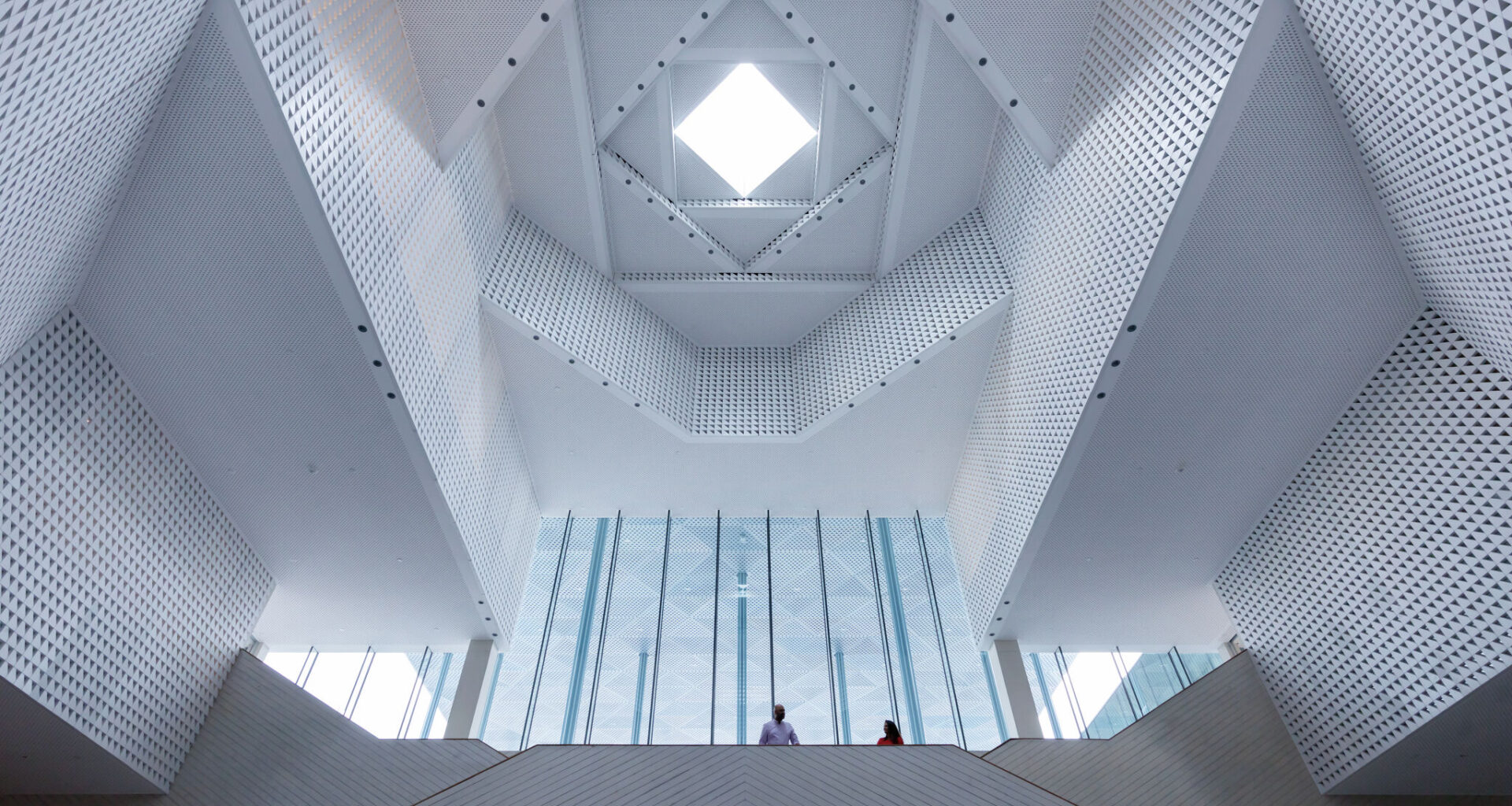
The dramatic atrium of the Ismaili Center in Houston.
Iwan Baan/Ismaili Center, Houston
For a critic, the opportunity to write a rave review is a too-rare privilege and pleasure. This, happily, is one of those occasions. To wit: The recently completed Ismaili Center in Houston is a flat-out masterpiece, a fusion of architecture and landscape that conjoins inspired design with meticulous craftsmanship while deftly embracing tradition and modernity.
To come upon it for the first time is a genuinely breathtaking experience. Its patterned form, bright white in the Texas sun, floats behind a long reflecting pool lined with lush vegetation, giving it the bearing of a modernized American Taj Mahal. At night, it glows from within, with gentle light filtering through its perforated façade.
“The mandate of the project was to create a building that speaks to the Islamic architectural tradition and also responds to the conditions of a site in the contemporary city of Houston,” says Farshid Moussavi, its architect.
Thus far, the center has not received anywhere near the national attention it deserves, having been overshadowed by major new projects in Los Angeles (the Geffen galleries at LACMA), Chicago (the soon-to-open Obama Presidential Center) and New York (buildings for the New and Studio museums), not to mention a certain ballroom in Washington, D.C. Among that group, it is the most holistically impressive work.
Aerial view of the Ismaili Center.
Iwan Baan/Ismaili Center, Houston

The center sits on an 11-acre site next to Houston’s Buffalo Bayou Park, and is the collaborative design of Moussavi, who is based in London, and American landscape architect Thomas Woltz, of Nelson Byrd Woltz. More broadly, it is the brainchild of the late Karim Aga Khan IV, spiritual leader of the Shia Ismaili Muslim community, which counts some 15 million adherents worldwide and is notable for its emphasis on education and gender equality.
Article continues below this ad
The Aga Khan, who was succeeded by his son after his death last year, was a leading patron of the arts, and architecture in particular. In 1977, he established the Aga Khan Award for Architecture, which is bestowed on projects in Muslim communities and carries a prestige similar to that of the Pritzker Prize.
“He really believed that architecture can impact lives, can inspire,” Moussavi says. “He was very interested in buildings as making communities.”
That is the aim of the Ismaili Center, which is free and open to the public without appointment. Its facilities include an art gallery, a black-box theater, large multipurpose rooms, education spaces, a playground, pickleball courts (yes) and a café. It is the seventh Ismaili Center worldwide, and the first in the United States, where the Ismaili population is estimated at 50,000, with roughly 30,000 in and around Houston (hence the location of the center). The project budget was $220 million.
Facade of the Ismaili Center.
Iwan Baan/Ismaili Center, Houston
Though she is not of Ismaili descent, the Iranian-born Moussavi proved a wise choice for the project. She emigrated to England in 1979 at the age of 13 to escape the Islamic Revolution, and came to professional prominence in the mid 1990s, when her former firm, Foreign Office Architects, won an international competition to design a new passenger port terminal in Yokohama, Japan. That project, completed in 2002 to considerable acclaim, embraced new computing technologies to produce an architectural landscape of fluid form. Her most significant work in the United States, until now, is Cleveland’s Museum of Contemporary Art, a crystalline block of mirrored glass with a soaring internal atrium. It was completed in 2012.
Article continues below this ad
Make Dallas News a preferred source so your search results prioritize writing by actual people, not AI.
Add Preferred Source
With the ongoing war in Iran, the Ismaili Center arrives at a difficult moment in America’s relationship with the Islamic world. In Texas, there has been a rise in anti-Muslim rhetoric and attacks on developments like the Meadow (formerly Epic City), the North Texas planned community described as a “Shariah” compound by Republican leaders, including Gov. Greg Abbott.
The Ismaili Center stands a pluralistic rejoinder to those attacks, part of a diverse lineage of sacred architecture in Texas that includes other recent additions, among them St. Sarkis Armenian Orthodox Church in Carrollton.
Like so much Islamic architecture, the center is defined by complex ornamental pattern. Both the architecture and the landscape are driven by an organizing system derived from the north-south orientation of the site and the requirement that the prayer hall be pointed toward Mecca, at a 45 degree angle from that axis. That clash of geometries produced a grid with square and triangular forms that spread across the surfaces of the building and its gardens.
Article continues below this ad
Prayer hall of the Ismaili Center.
Iwan Baan/Ismaili Center, Houston
That patterning is felt most viscerally in the center’s soaring atrium, a five-story volume that steps back gradually as it rises, culminating in a square skylight. It is a dizzying tour de force, with walls composed of an endless series of square concrete modules that are cut by triangles — a testament not only to inventive design but to careful construction, as any misalignment would immediately stand out.
That atrium leads into the center’s Jamatkhana, or prayer hall, a dramatic, column-free room large enough to hold 1,500 worshippers. Where the atrium soars, the Jamatkhana expands horizontally, with concrete structural beams visible in shadow behind a luminous ceiling made of perforated aluminum screens. “It basically inverts the feeling of weight into lightness,” says Moussavi, who describes the room as an “infinite space.” It is an aesthetic and structural wonder.
Another distinctive feature of Islamic architecture employed at the center is the eivan (pronounced, ay-von), a veranda with a roof supported by a field of columns. The center has several of these, their form inspired in part by the Safavid palaces of Chehel Sotoun and Ali Qapu in Isfahan, both of which have been damaged in the conflict with Iran.
Article continues below this ad

By signing up, you agree to our Terms Of Use and acknowledge that your information will be used as described in our Privacy Policy.
“As an architect, and as someone born in Iran, I cannot help feel immense sadness when I heard that these two palaces were damaged,” Moussavi says. “These are part of world cultural heritage and their loss is devastating.”
The center’s principal eivan sits directly above the Jamatkhana, its thin projecting roof supported by 49 star-shaped steel columns painted a sky blue as a shot of animating color — a direct request from the Aga Khan.
An eivan, or verandah, at the Ismaili Center, Houston.
Iwan Baan/Ismaili Center, Houston
That porch provides sweeping views of Woltz’s garden, which gradually steps down toward Buffalo Bayou. At its lower end is a sunken garden with a drainage system designed to mitigate inundation when the river floods, as it is wont to do. Everywhere, it is planted with colorful floral species appropriate to Houston’s jungle-like ecology. Vines should eventually cover the garden’s retaining walls, intended to suppress noise from the adjacent high-speed roadway and otherwise protect the garden’s oasis-like quality. If there is anything to complain about here — and there is very, very little — it is the closed-off nature of the complex, and the unfortunate reality that most people will first experience it after emerging from an underground parking garage that deposits visitors inside the main building, instead of at a distance from which it can be viewed in totality. That is a small price to pay for such a thoughtful and beautifully executed work that promotes community and understanding between cultures.