
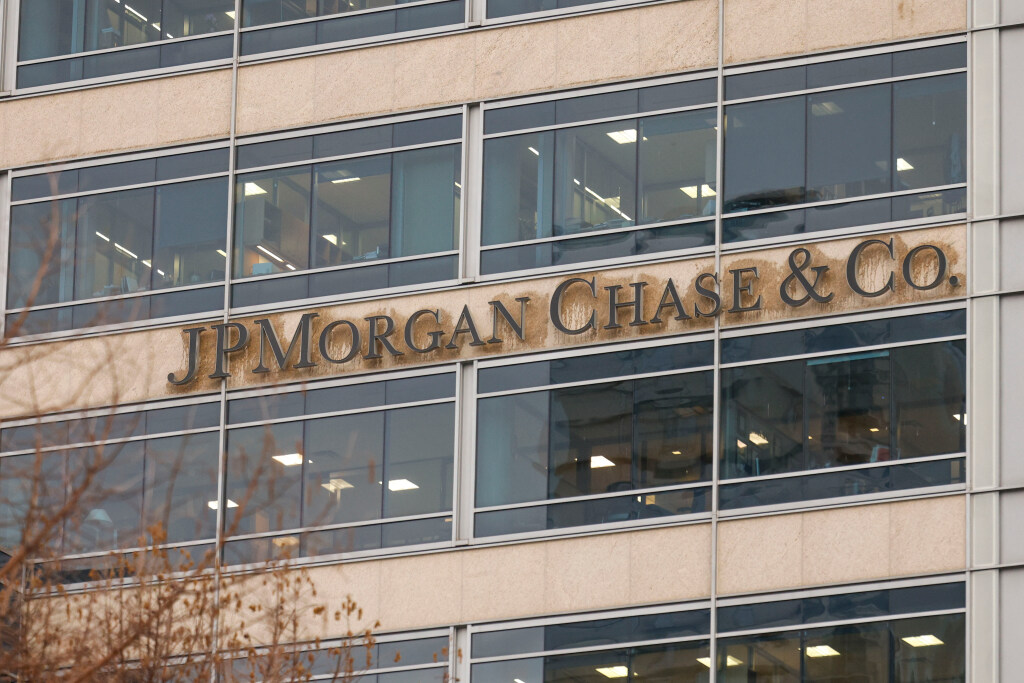
JPMorgan Chase employs about 17,000 people in North Texas and has expanded its downtown Dallas office overlooking Klyde Warren Park.
Shafkat Anowar/Staff photographer
The world’s largest bank has its eyes on North Texas.

From providing $400 million in backing for AT&T’s forthcoming $1 billion Plano headquarters, to helping local middle-market business scale, JPMorgan Chase has its fingers in many pots across Dallas-Fort Worth. Internally, the bank employs about 17,000 people in North Texas and has expanded its downtown Dallas office overlooking Klyde Warren Park.
Article continues below this ad
Last Thursday, The Dallas Morning News spoke with John Simmons, co-head of global banking, and Belen Garren, region manager for middle market banking in North Texas and Oklahoma.
The duo shared insights about the flourishing business and finance landscape in Dallas, investment opportunity in the region and the AI investment boom.
Responses have been edited for length and clarity.
Make Dallas News a preferred source so your search results prioritize writing by actual people, not AI.
Add Preferred Source
Question: JPMorgan Chase has been in North Texas for a while. How are you all thinking about the growth of the region as a financial center?
Article continues below this ad
Simmons: “The thing that I’ll sort of smile about a little bit, is we’ve been here for 160 years, so we consider Texas home, and it’s a bigger state in terms of our talent workforce than the state of New York, where we’re headquartered. So it’s not surprising to see others follow, but to us, we’re executing the same play that we’ve been executing for more than a century and a half. Texas as a state would be one of the largest countries in the world, and we think that a lot of the best days are yet ahead of it, and we’re planning to be here in support.”
Garren: “What we’re hearing within the market is that it’s a growth mindset market. We have a very favorable business environment in terms of working and doing business. From a work-life balance, community aspect, we have an incredible culture here with parks, museums and a lot of investment that’s happened over the last several years.
“When Scotiabank was coming into town, Mike Rosa from the Dallas Regional Chamber reached out and said, ‘Hey, Belen, would you speak to the group?’ as they were doing their last tour to make a decision. And it was fun to get to brag on this community. We talked about the business-friendly environment. We talked about how it’s a great place to work and to live. It’s also central, we have easy access to each coast.
“Another asset within North Texas, whether you’re looking at the universities in Dallas and Fort Worth — the colleges and community colleges — it’s a really, really phenomenal pipeline that helps drive both the financial services industry as well as industries more broadly.”
Article continues below this ad
Related story: How George W. Bush helped lure Scotiabank to Dallas
JPMorgan Chase’s John Simmons (right), co-head of global banking, and Belen Garren (left), region manager for middle market banking in North Texas and Oklahoma, pictured in the lobby of JPMorgan Chase’s office in downtown Dallas.
Sasha Richie/Staff writer
Question: AI investment is dominating the stock market, but there are disagreements about whether or not AI is a bubble that’s about to burst. What are your thoughts on this, and how does JPMorgan Chase use AI?
Simmons: “It is an incredibly powerful secular force in this economy and the global economy. You’ve got unprecedented levels of capital expenditures, which in many ways are a nice tailwind for the economy that are coming from the so-called hyperscalers of the capital markets. It’s not uncommon to see firms individually spending $100 billion, $150 billion, $200 billion as an individual firm on capex. These numbers are pretty unprecedented.
Article continues below this ad
“To my own personal view, this is not cyclical. This is a secular change, and I think in many ways it will change every company in some way, large or small. We are spending a ton of time thinking about how it can accelerate our business, how we can serve our clients better, how we can do things faster, how we can do things cheaper. However much time you’re spending on AI, you’re probably not spending enough, in terms of how we’re thinking about it.
“There will be, undoubtedly, lots of change in terms of opportunities and also in terms of how the workforce evolves. So to me, it’ll be one of the most powerful forces that affects and changes the way we serve our clients and how they’re thinking about navigating and adapting. You can’t have a conversation with a company right now that doesn’t in some way touch on AI.”
Garren: “You think about folks that were coming in from an entry-level position, some of what they were doing previously was digging into data, number crunching, putting together decks. And now they’re coming and there’s tools that can help them. When they’re walking in day one, they’re able to leverage AI for those resources, and then taking more of a strategic view and lens as they’re coming into conversations, as they’re interfacing with their colleagues, and then also working with our clients.”
Question: J.P. Morgan led a $1 billion financing arrangement for MP Materials’ Northlake “10X” rare earth magnet factory, part of a first-of-its-kind public-private partnership with the Department of Defense, through JPMorgan Chase’s Security and Resiliency Initiative. How did the Security and Resiliency Initiative come about, and how will Texas fit in?
Article continues below this ad

By signing up, you agree to our Terms Of Use and acknowledge that your information will be used as described in our Privacy Policy.
Simmons: “The initiative was actually born out of something [chairman and CEO Jamie Dimon] is personally passionate about, where we think that there is an opportunity, and in many ways, as a patriot, an obligation, to help fortify and strengthen America and our allies’ resilience, because it is an ever complex world.
“We have a program over the next decade to finance and facilitate $1.5 trillion dollars of capital — a 50% increase from what our normal run rate would have been over a decade — and we’ve also decided to put $10 billion of equity behind that. That equity is coming off of our balance sheet to support the goals of the SRI program. We’re looking at advanced manufacturing, supply chain, healthcare, aerospace and defense, quantum computing and AI — all areas where we think there’s an opportunity to strengthen and make more vibrant America’s resiliency.
“Just within North Texas, there are 200-plus companies that would fit within the industry groups that I’ve outlined that we are working to see, is there a solution that we can bring to bear to help them — in many cases, family-owned, founder-led businesses — invest in their businesses, fortify their supply chains and be able to increase production should there be an opportunity to do so?”