
Relaxed in a chenille armchair, a young Larry McMurtry grins at a striped kitten yearning for attention in his lap. Emblazoned on his black crewneck, in white military typeface, are the words “Minor Regional Novelist.” A critic once shared that sentiment in a smug evaluation of McMurtry’s writing. In response, the American novelist, of a minor region in the South, reclaimed it with pride and a bit of irony, donning his mark of infamy.
Raised in Archer City, only 40 miles from my childhood home, where I played with feral barn cats, McMurtry ran Booked Up Inc., an oasis in the desert of rural North Texas, which undoubtedly had few bookstores. McMurtry’s sense of place and identity, plucky storytelling, and ability to tear away masks of Western myths and cowboys permeate the body of work gathered in the current exhibition at Nature of Things.
Featuring 16 artists with work ranging from the 1930s to the present, Minor Regional Novelist could be interpreted as a postscript to the gallery’s first exhibition, A Clean, Well-Lighted Place: An Homage to Dave Hickey. Born in Fort Worth, Texas, Hickey, an American essayist, art critic, and friend of McMurtry, began Austin’s first commercial art gallery, A Clean, Well-Lighted Place, which frequently featured the work of artists such as Jim Franklin and Terry Allen.
 Concert poster by Jim Franklin. Photo: Kevin Todora
During my visit to the gallery, founder Tessa Granowski walked me up the staircase to her temporary sanctuary of wood and brick, atop Deep Vellum bookstore. She guided me through the exhibition in conversation, noting repeated subjects, patterns, and styles. Wood, beer, metal, vast and cavernous earth, portraiture, caricature, and agrarian scenery infiltrate the premises. Permeating the vicinity, too, are stories, personal anecdotes, and droves of research generously offered by Granowski.
 Sam Linguist, “KZPS,” 2024-2025, underglazed stoneware, 44 x 55 x 3 3/4 inches. Photo: Kevin Todora
I’m greeted at the top of the staircase by a wall-hanging installation of stoneware morsels. The work, by Waxahatchie-born, New York-based Sam Liguist, features a fingerprint, fragmented into clumps that appear like caked earth. The artist’s spiraling mark of individuality signals the exhibition’s expression of rugged Texas individualism. That sense of individualism spreads throughout the show, revealing real and fictitious characters.
 (Left) Will Boone, “Inheritance,” 2026, cardboard box, found objects, 6 x 29 x 26 inches. (Right) Will Boone, “Jesus, The Cowboys, Anna Nicole,” 2026, acrylic on canvas, 48 x 36 x 1 1/2 inches. Photo: Kevin Todora
In an empty closet off the west wing of the loft sits an installation by Houston-based Will Boone. It features a small cardboard box filled with relics and personal belongings: two books, Alcoholics Anonymous and What Cops Know, a pair of handcuffs, a blue leather belt with braided finishings, and a wooden skeleton. The objects in the box belonged to the artist’s uncle. Hanging on the wall next to the box is a painting by Boone depicting a hazard-yellow wood grain with black-and-white images. In the top left corner, Jesus, in his crown of thorns, weakly lifts his eyes to the heavens, in agony. In the bottom right corner, Anna Nicole Smith sports a pout and thick black sunglasses. Between them, the words “Budweiser” and “Cowboys” mingle casually. While the painting represents a collage of a Texas caricature, obsessed with Christianity, beer, football, and beautiful women, the box reveals a real, complex Texan, vague and problematic, yet familiar and endearing.
 (Left) An installation view of Emily Budd’s sculptures. (Right) Emily Budd, “Thunderation in the Honey Pot (1),” 2026, rusted reclamation fragments, cast tin, 1 x 2 x 4 inches. Photos: Kevin Todora
On a built-in glass shelf in the west wing, relics by Dallas-based Emily Budd convene. Comprised of rusted reclamation fragments and cast tin, the objects appear ceremonial and utilitarian with silver tongues, phallic nubs, and prodding devices. The tarnished and adorned appendages look like sex objects and represent fixtures in Budd’s series of sculptures reflecting on queer experiences involving abandonment and companionship.
 (Left) George Zupp, “All the Laughing Cowboys,” 2025, oil on wood, 18 x 20 inches. (Right) George Zupp, “Still Life,” 2025, oil on wood, 19 x 23 inches. Photos: Kevin Todora
Cowboys at a rodeo, mouths agape in exaltation, hoot-n-holler as two hogs engage in coitus. In the West Texas town of Marathon, George Zupp reimagines Western scenes; the raucous, raunchy rodeo is one, and a still life of beers, limes, and squash on a table, with onlooking kittens, is the other; that piece is fittingly placed in the loft’s kitchenette.
 (Left) Jerry Bywaters, “Ranch Hand and Pony,” 1944, lithograph, edition of 200, 10 x 13 inches. (Right) Alexandre Hogue, “Desert Glare,” 1945, lithograph, 6 3/4 x 11 3/4 inches. Photos: Kevin Todora
A ranch hand and his pony linger in a frame by the north window of a room in the east wing. The lithograph by the late Jerry Bywaters, previous director of the Dallas Museum of Art, faces another lithograph, of a glimmering desert, two paces away, by the late Alexandre Hogue, an illustrator for the Dallas Morning News. Bywaters and Hogue were both members of the Dallas Nine, a group of artists promoting regional aesthetics between the 1930s and 40s.
The Nine depicted the societies, agrarian systems, and landscapes of the Southwest, drawing inspiration from Mexican painter Diego Rivera, a mentor to Bywaters. While Bywaters and Hogue represent Texas and Southwest regionalism with serious, lonesome figures and detailed renderings of natural settings, contemporary regionalists, like Zupp, welcome images of communal settings frivolously filled with humorous taboo, dispelling myths of the lone ranger and romanticized landscape.
 (Left) William Lester, “Man Wearing White Hat,” 1930s, oil on board 15 1/2 x 12 inches. (Right) Emile Guidroz, “Self Portrait (Unfinished),” oil on canvas, 24 x 20 inches. Photos: Kevin Todora
Another member of the Dallas Nine was William Lester, whose portrait of a man with a long face, wearing a white hat, idles in the southwest corner of the west wing. Another portrait by Emile Guidroz, former Dallas portraitist and muralist at Fair Park, floats on the south wall of the east wing. The portraits by Lester and Guidoz crop the figure, centralizing the individual in an empty, unrevealing setting. Houston-based Contemporary figurative painter El Franco Lee II fills his settings with representations of real encounters with Southern subjects in detailed social environments, revealing unexpected and contentious objects significant to the individuals and the imaged site.
 El Franco Lee II, “DJ Screw in Heaven Remixed,” 2025-2026, acrylic on canvas, 36 x 38 x 1 inches. Photo: Kevin Todora
El Franco’s paintings don themselves across both rooms. The surrealistic compositions read like comic books with lyrical movement. The six-armed DJ Screw, Houston legend and originator of the chopped and screwed method, is pictured spinning vinyl with one hand and passing a cigarette with the other. An actual, red vinyl record, affixed to the canvas, mimics the red records splashed across the piece, pulling at the real, tangible life and history of the image depicted.
 Carrie Cook, “Pink Air, Rain Prayer,” 2025, oil on canvas, 57 x 77 inches. Photo: Kevin Todora
I reflected on a recent magical trip to Galveston as I gazed at Los Angeles-based Carrie Cook’s abstracted painting of the interior of a car crossing the bridge connecting Houston to the island city of G-Town. Cook was born in Nashville but raised in Abilene, Texas. The image is obscured and unsteady. I look out the car window at the ocean kissing the horizon line during sunset. A green portal floating in the sky drops pools and puddles of rain. A beam of light, shining in the car, coming from what I can only assume is a lighthouse, connects with the lane lines, zooming past the steering wheel with oncoming traffic ahead.
 Rev. Johnnie Swearingen, (left) “Untitled (Trucks),” 1980s, oil on board, 24 x 24 inches; (right) “Untitled (Farmers),” 1977, oil on canvas, 20 x 24 inches. Photos: Kevin Todora
Depictions of natural landscapes, not only in Texas but also in other rugged places like Utah and Wyoming, are scattered throughout the show. Even imagined landscapes or loose impressions of them are reflected, too, like in the work of Reverend Johnnie Swearingen. The Swearingen’s psychedelic color palette and trademark cascading hillscapes make for dreamy agrarian depictions of crop laborers and country homes. Granowski sweetly remarked that the artist claimed a painting wasn’t complete until it featured a child and a dog.
 (Left) An installation view of the bathroom at Nature of Things, featuring Jim Franklin. (Right) Coreen Spellman, “Old Inge House,” 1948, lithograph, 8 x 12 inches. Photo: Kevin Todora
The loft’s glorious beige bathroom, fitted with a floor-length window looking into the walk-in shower and a staircase leading to the bathtub, bears the work of El Franco, Franklin, and archival photos of Bywaters selling his works at a street fair; two of the lithographs pictured in the photo are in the exhibition too. A modest image, by Franklin, of the Colorado River snaking through Utah, perches itself above the tub. The staggered, tile wall to the left of the tub is reminiscent of Coreen Spellman’s lithograph hanging by the staircase at the front of the loft. Back in the west wing, Franklin’s large, air-brushed painting of Moab, Utah, with its mesas, plateaus, and buttes, carved out by the river, hangs proudly.
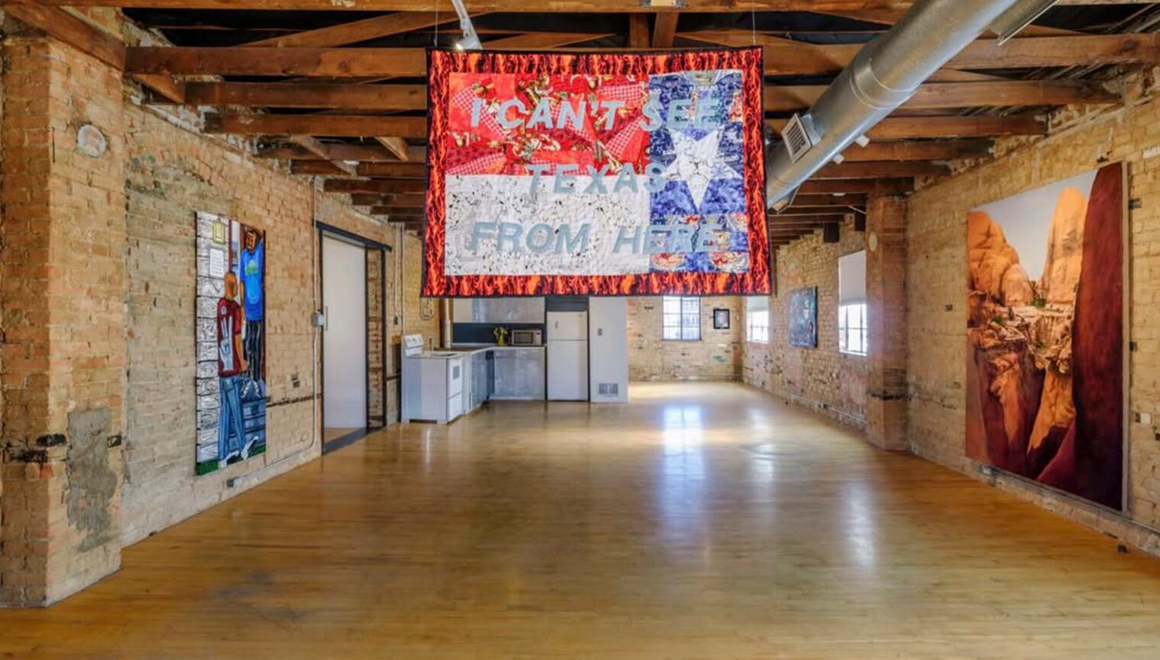
 An installation view of “Minor Regional Novelist” at at Nature of Things. Photo: Kevin Todora
Hung in front of the north-facing window is the quilted work of Dallas-based Daryl Meador. The quilt, featuring an inverted Texas flag (upside-down and backwards), is a patchwork of familiar fabrics. A burgundy-red patch featuring a gun-slinging cowgirl straddling a bucking painted horse is the same fabric as my mom’s duvet cover. Patches of a blue fabric with a cowboy in a red button-down and a yellow wild rag are the same fabric as a hand-me-down vest my mom gave me. Fabric pieces of the Dallas Cowboys star logo, gingham, barbed wire, cotton patches, and flames of glory consume the work as well.
My mom’s favorite musician is George Strait; she used to lull my brother and I to sleep, dancing with us in her arms while she listened to the greatest hits like “Amarillo by Morning” and “I Can’t See Texas From Here,” which are the same words echoed in Meador’s quilt. The lyric is an homage to Strait, to Texas, and to the deep, permeating histories that call us home. On the back of the quilt, you can see the swirling flame pattern stitched into the work, a beautiful touch by Meador.
Another quilt in the exhibition, by El Paso-born Ali Dipp, patches together frayed denim. The borders of the work are adorned with belt loops, tack buttons, and rivets. The image, painted by thread, recreates Albert Bierstadt’s depiction of the vastness of Lander’s Peak in the Rocky Mountains. The rays of light beaming down on the mountains mimic the rays of light reflecting off the desert in Hogue’s lithograph that hangs to the left of Dipp’s quilt.
 Carol Ivey, (left) “Urgent Stillness,” 2022, oil on canvas, 72 x 48 x 1 1/2 inches; (right) “Portrait of a Still Life Painter,” 2008, oil on linen, 48 x 30 x 1 1/2 inches. Photos: Kevin Todora
At the front of the loft are two works by the recently deceased Fort Worth-based painter, Carol Ivey. Across from two chairs nuzzled up to a coffee table overflowing with books referencing the exhibition hangs a painting of Ivey’s featuring an empty chair with a dried, yellowing palm frond balanced on the base of its stem. The open chair feels like an invitation and a silent memorial to Ivey, who was cherished by those in her community. Her self-portrait on the east wall shows her standing, proudly wielding a ceramic fragment and a paintbrush; a dried okra plant with beans intact floats next to her.
Overall, Minor Regional Novelist toasts to Regionalism, pairing contemporary artists with those of the past to reveal what has endured and evolved in visual representations of Texas and the Southwest. In conversation with one another, the works transcend space and time, drawing throughlines and serendipitous connections between stories and histories present and gone by. The exhibition is a rodeo time machine and a road trip to the heart of Texas.
Minor Regional Novelist is on view, by appointment, through May 30, 2026, at Nature of Things next to Deep Vellum.
May 13, 2026: This article has been updated to correct the city where Carrie Cook is based and add context about where the artist was born and raised.