
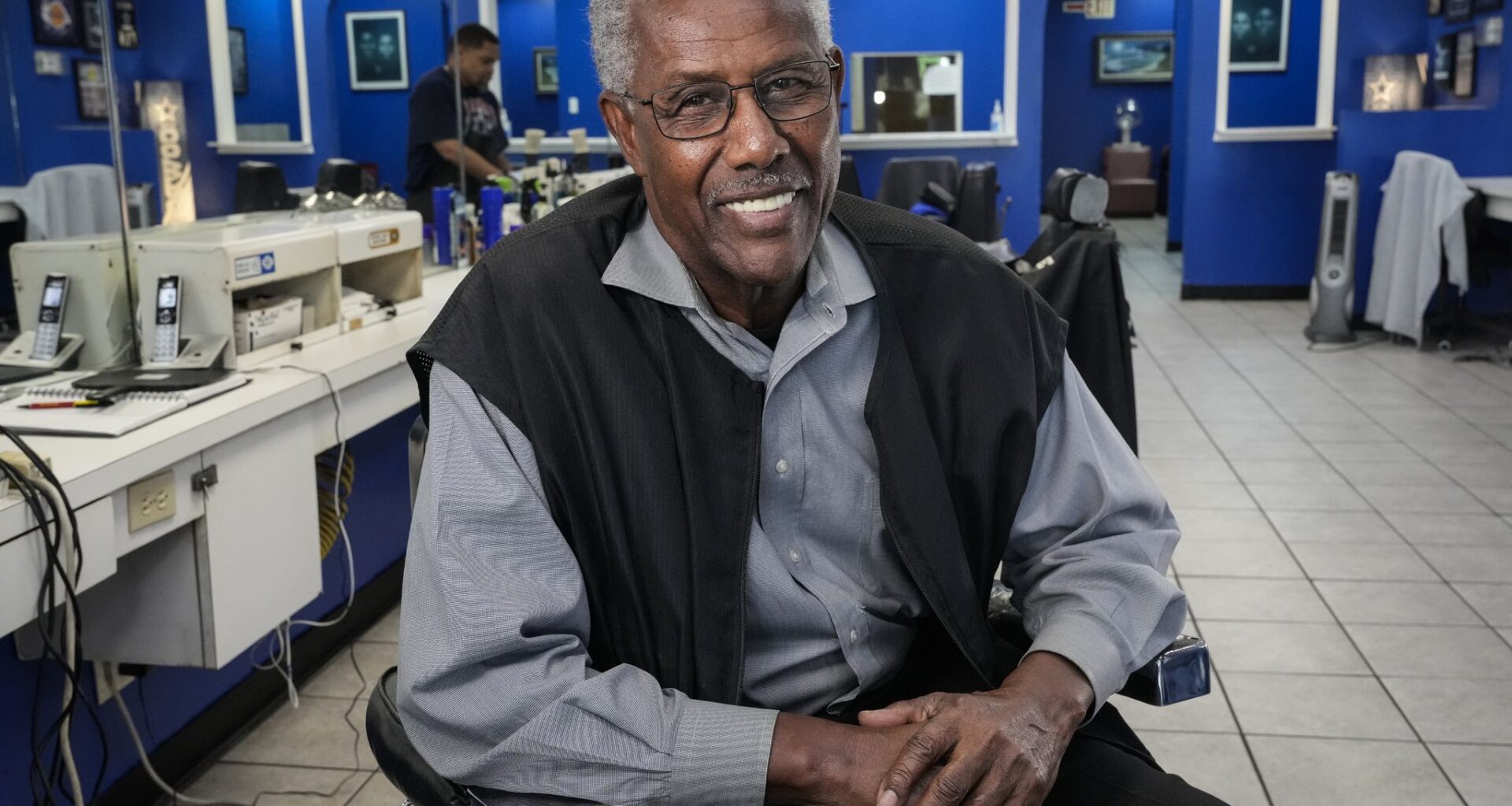
Roy Griffin has run his barbershop in Missouri City for more than 40 years. He’s seen the city grow from a country town with only small post office to a thriving suburb.
Brett Coomer/Houston Chronicle
If you survive 43 years in business in the same strip mall, clippers humming from open to close, you are more than a barber.
You are the keeper of memories — of growing families, friendships, graduations and the next generation of customers wanting a fresh fade.
Roy Griffin has spent 43 years being a constant in a place that never stops changing — and growing — around him. His barbershop, tucked right off Texas Parkway in Missouri City, is a symbol of suburban life: not so fast that you miss the chance to get to know the person in the next chair getting a trim, and slow enough to savor every minute.
Article continues below this ad
Roy Griffin cuts Leroy Roberts’ hair in the barber shop that he has run for more than 40 years on April 29, 2026.
Brett Coomer/Houston Chronicle
This is Missouri City, home to more than 77,000 people. According to the U.S. Census, the city’s population is roughly 39% Black, 20% Hispanic, 19% Asian and 22% white.
Although it might seem like any other suburb, Missouri City is quite remarkable. It’s considered a national benchmark for Black suburban life since so many Black families have migrated there over the last half century. In the 2000s, Black Entertainment Television named Missouri City a “model city” for middle-class African Americans in the United States.
RECENT COLUMN: The Supreme Court made it easy to silence Black voters. It’s time to push back.
Article continues below this ad
Today, the city’s median household income is $94,000, compared to Houston’s $64,000.
But that’s only part of Missouri City’s story.
The Missouri City water tower is shown on April 30, 2026.
Brett Coomer/Houston Chronicle
This “Show Me City,” a nickname adopted in 2007, layers a prosperous Black community on top of a past deeply entrenched in racism and slavery. For generations, relics of that history were evident by street names and historical markers that few stopped to question.
It wasn’t until the national outcry for justice after the murder of George Floyd by a Minneapolis police officer that residents and city leaders began calling for an urgent racial reckoning.
Article continues below this ad
The city’s first Black mayor, Yolanda Ford, made it a point to get rid of the racist street names when she was elected in 2018.
Small-town appeal
Missouri City’s Black suburban population began growing in the 1970s as families, many of them first-time homeowners, were drawn to the newer developments far enough away from Houston, but close enough if they had to return. They bought homes — and a vision of the life they wanted.
Situated about 20 miles from downtown Houston, Missouri City was Griffin’s home long before master-planned communities with lakes were commonplace and sun-drenched fields were ripe for hunting rabbit and quail. There wasn’t much more than a grocery store and a small post office when he and his wife moved there.
A city sign is shown in Missouri City .
Brett Coomer/Houston Chronicle
Like many people who packed up and left the big city, they wanted a better life — a nice house with a two-car garage, pristine yards and excellent schools. Back then, the most expensive house sold for about $36,000, Griffin said.
Article continues below this ad
“When we moved into Chasewood, it was like something from the past — an old cowboy town. It was peaceful, like on a farm,” Griffin said.
NEW HIRE AT CITY HALL: Former Houston Police Chief Troy Finner to lead Missouri City Police Department
By 1980, the Black population increased to nearly 12% of the 24,000 residents, according to the U.S. Census. A decade later, it would double, and double again. It became something many major cities had not seen before, a thriving Black suburb with a mix of blue-collar and professional residents — and even a rapper or two.
Sunnyside native Wanda Webster was one of many Houstonians who wanted a quieter, cleaner and safer neighborhood to raise a family with her husband. They rented a house in Missouri City first, then eventually bought a home in the Quail Valley subdivision.
Their home was filled with energy and the steady rhythm of kids hanging out. Oldest son, Jacques Webster II, now 35, was the neighborhood DJ — a talented drummer and pianist whose creative ambition led him to adopt the stage name Travis Scott and rise to global super stardom as a rapper. Webster’s 25-year-old twins, Joshua and Jordan, both went onto college. Jordan is now in law school, and Joshua works with Scott.
Article continues below this ad
“I liked that Missouri City was small,” Webster said. “Many of us moved to the suburbs because we didn’t like the hustle and bustle. We wanted to raise our families in a community that was small where we knew everyone.”
EMPLOYMENT CRISIS: It’s time to fix the job crisis that put 300,000 Black women out of work
When her children were young, Webster worked at the area’s only AT&T store, where she quickly became a familiar face. She also was active in the Missouri City chapter of Jack and Jill of America, an 88-year-old national organization dedicated to developing Black children through volunteer service, philanthropy and leadership.
Webster moved away in 2017, but said she still returns to visit friends and an occasional check from her dentist, Dr. Opal Brandy, who has practiced in Missouri City for 40 years.
Breaking barriers
The Black residents of Missouri City built something special, but it was less evident in their representation at City Hall. In 1981, Missouri City elected its first Black city council member, Jerry Wyatt, but it would be decades before another barrier was broken.
In 2018, Ford, a Missouri City native who served on city council, was elected as the city’s first Black and first female mayor. She surprisingly defeated incumbent Allen Owen, who served as the city’s mayor for 24 years. In 2020, Robin Elackatt became the first Asian-American mayor.
Remus Wright, senior pastor of The Fountain of Praise, left, hugs Yolanda Ford, mayor of Missouri City, center, after she took the oath of office on Feb. 17, 2019.
Melissa Phillip/Staff photographer
“It was a challenge with the culture that had been embedded into city government,” Ford said. “We had never had representation at that level. It was like we had a seat at the table now. That was something very important.”
Ford grew up in Missouri City’s Quail Glen subdivision with parents who both worked in the oil and gas industry. They were from Wharton, a small town 60 miles from Houston. They moved to Missouri City after the 1980s oil bust when many white families left the area and Black families moved in, Ford said.
“At the end of the day, it was a community. We played with everybody in the neighborhood, across the neighborhood. We rode our bikes over what we called the bridge into Quail Valley.”” she said.
For all of its idyllic appeal, Missouri City isn’t without its scars.
In 2019, the Sienna subdivision in Missouri City had on display three large bowls, left, that were believed to be used between 1888-1905 in sugarcane production, which depended on enslaved labor. At right, a large brick building called a purgery dates pre-Civil War.
Jon Shapley / Houston Chronicle
In 2019, the Sienna subdivision in Missouri City had on display three large bowls, left, that were believed to be used between 1888-1905 in sugarcane production, which depended on enslaved labor. At right, a large brick building called a purgery dates pre-Civil War.
Jon Shapley / Houston Chronicle
Large portions of land were once used for sugarcane and cotton plantations, including the Arcola Plantation, where more than 200 enslaved people were held. It was considered to be one the largest and most brutal plantations in Texas. According to the Texas State Historical Association, plantation owner Jonathan Dawson Waters was known for overworking enslaved people and feeding them nothing more than cornmeal mush.
In 1997, Johnson Development began transforming the land into an upscale master-planned development called Sienna Plantation. For some who bought homes there, the promise of luxury amenities and high-end construction outweighed the discomfort of the name.
Still, it bothered Ford.
In 2019, while serving as mayor, she initiated the ordinance prohibiting historically offensive names from being assigned to streets and subdivisions. The following year, Sienna Plantation quietly became Sienna. Today, the community is nearly 62% white, 12% Black and 12% Hispanic.
Ford’s push also reignited an effort by a Missouri City couple to rename their street, from Confederate Drive to Prosperity Drive. They had tried in 2014, but couldn’t get the neighbor support required to move forward.
The moment came in 2020 after the murder of George Floyd prompted an outcry internationally, forcing a reckoning of the U.S.’s racist past.
Monuments fell, and flags came down.
Friends and neighbors toast the renaming of their street to Prosperity Drive Sunday, Feb. 6, 2022 in Missouri City.
Brett Coomer / Houston Chronicle
Friends and neighbors toast the renaming of their street to Prosperity Drive Sunday, Feb. 6, 2022 in Missouri City.
Brett Coomer / Houston Chronicle
According to The Southern Poverty Law Center, more than 160 Confederate monuments and symbols were removed nationwide in the months following Floyd’s death.
Prosperity Drive was approved. A wave of other street name changes followed, including Bedford Forest Drive – named for the Confederate general and first Ku Klux Klan grand wizard Nathan Bedford Forest – which was changed to Liberty Way Drive.
At his barbershop, Griffin doesn’t dwell on the past. He’s seen what a community can do.
He’s watched the children leave the nest and forge their own paths, becoming the people he knew they would be. His own children, an engineer with the Houston Fire Department, a psychologist daughter and a nurse practitioner, are also examples of that.
“I’m proud of all these kids who have come through here because they excelled greatly. When I see them grow up, that’s my joy. It’s not about the money. It’s about the joy of seeing them go on and do great things,” he said.
Outside, Missouri City keeps growing. Inside the shop, the clippers still hum as time slows just enough to hear one more of Griffin’s stories.
Roy Griffin cuts Leroy Roberts’ hair in the barber shop that Griffin has run for more than 40 years in Missouri City.
Brett Coomer/Houston Chronicle
This column is part of a content partnership with the online community Black Houston.
COMING UP: As Missouri City evolves, it’s not just growing in size, but in vision, becoming a place where prosperity and possibility rise together.