
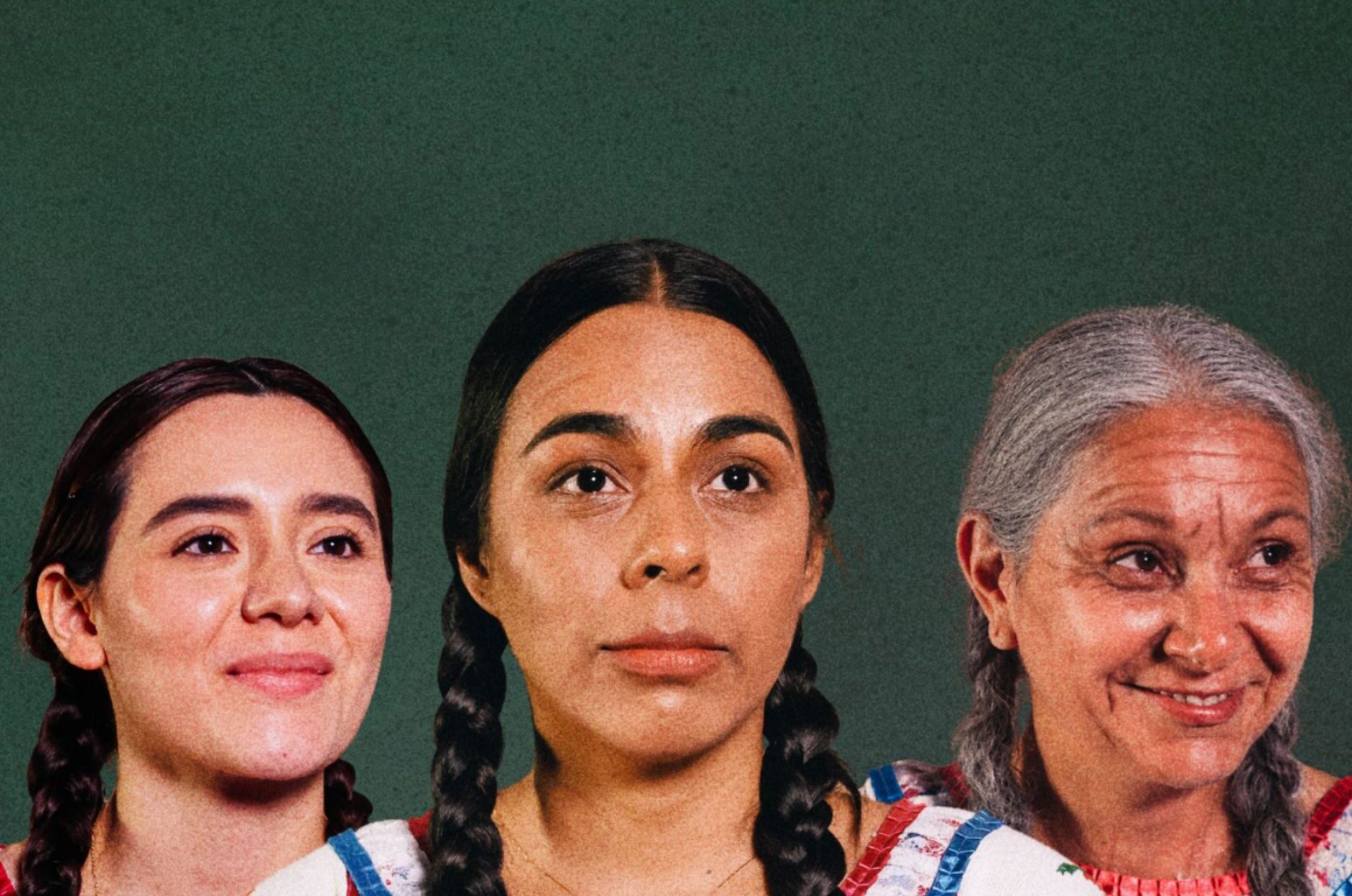
From left, Lucila Rojas, Julia Landey and Frida Espinosa Müller play the title character at different stages of her life in Cora Cardona’s “Los Niños Santos de María Sabina,” which is premiering in a production by Teatro Dallas.
Frederick Ezeala
Cora Cardona was shocked and saddened when she recently visited the remote Mexican town of Huautla de Jiménez. The co-founder of Teatro Dallas says it has become commercialized around its most famous product — María Sabina and the magic mushrooms she used to cure the sick — while its Indigenous people remain poor and the healer’s legacy misunderstood.

“The little town boomed when she became a famous figure internationally, but they are still not financially in good shape,” says Cardona, who has written a play about Sabina in the hope of rehabilitating her image and bringing attention to the true meaning of her practices.
Article continues below this ad
“There are ‘María Sabina’ taxis. You see little shops with her name and arts and crafts that deal with her. … What’s painful is they use her name as a source of tourism, but her family still lives in poverty. Her little museum is ridiculous. You want to weep because there is no museography. There are stacked Xerox copies of her face with some tags. There’s a photo of John Lennon, though there’s no proof he visited. A good museum would take us back to the pre-Hispanic history of the area. Money needs to be invested to recuperate her. I think she’s another Frida Kahlo.”
The tradition of using psilocybin mushrooms in ritual ceremonies called veladas dates back centuries among the native Mazatec population, but it was largely hidden from the West until American banker R. Gordon Wasson visited Huautla de Jiménez in 1955. An article for Life magazine about his experience taking mushrooms in a velada led by Sabina and his later writings fueled hippie pilgrimages to the region few outsiders were previously familiar with.
Like with Lennon, misinformation still flows today, such as the claim that ’60s music celebrities like Bob Dylan and Jim Morrison, who were part of the psychedelic movement, “tripped” with Sabina. It’s true she entertained interest from Westerners seeking her help, sometimes under false pretenses, and her open-door policy contributed to the popularization and the later criminalization of recreational use of psilocybin mushrooms.
Make Dallas News a preferred source so your search results prioritize writing by actual people, not AI.
Add Preferred Source
Cardona’s new play Los Niños Santos de María Sabina — named for “the holy children,” Sabina’s description of the sacred mushrooms that were part of Mazatec culture — is now premiering at Teatro Dallas, where Cardona was artistic director until 2018. She has since moved back to her hometown of Mexico City.
Article continues below this ad
Performed in Spanish with English subtitles, it received a new works grant from North Texas arts funder TACA at the suggestion of Cardona’s daughter, Sara, the company’s development director, who visited Huautla de Jiménez with her mother.
Cardona, who is directing the production, has cast three actresses to play Sabina at different stages of her long life. She was in her 90s when she died poor and malnourished in 1985. They also take on the roles of her mother and younger sister. Three actors play the men in her life, including her father, her biographer Alvaro Estrada and a pair of fictional students who visit her.
Lucila Rojas plays Maria Sabina during one stage of her life in Cora Cardona’s “Los Niños Santos de María Sabina,” which is premiering in a production by Teatro Dallas.
Frederick Ezeala
Sabina was so rooted in the ancient past of Oaxaca’s Sierra Mazateca region that she didn’t speak Spanish; she spoke only her native Indigenous language. Besides being a curandera, she was a poet despite never having learned to read or write. Her family were peasants who handed down the shamanistic customs of the Mazatecs. She practiced Catholicism, which she mixed with her pre-Christian beliefs in a way that was acceptable to the church.
Article continues below this ad
Her father died when she was 3. There are many myths, half-truths and unknowns about her life, but it’s clear she was surrounded by tragedy and death. Some people in Huautla de Jiménez were unhappy about her contact with Westerners and punished her and her family for it.
“Maria Sabina had the memory of our ancestors on the American continent,” Cardona says. “She embodies the DNA of our origins even way back to China and Siberia. She had an incredible life, living a whole century, just about. It’s an epic, which I’ve tried to summarize. Of course, we can’t do everything but highlight the hardship of her life and the wonderful job she did curing and healing.”
Cardona first visited Huautla de Jiménez when she was 18 or 19, after an experience she doesn’t want to detail publicly led her there. She says she took mushrooms.
“It was very beautiful in that I saw some Indigenous imagery, very colorful. The trip was about discovering — not to say that it’s a fact in reality — that we never die. I didn’t find out how or anything in detail, but I had that sense that death was not feeling anything — cold, hunger, emotion — that it was nothingness, that I am and would always be here. And then the harmony of how everything is connected to you — the rocks, the trees, the animals, the person crossing the street, the person crossing the mountain, the stars, the cosmos and everything around them. Even the stone is alive.
Article continues below this ad
“Not to say that’s the same trip that’s going to happen to you or someone else. After I received that information, I felt like I don’t want to do it again because I’m not sure I’m prepared. I was very young.”
Cora Cardona’s (pictured) new play, “Los Niños Santos de Maria Sabina,” is premiering in a production by Teatro Dallas. Cardona was the troupe’s artistic director until 2018.
Leticia Alaniz
Cardona hopes Los Niños Santos will help audience members see a side of themselves we often ignore.
“In a society in which we’re fixed on everything but our interior, we’ve lost touch with magic and nature, with everything that seems weird and impossible,” she says. “The richness from Alaska to Patagonia lies with the original people of this continent, the Indigenous people that we have forgotten. Their lives, their stories, their crafts, their whole world and the cosmology they had is so important to recuperate our identity.”
Article continues below this ad
Details
May 15-24 at the Latino Cultural Center, 2600 Live Oak St. $25-$40. teatrodallas.org.