
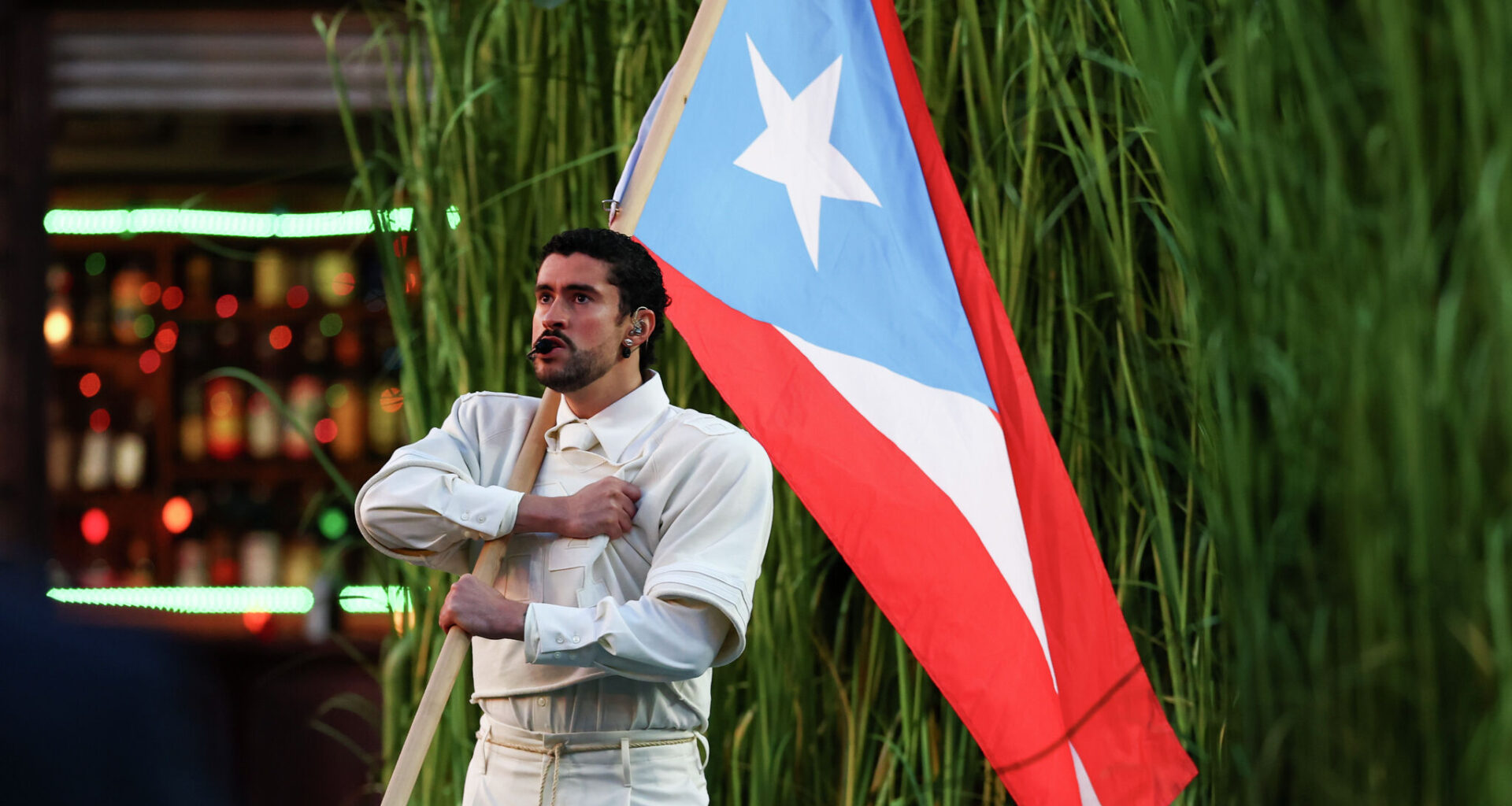
Bad Bunny performs in the Apple Music Halftime Show during the NFL Super Bowl 60 football game between the Seattle Seahawks and the New England Patriots, at Levi’s Stadium on February 8, 2026 in Santa Clara, California.
Kevin Sabitus/Getty Images
The backlash to Bad Bunny’s Super Bowl LX halftime show says as much about the country as it does about the performance itself.

Wired received information on 2,155 complaints through a Freedom of Information Act request to the FCC, the federal agency that regulates television. The data shows that Texas led the nation in objections to the February halftime performance, followed by Florida and California. The grievances were familiar: too much Spanish, too much sexuality, too much queerness, too much Puerto Rico on one of the most American stages in television.
Article continues below this ad
The NFL spent years trying to make the halftime show feel globally relevant. Then it booked the world’s biggest Spanish-language artist and discovered exactly how many viewers still expect the Super Bowl to speak only one language.
“Such trash should not appear during prime time hours when little eyes and ears are viewing,” one viewer wrote.
President Donald Trump amplified the outrage in real time, posting on Truth Social that “nobody understands a word this guy is saying” and calling the performance inappropriate for children. Trump had criticized the NFL’s decision to book Bad Bunny months before kickoff, framing the halftime show as evidence of a country drifting away from a cultural center.
But the panic surrounding the performance often ignored what was actually happening onstage.
Article continues below this ad
Bad Bunny — born Benito Antonio Martínez Ocasio in Puerto Rico — did not deliver an overtly political set. He delivered something more specific: a distinctly Puerto Rican one.
What did Bad Bunny say at the Super Bowl?
Bad Bunny performs onstage during the Apple Music Super Bowl LX Halftime Show at Levi’s Stadium on February 08, 2026 in Santa Clara, California.
Kevin Mazur/Kevin Mazur/Getty Images for Roc
For 12 minutes, the halftime show transformed Levi’s Stadium into a compressed version of the island itself. Piraguas, public housing communities, slang, salsa samples and references to blackouts caused by Puerto Rico’s fragile electrical grid all flashed across the screen. Older Puerto Rican men played dominoes under stadium lights usually reserved for military flyovers and beer commercials.
Article continues below this ad
At one point, Bad Bunny knelt beside a young boy, placed a Grammy trophy in his hands and told him, “Cree siempre en ti” — believe in yourself. Later, he explained to viewers that if he had made it to the Super Bowl stage, it was because he never stopped believing in himself.
The show functioned as a cultural collage. Every visual cue carried meaning for Puerto Rican audiences: the agricultural imagery at the opening, references to “El Apagón,” nods to Taíno heritage, the invocation of “Nueva Yol,” Puerto Rican shorthand for New York City and the diaspora that has long moved between the island and the mainland.
What drew backlash in some households was precisely what made the performance resonate for others. The show refused translation. It did not pause to explain slang or sanitize itself into something more digestible for English-speaking viewers. It assumed Puerto Rican culture deserved the center of the frame without apology.
Why Bad Bunny’s halftime show hit a nerve in Texas
Bad Bunny performs onstage during the Apple Music Super Bowl LX Halftime Show at Levi’s Stadium on February 08, 2026 in Santa Clara, California.
Kevin Mazur/Kevin Mazur/Getty Images for Roc
FCC commissioner Anna Gomez ultimately found no broadcast violations after reviewing the complaints and transcripts. Lyrics had been edited appropriately for network television standards.
Article continues below this ad
The backlash arrived as the performance shattered records. According to the NFL, Roc Nation and Apple Music, the halftime show drew roughly 4.157 billion global views across platforms, becoming the most-watched halftime performance in history. Viewership peaked during Bad Bunny’s set.
Previous halftime controversies now feel comparatively minor. Kendrick Lamar’s performance last year drew about 125 complaints. Rihanna’s 2023 set drew just over 100. Bad Bunny’s crossed into the thousands.
Texas leading the complaint count feels particularly revealing. This is a state where Spanish surrounds daily life — on billboards, in grocery stores, at family parties, in neighborhoods built long before MAGA slogans. Yet the visibility of Spanish inside the Super Bowl still managed to provoke outrage from viewers who treated it like an invasion.