
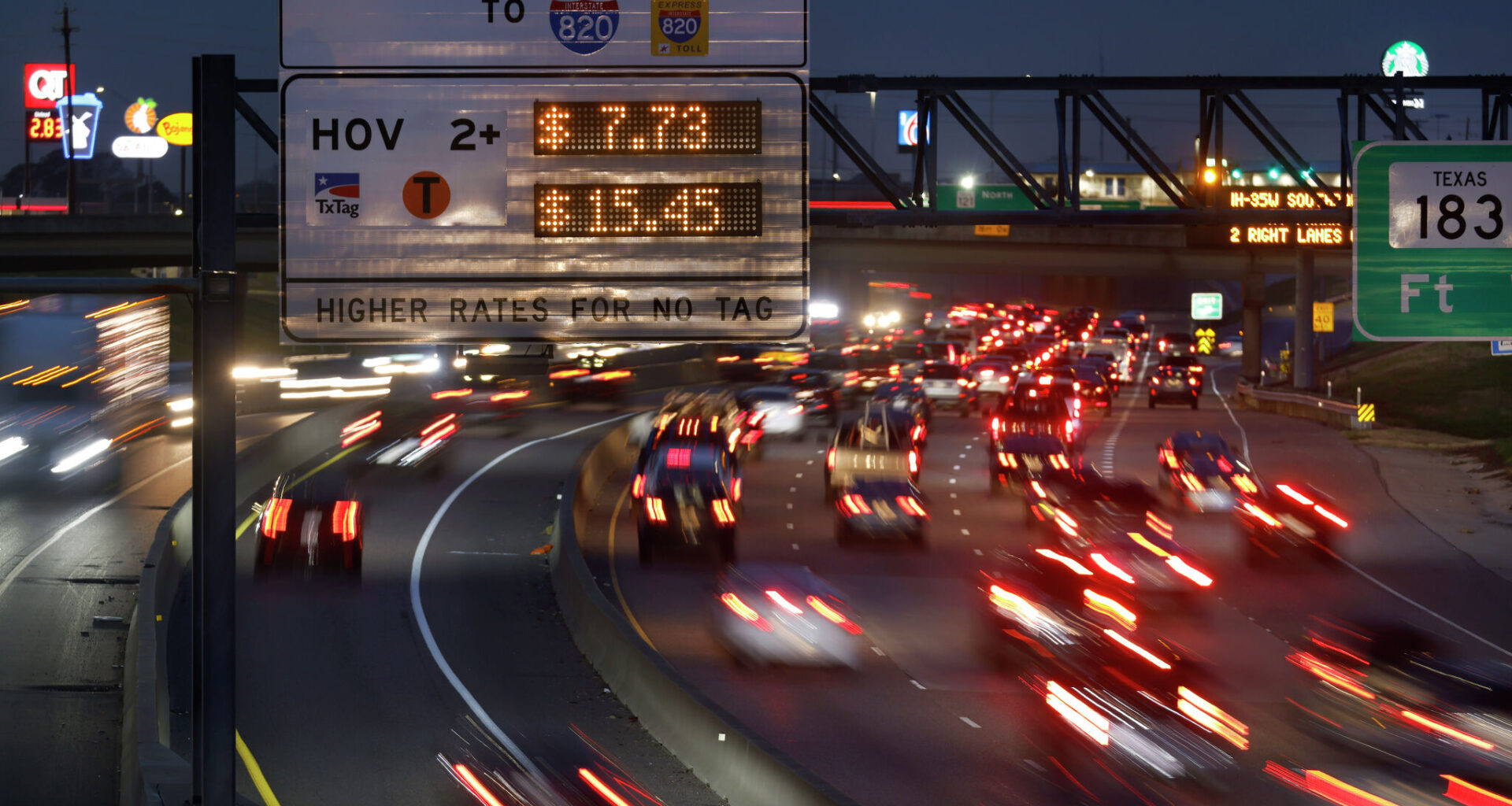
At dusk, traffic flows on the TEXpress Lanes along westbound SH 183 at American Blvd in Euless, Texas, February 6, 2024.
Tom Fox/The Dallas Morning News via Getty Images
Toll roads can be a sneaky thing. If you live your life only driving within San Antonio’s two loops you’ll successfully avoid toll roads entirely. But if you’re on a road trip and end up not exiting in time, you might find yourself getting caught on camera and wondering how to pay a bill you just acquired.

Toll roads in Texas generate more than $2 billion across the state, with Harris County alone reporting $1 billion in tolls and North Texas reporting $1.19 billion in 2024. The state operates 36 toll roads covering 263 centerline miles of Texas highways, but not an inch in the Alamo City.
Article continues below this ad
How much are toll road fees?
Drivers on toll roads are charged every time they pass through a toll plaza, but those rates will vary by location. For example, drivers in SUVs, sedans, pickup trucks, and other passenger cars driving on SH 130 will be charged between $0.61 and $2.24, depending on the part of the toll road they pass through.
In contrast, drivers on SH 45 North will be charged between $0.90 and $1.36 at the toll plazas. Those rates increase for larger vehicles such as 18-wheelers, but that’s the general scale most drivers can expect on toll roads across the state.
Which Texas cities have the most toll roads?
Dallas, Houston and Austin are all tied for the most toll roads in Texas with five apiece.
Article continues below this ad
In Dallas that number grows to 19 when you add the 14 surrounding area toll roads in Fort Worth, Hurst, Grapevine, Garland, Grand Prairie, Frisco, Irving, Addison, Lakewood Village, Lake Dallas and McKinney.
The Houston area also houses toll roads in Spring and Harris/Montgomery County, in addition to a toll road in Baytown to the east. Austin, meanwhile, has neighboring toll roads in Georgetown, Leander, and Manor.
Brownsville is home to the only toll road in the Rio Grande Valley.
Article continues below this ad
Why are there so many toll roads in Texas?
Texas has so many toll roads as a means of closing the funding gap so that “timelier infrastructure expansion is made possible,” according to the Central Texas Regional Mobility Authority.
“Simply put, federal and state transportation funding is in very short supply and the level of taxpayer dollars appropriated by our legislature cannot keep pace with demand,” the Authority writes. “Toll roads provide a viable funding option to build roads now rather than using the traditional gas tax-funded, pay-as-you go approach.”
Vehicles pass under a toll plaza along the west Sam Houston Parkway, Thursday, Aug. 15, 2024, in Houston.
Jason Fochtman/Houston Chronicle via Getty Images
How do I pay for toll roads in Texas?
Tolls are paid most commonly by having electronic tags with either TxTag, TollTag or EZ TAG. If drivers already have funds in their electronic accounts, the toll roads will automatically debit the funds. Otherwise drivers will
Article continues below this ad
Drivers without electronic tags will receive invoices by mail with payment instructions. Cameras at the toll plazas take pictures of license plates and the invoices will be mailed to the addresses registered with the DMV.
One-time payments or missed tolls can be paid at paymobilitybill.com, hctra.org or NTTA.org.
If someone wants to pay in person, they can visit the TxTag Customer Service Center at 12719 Burnet Road, Austin, TX 78727. Cash, checks, money orders and credit card payments are accepted Monday through Friday from 7 a.m. to 7 p.m. and Saturday from 8 a.m. to 4:30 p.m.
What’s the difference between TxTag, EZ TAG and TollTag?
The difference in the electronic tags mainly lies in where they’re most used in the state.
Article continues below this ad
EZ Tag is overseen by the Harris County Toll Road Authority (HCTRA), while TollTag is run by the North Texas Tollway Authority. However, while both tags are primarily for Houston and Dallas, respectively, they are also accepted on all Texas toll roads.
TxDOT previously oversaw TxTag services, but as of November 9, 2024, the HCTRA is now processing all toll transactions for TxDOT-operated toll roads in the Austin and Houston regions.
How do I find out if I owe tolls in Texas?
If you’re unsure if you owe a toll or not, you can check your status on the HCTRA website by entering your license plate number. Any pending payments will appear under that page.
Article continues below this ad
A toll sign stands alongside an onramp to SH 99 Grand Parkway Wednesday, May 18, 2022 near Dayton.
Brett Coomer/Houston Chronicle via Getty Images
What happens if you don’t pay a toll in Texas?
If you don’t pay a toll in Texas you run the risk of receiving additional fees and criminal charges.
The non-payment fees, as outlined by the Central Texas Regional Mobility Authority, are:
Article continues below this ad
Toll Bill: tolls + $1 processing fee
Notice of Non-Payment: (30 days past due) unpaid tolls + unpaid fees + $15 non-payment fee per invoice
Second Notice of Non-Payment: (60 days past due) unpaid tolls + unpaid fees + $15 non-payment fee per invoice
Final Notice of Non-Payment: (90 days past due) unpaid tolls + unpaid fees + $15 non-payment fee per invoice
After more than 120 days of non-payment, drivers can be charged a misdemeanor for toll evasion on top of having to pay the toll, court fees and up to $250 special fine per unpaid toll.
Can unpaid tolls affect vehicle registration in Texas?
If someone is identified as a “habitual violator,” meaning they have 100 unpaid tolls within a year, they could have their vehicle registration blocked, receive a vehicle ban, criminal misdemeanor charges, a fine up to $500 and have their vehicle impounded.