
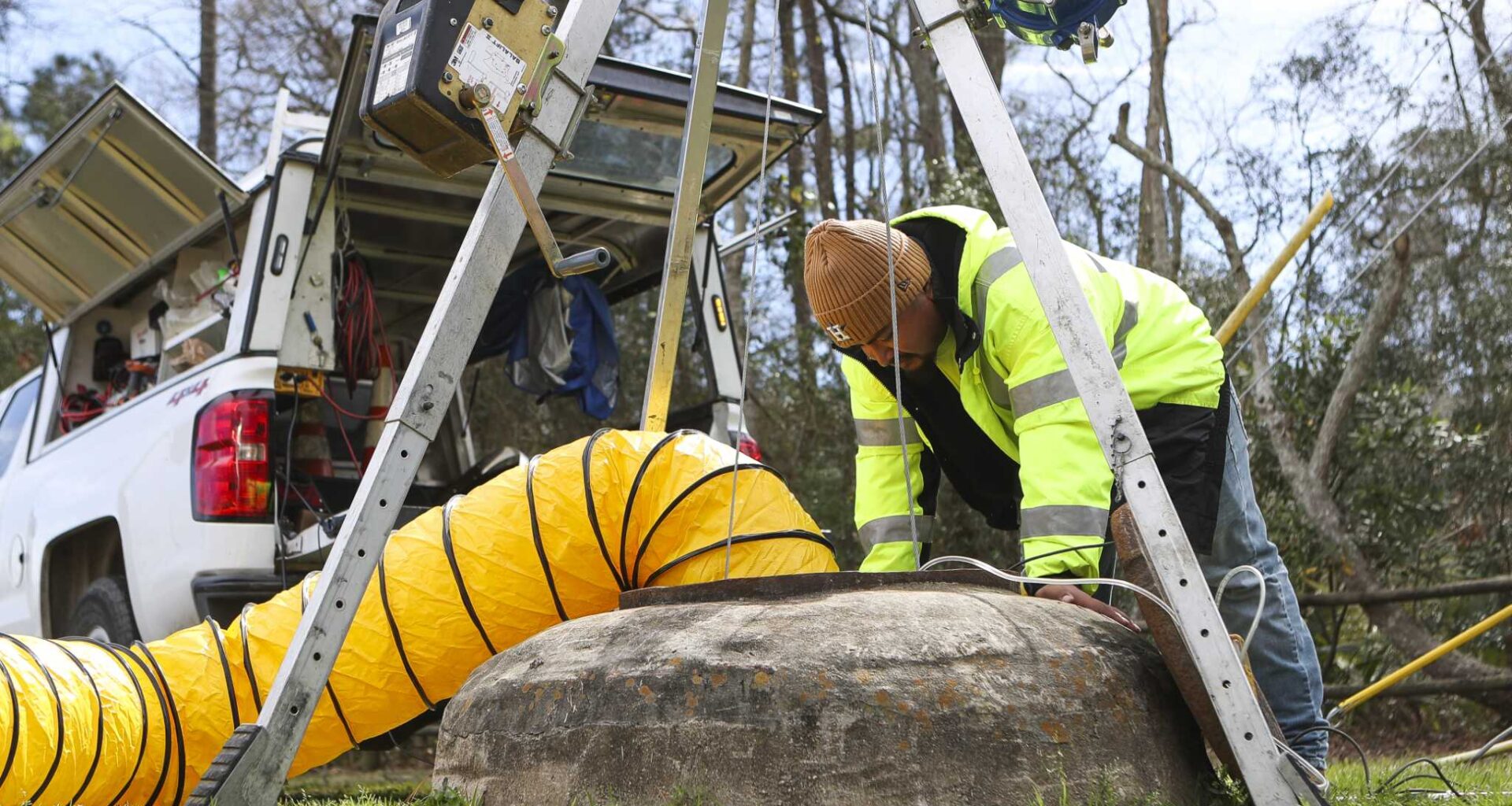
A worker measures water flow near a Houston sewer lift station in 2023, in Kingwood.
Jason Fochtman/Staff photographer
Contractors work to make repairs on a Houston sewer line that runs behind homes on Jefferson Street at Telephone Road in 2020.
Mark Mulligan/Staff photographer
Mayor John Whitmire’s proposed budget closes a $180 million deficit by relying heavily on revenue from the water bills Houston residents and businesses pay, a significant shift that critics warn could weaken the city’s ability to address enormous needs in its water and sewer systems.
Much of the discussion of Whitmire’s $7.5 billion budget for the fiscal year that starts July 1 has focused on his proposal to begin charging city trash customers $5 per month – a major policy shift in the largest Texas city without a garbage fee and one that hasn’t raised its property tax rate in three decades.
But the new fee is only one piece of a much larger financial restructuring unfolding at City Hall.
Article continues below this ad
Whitmire proposes removing the solid waste department’s $117 million budget from the strained general fund and placing it in the city utility system within Houston Public Works. Instead of funding the department mostly with property and sales taxes, it would be funded mostly by residents’ water bills and the new fee.
But the new fee is expected to generate just $24 million next fiscal year. That means it will take $93 million in water and sewer revenue to cover the rest of the solid waste budget.
Whitmire also proposes charging the utility fund for its pipes using the city right of way – moving $104 million in water bill revenues to the general fund.
That’s a combined $197 million burden on the utility system next year alone.
Article continues below this ad
In announcing his budget earlier this month, Whitmire said the proposal would bring Houston in line with other major Texas cities that already rely on utility transfers and trash fees.
“Why didn’t Houston do this a long time ago? I mean, it’s just a practical solution,” he said. “We’ve really been fooling ourselves for a long time. There is a tremendous source of revenue that other cities are using and for whatever reason the city of Houston didn’t.”
But the utility system also faces serious challenges.
City water pipes leak billions of gallons each year. Water treatment plants require massive upgrades. The city sewer system spills raw waste so often that Houston must invest billions of dollars under a federal decree. The city also funds about $90 million in drainage projects each year using utility revenues.
The financial impact of Whitmire’s proposal would affect the utility system far beyond one year.
Article continues below this ad
Water bills would subsidize solid waste services for at least 6 years. That’s how long administration officials say they will take to incrementally raise the fee to $25 per month and cover the solid waste budget.
But Whitmire has not publicly committed to go above $5 per month. And a study the city commissioned also raises questions about whether the fee would need to be far higher than $25 to fully cover solid waste services.
“Playing fast and loose with these restricted funds shortchanges both systems and degrades trust in government,” said Alice Liu, of the Houston People’s Budget campaign. “What we need instead is a budget that prioritizes Houstonians, addresses failing water and flood infrastructure, refuses to compromise on worker safety, and stops police overspending.”
Whitmire’s office did not respond to a request for comment. The mayor’s office has not answered requests for comment from the Houston Chronicle since August.
City officials have argued the utility system is financially healthy enough to absorb the changes because years of rate increases – driven in part by the sewer consent decree – have made it flush with cash.
Article continues below this ad
Steven David, Whitmire’s deputy chief of staff, said at a May 11 Super Neighborhood Alliance meeting that the proposal would not delay water or wastewater projects. He said the changes are necessary because Houston relies too heavily on property and sales taxes compared to other major Texas cities.
“We can’t continue to do business the same way,” David said, adding that Houston must “systematically change” how it funds government services.
But critics argue Whitmire is using water bills to temporarily relieve broader budget pressures. They warn the strategy depends heavily on future trash fee increases and continued strong utility finances to remain sustainable over the long term.
City Controller Chris Hollins has criticized Whitmire’s proposal in a series of “Reality Check” town halls, arguing the administration is not fully accounting for the scale of the utility system’s obligations. He questions whether the fund has enough reserve funds to weather the changes.
“We’re saying, ‘Let’s take the money out of water and let’s put it over here in the general fund,’” he said. “And we’re advertising that no one’s going to have to pay to make the water fund whole again. Which is just false.”
Article continues below this ad
Infrastructure obligations
Critics argue the proposal arrives at a risky moment for Houston’s utility system, which is already under a federally mandated overhaul.
Houston is five years into a 15-year federal consent decree requiring the city to spend billions repairing aging sewer infrastructure after decades of sewage overflows violated the federal Clean Water Act.
The city must replace or rehabilitate hundreds of miles of sewer pipe annually, upgrade lift stations and wastewater treatment plants and reduce sewage spills into neighborhoods and waterways.
While the decree was initially estimated to cost roughly $2 billion when it was finalized in 2021, environmental advocates and independent reviewers now estimate the long-term cost could reach $9 billion as infrastructure needs, inflation and delayed projects continue driving expenses higher.
A recent independent review commissioned by the nonprofit Bayou City Waterkeeper found some of Houston’s highest-priority consent decree projects remain delayed or incomplete, while it’s unclear whether sewage overflows are decreasing across the city.
The city also continues to face persistent leaks in aging water pipes and mounting costs tied to major water treatment plant upgrades, including a $1.8 billion project at the North East plant and an estimated $4.2 billion in work at the East plant — $1.1 billion of which is coming out of the utility fund.
Advocates say these existing obligations are what make Whitmire’s proposed budget restructuring concerning.
“It’s really unclear how the city is going to comply with the consent decree over time,” said Ben Hirsch, co-director of West Street Recovery. “There has been no presentation of the math that they can move this money out on a yearly basis and comply with the consent decree, and comply with the debt service requirements.”
Guadalupe Fernandez of Bayou City Waterkeeper also called for greater transparency from the city on how the utility system will handle the changes.
“The stakes are high because deferring water repairs only makes them more expensive later,” Fernandez said. “We have deep concerns about moving money out of the utility when the system’s needs are so visible. If the city has found extra room in the (utility) budget, that money is best spent fixing the infrastructure we already have and helping low-income residents keep up with their rising water bills.”
The monthly water bill for a typical single-family home using 4,000 gallons of water has risen from roughly $75 to $125 since the consent decree was finalized in 2021.
Even some supporters of Whitmire’s proposal worry about the longterm effects on the utility system.
Bill King, a fellow at Rice University’s Baker Institute for Public Policy, said he believes the utility system can likely absorb the added burden in the near term because water rate increases have strengthened its finances.
City data show utility revenues and expenses have both risen after the consent decree, but that spending grew slower than revenues, growing the cash on hand in the utility system to $1.3 billion.
“It fixes the general fund for a few years,” King said. “I don’t think the financial problems are in the (utility system) given how much we’ve increased the water rates.”
King cautioned, however, that the proposal does not permanently solve Houston’s broader budget problems. And said he doubts future city leaders will raise trash fees high enough to fully cover solid waste operations.
Fear and relief
For many residents, the debate over Houston’s utility system comes down less to bond ordinances and reserve thresholds and more about improvement to city services.
At the Super Neighborhood meeting at City Hall, residents repeatedly questioned why they are being asked to pay new fees while many still experience missed trash pickups, water leaks and illegal dumping — especially when the administration has not clearly explained what immediate service improvements residents should expect in return.
Some questioned why the city is shifting more costs onto residents while spending heavily on police and fire services. Others asked why Houston is not pursuing more aggressive code enforcement to generate ticket revenue before introducing new fees.
Vicky Martin, President of the Settegast Super Neighborhood, described the proposal as a fear and relief strategy: creating pressure through deteriorating services before presenting new fees as the solution.
“We feel like we’re victims of that,” Martin said. “People here know how to balance budgets. But there’s an efficient way to do it.”
Other residents questioned whether future city councils would actually approve the steady fee increases needed to sustain the proposal long-term, or whether residents would eventually face more utility rate increases if the trash fee never reaches its full cost.
“We had water rates raised every year for five years, but when we have problems, it’s difficult to get service,” Beverly Adjei, president of the OST/South Union Super Neighborhood, said to David, the senior Whitmire aide. “What are you doing to help us?”
In response, David spoke of the operational efficiencies city staff have found in the budget.
“The bites of the apple are thinner and thinner,” he said. “At some point, we have to have a conversation about the fact that there’s a structural imbalance and what we want the city of Houston to do.”