
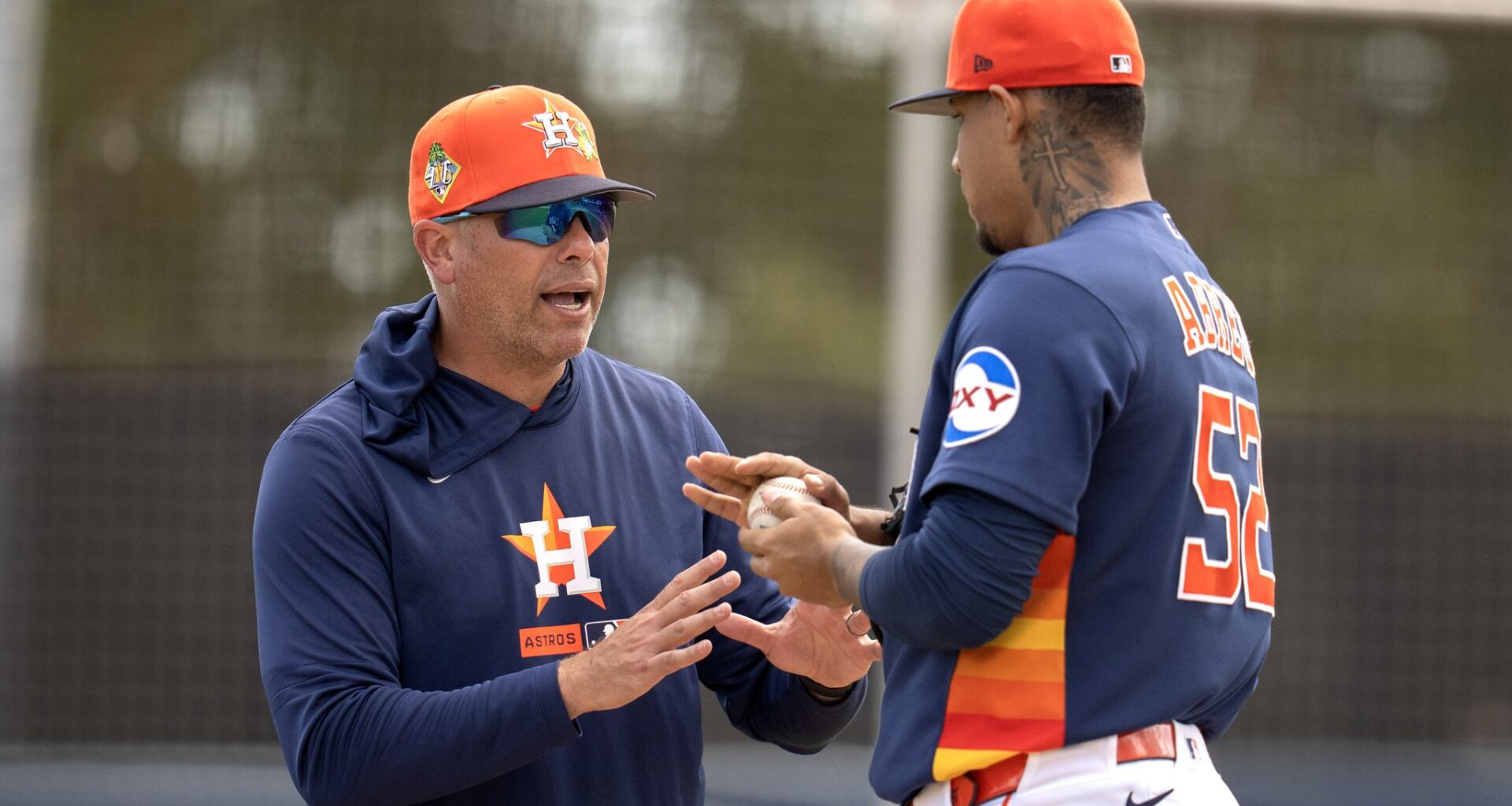
Astros pitching coach Josh Miller has seen a variety of issues result in his hurlers walking hitters at a historic rate this season.
Jason Fochtman/Houston Chronicle
Perhaps no element of the Houston Astros’ pitching issues early this season is more glaring — or puzzling — than the walks.
Astros pitchers have issued the most walks in the majors, averaging 5.04 per game entering Saturday’s game against the Texas Rangers, contributing to the staff’s majors-worst ERA. Houston issued six or more walks in 20 of its first 46 games, amid an 18-28 start. Last season, it did that in 24 games overall.
“Need to be better, obviously,” Astros pitching coach Josh Miller said Friday. “We’ve brought awareness to our walk rate, to other things that have gone awry of our plan. (We’re) trying to execute pitches at a higher level. Trying to tap into our pitchers’ strengths and have them attack the zone early. And that goes for the whole staff.”
Article continues below this ad
The past few weeks have indicated moderate progress. Astros pitchers averaged 5.5 walks over their first 25 games this season, then 4.5 walks in their next 21 games.
Still, the rate at which Houston is walking batters so far is historic. Entering Saturday, the Astros were on pace to issue 817 walks this season — the MLB modern-era record is 827 by the 1915 Philadelphia A’s. Houston averaged 5.2 walks per nine innings across its first 46 games. Just six MLB teams have walked more than five batters per nine innings over a full season since at least 1900, per Baseball Reference.
“There’s a myriad of things that haven’t gone well for us as a group,” Miller said. “I do think the new ABS system has changed the dynamic of the game somewhat (with) umpires’ strike zones and hitters’ swing behavior. Maybe it happened a little heavier than we anticipated at the start of the season.
Article continues below this ad
“We’ve attempted to adjust for that. But mostly it comes down to us executing pitches and being confident in the zone with whatever pitch selection we make. And the guys are getting better. Still room to go.”
BATTERS
AVG
OBA
AB
R
H
2B
3B
HR
RBI
BB
SO
SB
CS
E
Team Totals
.253
.329
1559
208
395
82
3
55
198
162
368
17
7
17
Shewmake
.366
.366
41
6
15
1
0
3
7
0
6
0
0
0
Trammell
.345
.424
29
4
10
1
1
0
4
4
9
1
0
1
Alvarez
.321
.431
168
29
54
11
0
14
30
29
31
1
0
1
Correa
.279
.369
122
22
34
8
0
3
16
18
26
1
0
1
Loperfido
.276
.348
58
7
16
5
0
0
7
6
19
1
1
1
Walker
.265
.342
166
26
44
10
0
10
29
18
36
0
0
0
Paredes
.257
.349
148
17
38
7
0
4
18
15
29
0
0
2
Peña
.256
.304
43
5
11
4
0
0
0
3
6
1
0
1
Vázquez
.253
.306
79
7
20
4
0
3
12
6
16
0
0
0
Altuve
.245
.328
159
26
39
10
0
3
11
19
34
1
2
2
Meyers
.243
.326
37
5
9
2
0
1
4
4
8
1
2
0
Diaz
.238
.255
101
7
24
5
0
2
14
3
16
0
1
0
Cole
.226
.250
31
2
7
1
0
2
6
0
13
0
0
1
Harris
.226
.286
31
4
7
0
1
0
4
2
6
2
0
0
Allen
.219
.265
32
7
7
1
0
0
0
2
6
0
0
0
Matthews
.208
.261
106
12
22
4
1
4
13
8
38
2
0
1
Smith
.199
.289
151
18
30
6
0
4
17
18
50
6
1
4
Dezenzo
.158
.238
19
2
3
2
0
1
2
2
7
0
0
0
Johnson
.143
.294
14
1
2
0
0
0
0
2
3
0
0
0
Whitcomb
.125
.176
16
1
2
0
0
1
4
1
9
0
0
0
Salazar
.125
.300
8
0
1
0
0
0
0
2
0
0
0
0
___
PITCHERS
W
L
ERA
G
GS
SV
IP
H
R
ER
HR
BB
SO
Team Totals
18
28
5.47
46
46
9
403.1
398
254
245
61
232
397
VanWey
0
0
0.00
2
0
0
2
1
0
0
0
0
3
Brown
1
0
0.84
2
2
0
10.2
5
1
1
0
6
17
Arrighetti
5
1
1.50
6
6
0
36
22
8
6
1
21
35
Lambert
2
3
2.76
5
5
0
29.1
21
9
9
1
12
29
Teng
1
3
3.12
15
2
0
26
20
9
9
3
8
23
King
0
1
3.26
16
0
4
19.1
18
9
7
0
8
16
Okert
0
0
3.79
21
1
0
19
15
8
8
2
7
14
De Los Santos
0
1
4.15
16
0
3
17.1
15
8
8
1
4
16
Bolton
0
1
4.76
7
3
1
17
17
9
9
2
14
20
Blubaugh
2
2
5.19
17
0
0
26
22
15
15
4
17
22
Roa
0
1
5.19
7
0
0
8.2
10
5
5
1
7
6
Murray
0
0
5.40
6
0
0
10
12
6
6
0
5
5
Burrows
2
5
5.72
9
9
0
50.1
60
32
32
10
17
46
McCullers
2
3
6.86
8
8
0
39.1
38
32
30
7
22
43
Weiss
0
3
7.62
9
2
0
26
35
24
22
8
20
30
France
0
0
8.10
3
0
0
6.2
6
6
6
1
5
4
Sousa
0
0
8.10
5
0
0
3.1
3
3
3
0
5
4
Abreu
2
2
8.56
15
0
1
13.2
13
14
13
4
17
21
Salazar
0
0
9.00
1
0
0
1
1
1
1
1
0
0
Imai
1
1
9.24
4
4
0
12.2
12
13
13
2
14
16
Gordon
0
0
11.57
4
1
0
9.1
21
12
12
6
3
11
Javier
0
1
12.54
3
3
0
9.1
13
13
13
2
9
4
Alexander
0
0
14.21
2
0
0
6.1
11
10
10
2
5
6
Muñoz
0
0
15.75
3
0
0
4
7
7
7
3
6
6
The arrival of the ABS challenge system, which regulates the strike zone relative to individual hitters’ heights, has created a tighter zone early this season, according to anecdotal and statistical evidence.
League-wide, 47.3% of pitches had been thrown in the strike zone entering Friday, per Baseball Savant, down from 50.6% last season. The league-wide 46.9% swing rate was its lowest in a full-length season since 2018, and the league 9.5% walk rate its highest since 2000.
Though ball-strike calls are not fully automated, umpires do now call subtly different strike zones from hitter to hitter. Pitchers and catchers are also navigating a zone whose limits shift slightly throughout a lineup, while each hitter can learn his individual zone and challenge pitches accordingly.
Article continues below this ad
“Umpires don’t want to call balls strikes, I think that’s pretty well agreed upon,” Astros starter Spencer Arrighetti said last month. “Nobody wants to be embarrassed in front of 40,000 people on a nightly basis. These hitters are really good at knowing where their strike zone is, so I would say that they lean towards the hitters more often than not.
“And that’s OK. We don’t need them to call balls strikes. We just have to deal with what we’re working with right now.”
Doing that has been a challenge for Houston’s pitching staff. Astros pitchers were throwing the second-lowest rate of first-pitch strikes and tied for the ninth-lowest overall in-zone rate in the majors entering Friday. No staff had more three-ball counts, and only one had reached a 3-0 count to more hitters.
Having pitchers attack the strike zone early in counts is an emphasis but “not anything new,” Miller said.
“But maybe we’ve been a little too liberal in attacking the edges,” he said, “where we need to be a little more general early in the count and attack guys in the zone.”
Article continues below this ad
That the Astros are not getting hitters to chase pitches out of the zone often only reinforces the thought. Miller noted “hitters overall are swinging less, so we’re not getting the chases that maybe we’ve been accustomed to.” Still, entering Friday, the league-wide 30% chase rate was up from 28.2% last year, while Houston was inducing a 27.1% chase rate, second-lowest in the majors and down from 28.3% in 2025.
The lack of induced chase, Miller said, “opens up another issue that we’ve had (which) is throwing too many hittable pitches in two-strike counts.” Opponents owned a .601 OPS against the Astros in two-strike counts entering Friday, tied for highest in the majors with the Rockies’ staff. League OPS in two-strike counts was .506.
“I think we need to get out of the zone intelligently when we get into those spots as well,” Miller said. “So, a few things that we’re focusing on top to bottom on the pitching staff, and we aim to be better.”
Amid other differences, changes to the makeup of the Astros’ pitching staff this season are worth noting. Of their nine highest walk rates entering Friday, five belonged to pitchers who did not appear for them last year: Roddery Muñoz, Tatsuya Imai, Cody Bolton, Christian Roa and Ryan Weiss. (Roa is no longer in the organization, while Muñoz and Weiss are currently in Triple-A.)
Article continues below this ad
Their second-highest walk rate belonged to Bryan Abreu, the erstwhile interim closer who has endured a brutal start. Injuries have also altered their pitching personnel. Ace Hunter Brown made just two starts before landing on the IL with a shoulder strain, while closer Josh Hader has yet to pitch for Houston this season while recovering from biceps tendinitis.
Hader, Bennett Sousa, Ronel Blanco and Brandon Walter all ranked among the Astros’ top eight pitchers in chase rate when healthy last season — all are on the IL. So did Abreu and Framber Valdez, who exited in free agency. Hader and Abreu were also key to a Houston staff that induced the highest in-zone whiff rate last season. Seventeen teams had a higher one this season entering Friday.
Miller said he “wouldn’t pinpoint (personnel changes) as the reason why things haven’t gone well.” The Astros entered Saturday with a 5.47 ERA, more than a half-run higher than any other major-league club. Their 4.10 ERA in May was lower than that of 10 other teams, while their 57 walks for the month ranked fourth-most in the majors, possible signs of incremental steps.
“Everybody’s been working hard,” Miller said. “They’re all major-league pitchers for a reason, they have great pitches. We just have to execute at a higher level.”