
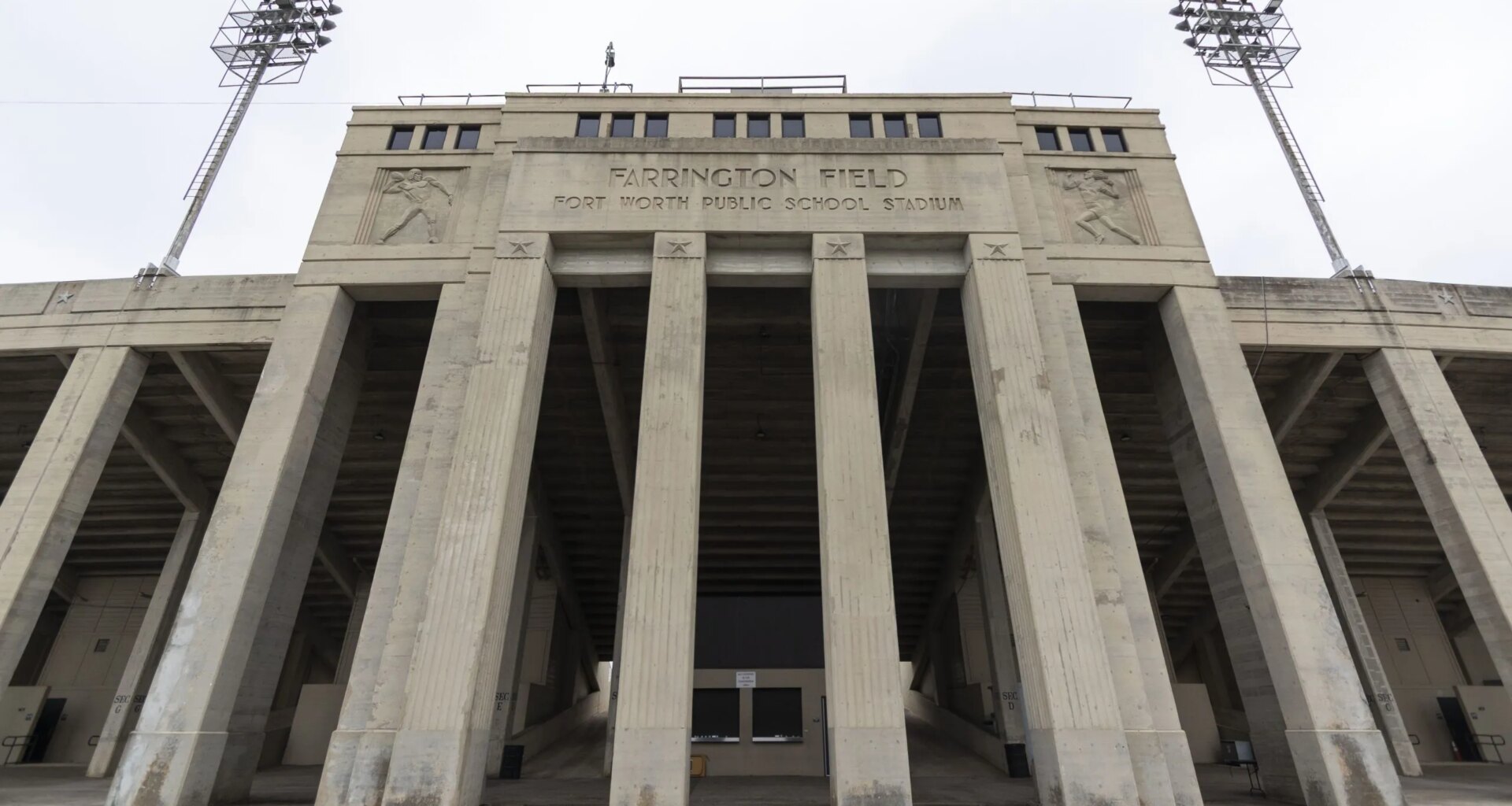
A third of Fort Worth ISD trustees had just been elected in 2019 when a major question came across their desk: What do they do with the administration building and Farrington Field?
Construction lawyer CJ Evans was among three new trustees. She said the question of what to do with the district headquarters and other nearby University Drive properties — plus Farrington — was overwhelming even for her.
In hindsight, Evans said she should have pushed to delay the discussion. Instead, the board launched a yearlong process that ended with FWISD selling its administration building for nearly $5 million and several nearby properties for $13 million, paving the way for a downtown-like $1.7 billion residential, retail and office development.
Now, Farrington Field is back in play. Experts and former trustees worry the district may repeat history by rushing to sell a major property, in a deal that benefits neither taxpayers nor students. This time, a new board of managers and superintendent — both appointed by Texas Education Commissioner Mike Morath — are overseeing the consequential public land decision.
“If it was premature to explore the sale when one-third of the board was new, how premature is it to explore the sale when all nine are brand new?” Evans said. “To just sell it outright from underneath the taxpayers when all nine are brand new, I feel like it’s extremely premature and somebody’s trying to hide something.”
Managers will discuss Farrington Field in executive session at their meeting Tuesday, according to board documents. They will not take action.
FWISD will host a community meeting about Farrington at 5 p.m. Wednesday at the District Service Center, 7060 Camp Bowie Blvd.
‘We could have gotten more’
 A fence wraps around the former Fort Worth ISD Administration Building on University Drive on Dec. 20, 2023. (Jacob Sanchez | Fort Worth Report)
Months into the pandemic in May 2020, elected trustees approved the decision to sell the former administration building and several other nearby properties over Zoom. There was no discussion. The votes were unanimous.
Norman Robbins, who was on the board at the time, said he doesn’t regret selling the University Drive properties.
Real estate firm JLL advised the district on the sales, Robbins said. He also consulted his own real estate contacts. At the time, he said, he believed the district received a fair price for the aging administration building.
The former headquarters was in poor condition, Robbins said, requiring significant and expensive maintenance to continue operating. Leasing the land could have taken years, he said.
The district did everything by the book, Evans said: Put the properties up for sale and accepted the highest bid. The properties were not sold below fair market value at the time, she said.
“Now, shortly after COVID, of course, prices went through the roof,” Evans said. “We could have gotten more if we had sold it a little later.”
Patience is important in deals like this, despite inside and outside pressure to rush, said Sriram Villupuram, a real estate professor at the University of Texas at Arlington. The location of the University Drive properties — near downtown, West 7th Street and the Trinity River — gave the district strong leverage over developers.
“The school district should sell from a position of strength,” Villupuram said. “If they’re selling from a position of weakness, then my goodness, that’s what leads to outcomes like what we’re talking about.”
Elected trustee Michael Ryan, who joined the board after the University Drive sales, said the lesson for Farrington is that FWISD should avoid treating valuable land as a short-term fix.
If structured correctly, a Farrington deal could aid the district’s goal of improving student outcomes for years to come, Ryan said. But if FWISD sells too quickly, he said, the district risks giving up control of land that will likely keep growing in value.
Tossing Farrington Field back and forth
 The Fort Worth ISD board of managers listen to speakers during a meeting on April 28, 2026. (Maria Crane | Fort Worth Report/CatchLight Local/Report for America)
Before the takeover, elected trustees planned a March 27 special meeting to consider rescinding the request for proposals, which sought private development around Farrington Field. Elected trustee Tobi Jackson said at the time that the school board owed taxpayers a fiduciary responsibility to safeguard the valuable property.
Days before that meeting, the Texas Education Agency installed a board of managers and superintendent, shifting authority over the project to state-appointed leaders.
The request for proposals sought developers to purchase and build on seven district-owned tracts surrounding Farrington Field as part of a mixed-use, sports-anchored development. The stadium itself would remain district-owned; the development is intended to raise funds via tax-increment financing for renovations to the historic stadium.
Two proposals were finalized in March and later presented to the board of managers in closed session. The board can move forward, restart the process or reject the proposals altogether.
The Fort Worth Report requested communications surrounding the drafting and release of the request for proposals, along with records related to the grading, scoring or ranking of proposals. FWISD released some records May 12, including the request for proposals and an April 14 presentation that outside counsel Brian Newby delivered to the board of managers.
But legal services staff member Kristin Carpenter said remaining information is exempt from disclosure under attorney-client privilege and because it relates to a pending request for proposals.
The Report requested both proposals as part of a separate records request, which is pending review by the Texas attorney general.
‘Best interest of the community’
 The historic Farrington Field features a football player carved into the stone facade, as photographed on June 4, 2025. (Mary Abby Goss | Fort Worth Report)
Word of the possible sale of Farrington Field reached a conference Evans attended. An architect told her he was glad the district wasn’t selling such a unique piece of architecture in a dense commercial urban area, Evans recalled.
“This architect’s opinion was that Farrington Field is as unique as Wrigley Field,” said Evans, who served one four-year term after her election in 2019. “It’s just confirmation that an outright sale is probably not in the best interest of the community.”
Robbins reached a similar conclusion — not because he regrets the University Drive sale, but because he sees Farrington as a different kind of asset.
His advice to district staff and the board of managers: Take your time, seek outside perspectives and consider leasing the land instead of selling it.
School districts are not in the business of selling land, Villupuram said. Growing districts know how to acquire land, but selling it is a different game. The district’s leaders should hire both a real estate firm and a market analysis firm before determining how to proceed with Farrington Field.
“It’s important to look at it from the buyer’s standpoint,” Villupuram said.
Leasing Farrington Field would provide the district with a recurring source of revenue while ensuring the property continues serving students, current and former trustees told the Report.
“Real estate is a finite commodity,” Robbins said. “If you sell it, it’s gone forever. If you lease it, you get payback year after year in perpetuity.”
In October 2020, FWISD staff asked the Tarrant County district attorney to seek an opinion from the Texas attorney general’s office about leasing school property for noneducational purposes.
In that request, the district laid out the case for leasing rather than selling: A long-term ground lease could generate annual revenue for educational programs, allow FWISD to retain ownership, return developed property to the tax rolls and give the district more control over future land use than an outside sale.
The attorney general determined that a district may lease property to a private entity, but the lease cannot interfere with district purposes. The district also must retain exclusive authority to manage and control the property.
The attorney general noted that the Texas Constitution bans gifts of public funds for private purposes. Any lease would have to satisfy a three-part test that the district would have to:
Accomplish a public purpose of the district, not benefit private parties.
Retain sufficient control.
Receive a return benefit.
‘Get the maximum benefit’
 Superintendent Peter Licata, left, speaks with President Pete Geren during a Fort Worth ISD board of managers meeting March 31, 2026, in the District Service Center. (Christine Vo | Fort Worth Report)
Elected trustee Ryan said he understands the board of managers and Superintendent Peter Licata are focused on student outcomes.
But any Farrington decision will ultimately affect classrooms, he said. A one-time sale could help the district temporarily, while a lease could preserve public ownership and create recurring revenue for students.
“We make more money during the time of the lease than to sell it,” Ryan said. “The district’s going to put whatever revenue in the general fund, and that goes away real quick.”
The warning echoes FWISD’s last major land sale: After trustees sold the former administration building in 2020, the proceeds went into the general fund.
Of the $5 million FWISD received from the sale, about $1.8 million was later spent renting that same building back from its new owner while the district waited for the renovation of the new headquarters.
Disclosure: FWISD manager Pete Geren leads the Sid W. Richardson Foundation, a financial supporter of the Fort Worth Report. FWISD manager Laurie George is a member of the Report’s reader advisory council. At the Fort Worth Report, news decisions are made independently of our board members and financial supporters. Read more about our editorial independence policy here.
Matthew Sgroi is an education reporter for the Fort Worth Report. Contact him at matthew.sgroi@fortworthreport.org or @matthewsgroi1.
Jacob Sanchez is education editor for the Fort Worth Report. Contact him at jacob.sanchez@fortworthreport.org or @_jacob_sanchez.
This <a target=”_blank” href=”https://fortworthreport.org/2026/05/16/as-farrington-field-talks-resume-what-lessons-linger-from-sale-of-fwisd-admin-building/”>article</a> first appeared on <a target=”_blank” href=”https://fortworthreport.org”>Fort Worth Report</a> and is republished here under a <a target=”_blank” href=”https://creativecommons.org/licenses/by-nd/4.0/”>Creative Commons Attribution-NoDerivatives 4.0 International License</a>.<img src=”https://i0.wp.com/fortworthreport.org/wp-content/uploads/2021/04/cropped-favicon.png?resize=150%2C150&ssl=1″ style=”width:1em;height:1em;margin-left:10px;”>
<img id=”republication-tracker-tool-source” src=”https://fortworthreport.org/?republication-pixel=true&post=553466&ga4=2820184429″ style=”width:1px;height:1px;”><script> PARSELY = { autotrack: false, onload: function() { PARSELY.beacon.trackPageView({ url: “https://fortworthreport.org/2026/05/16/as-farrington-field-talks-resume-what-lessons-linger-from-sale-of-fwisd-admin-building/”, urlref: window.location.href }); } } </script> <script id=”parsely-cfg” src=”//cdn.parsely.com/keys/fortworthreport.org/p.js”></script>