
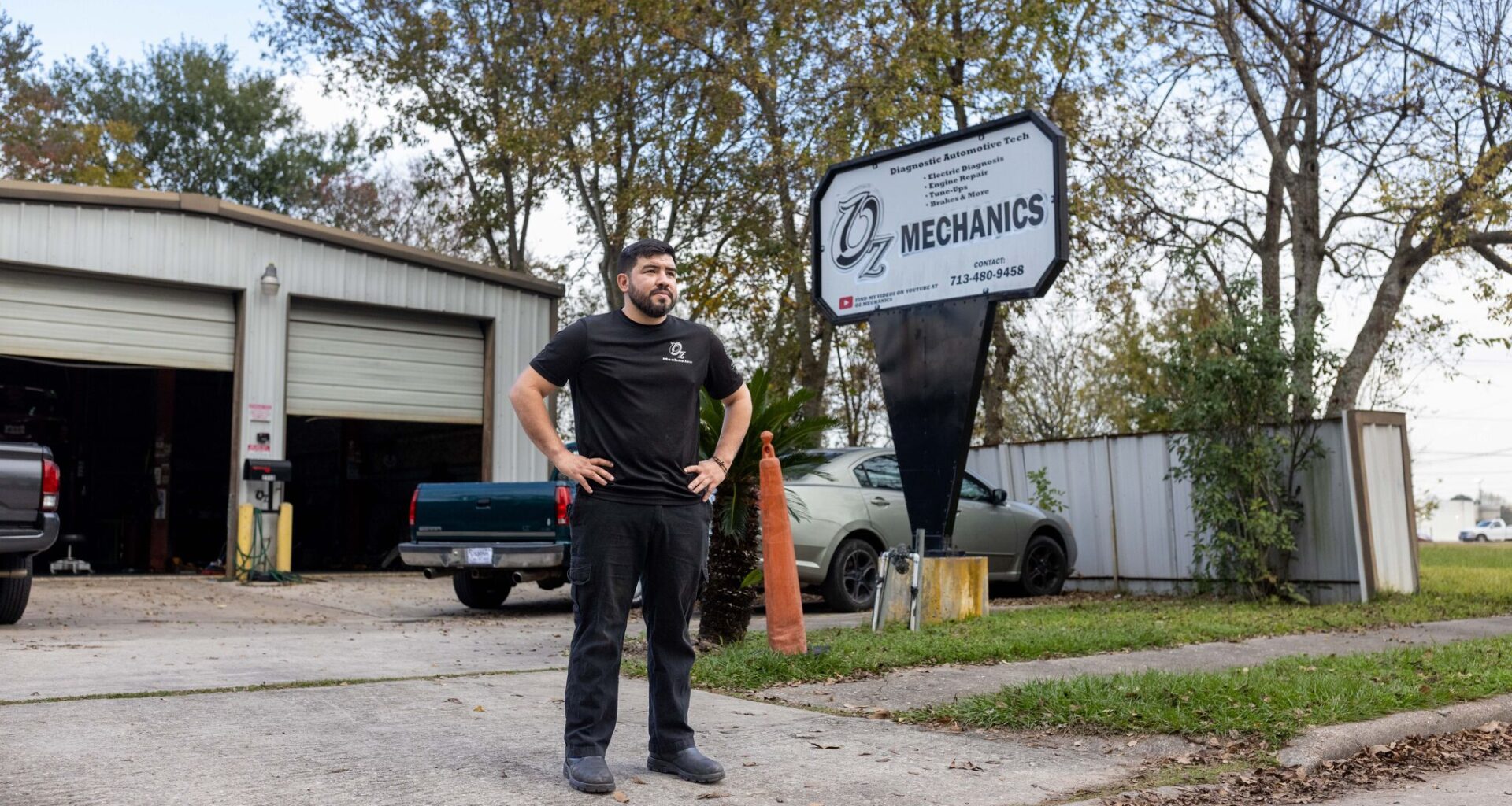
A Pasadena mechanic’s yearslong dispute with the city over parking requirements and permits is now headed to the Texas Supreme Court.
Institute for Justice (IJ)
A Pasadena mechanic who has spent years battling the city over parking requirements and permits is now asking the Texas Supreme Court to weigh in on a broader legal question: when can Texans sue local governments over land-use disputes?

Azael “Oz” Sepulveda, owner of Oz Mechanics, has spent nearly four years trying to move his appointment-only auto electrical repair business into a property he bought on Shaver Street in 2021. But according to court filings, the City of Pasadena required the site to have 28 parking spaces—something Sepulveda says was physically impossible on the property. Sepulveda argued the requirement was physically impossible to satisfy and would cost tens of thousands of dollars.
Article continues below this ad
A Pasadena mechanic’s yearslong dispute with the city over parking requirements and permits is now headed to the Texas Supreme Court.
Institute for Justice (IJ)
A Harris County judge later agreed, ruling the city’s parking demands were overly burdensome because the lot simply could not fit that many spaces.
The city and Sepulveda eventually reached a settlement agreement that dramatically reduced the parking requirement to seven spaces. Under the deal, the shop could move forward if Sepulveda met several conditions, including adding three spaces in front of the building and four on the side.
The city and Sepulveda eventually reached a settlement agreement that dramatically reduced the parking requirement down to seven spaces. Under the deal, the shop could move forward if Sepulveda met several conditions, including adding three spaces in front of the building and four on the side.
Institute for Justice (IJ)
But even after the agreement, the project still stalled
Article continues below this ad
According to the First Court of Appeals opinion issued in October 2025, the city rejected Sepulveda’s preliminary site plan over issues including bollard spacing and drive-aisle widths, while also identifying additional requirements involving drainage calculations, curbs, setbacks and vehicles backing into the right-of-way.
Sepulveda then sued Pasadena again, alleging the city breached the settlement agreement and violated constitutional protections related to due process of law and equal protection.
Under the deal, the shop could move forward if Sepulveda met several conditions, including adding three spaces in front of the building and four on the side. But even after the agreement, the project still stalled.
Institute for Justice (IJ)
Pasadena argued the lawsuit came too early because Sepulveda had not fully completed the city’s permitting process or exhausted every possible appeal option with city boards and commissions.
Article continues below this ad
A Harris County judge initially allowed the case to proceed, but Houston’s First Court of Appeals later sided with Pasadena and dismissed the lawsuit last year, ruling the city had not yet made a final enough decision for the courts to step in.
Now Sepulveda and his attorneys with the Institute for Justice are asking the Texas Supreme Court to take up the case, arguing cities should not be allowed to trap property owners in endless permit reviews before they can challenge government decisions in court.
“The city didn’t keep its word and now, nearly four years later, Oz is asking the Supreme Court of Texas to take up his case against the city,” lead attorney Diana Simpson told Chron in an emailed statement. “The court has a long history of protecting property rights, and its intervention is needed once more.”
Azael “Oz” Sepulveda, owner of Oz Mechanics, has spent nearly four years trying to move his appointment-only auto electrical repair business into a property he bought on Shaver Street in 2021
Institute for Justice (IJ)
The petition argues Pasadena repeatedly rejected Sepulveda’s site plans while simultaneously preventing him from advancing to the next stage of the permitting process because city code requires an approved site plan before a certificate of occupancy can be issued.
Article continues below this ad
“Ripeness is a ‘relatively modest’ requirement,” the petition states, quoting a 2025 Texas Supreme Court opinion.
In the filing, Sepulveda’s attorneys describe the process as a bureaucratic “procedural merry-go-round,” accusing cities of using technicalities and endless revisions to wear property owners down
“This is unfortunately common across Texas, as government entities routinely rely on procedural tricks to avoid courts from scrutinizing their unconstitutional behavior,” Simpson added. “We’re hopeful the Supreme Court will put an end to that here.”
The petition also alleges that immediately after Pasadena City Council approved the settlement agreement, a city planning official told Sepulveda it would be “impossible” for him to obtain a certificate of occupancy.
Article continues below this ad
Pasadena attorneys previously argued in appellate filings that the city had “not undertaken any action, let alone definitive action resulting in a concrete injury” because Sepulveda had not completed the permitting process. The city also argued it would issue a certificate of occupancy if Sepulveda complied with city code and the settlement agreement.
“Our goal over the last five years has been to get Oz open,” Simpson concluded. “We’re optimistic about this first step toward that goal and hope that the city continues to do the right—and constitutional—thing.”