
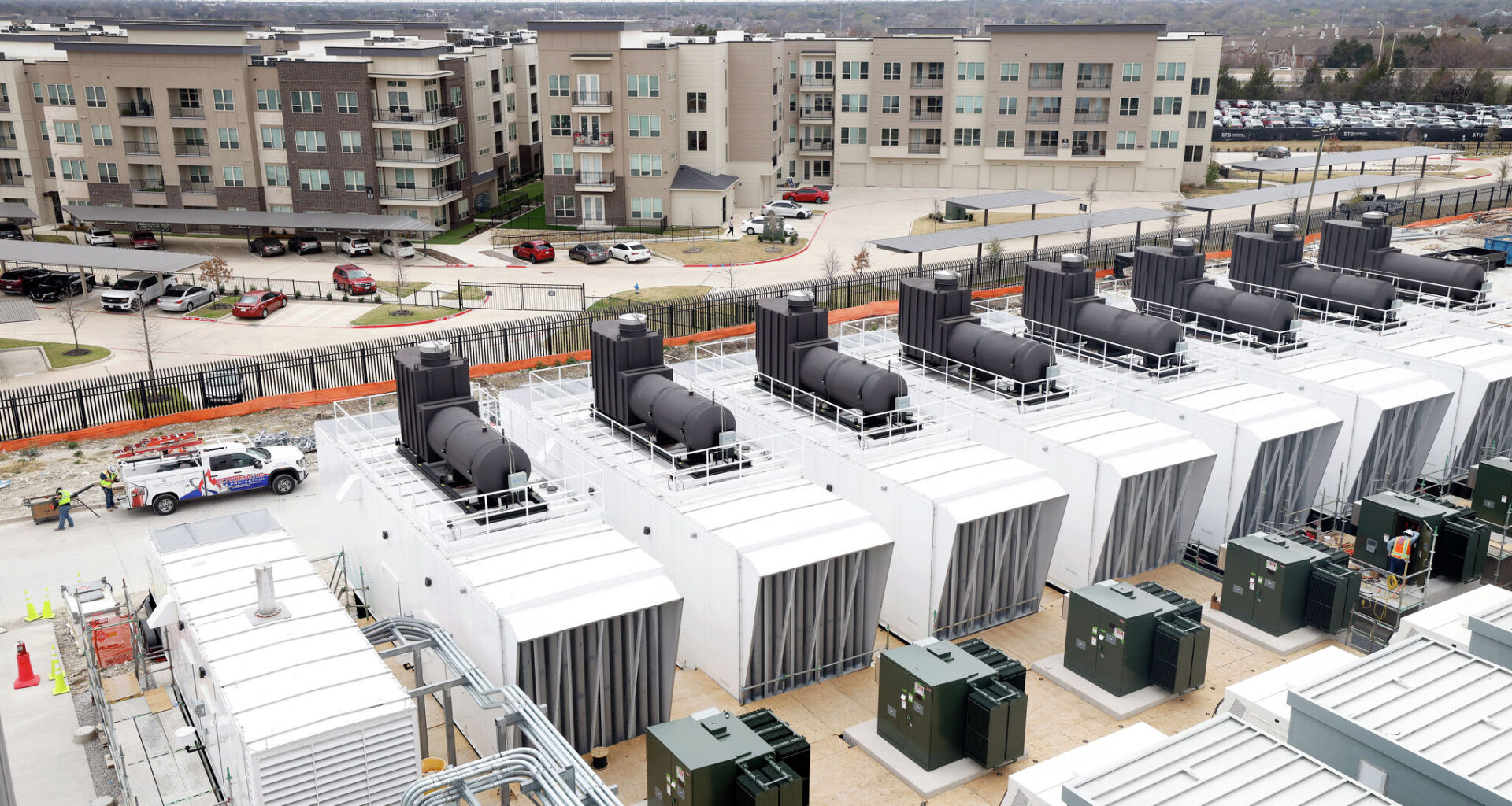
Apartments sit across the street from Dallas TX4, the fourth and final new data center building under construction at the NTT Data center campus in Garland, Texas, March 4, 2026. A row of diesel powered back-up generators in the foreground are being prepared to go online.
Tom Fox/Dallas Morning News
Most Houston-area residents report using artificial intelligence — but oppose the construction of data centers near their homes, according to a new study from the University of Houston.
It’s a paradox that reflects the widespread push in workplaces to adopt AI, as well as fierce resident backlash against the rapid buildout of data centers needed to train and run AI models.
SEARCHABLE MAP: See where data centers are planned or operating near you
Article continues below this ad
Though water use has emerged as a key flashpoint in other parts of Texas more prone to water scarcity, Houstonians surveyed by UH’s Hobby School of Public Affairs say they’re most worried about the massive amounts of electricity that AI data centers can consume.
“When (Houston-area) residents say they are concerned about data centers, they’re mostly referring to grid reliability and affordability,” Soran Mohtadi, a UH post-doctoral fellow and author of the study, said in a statement.
Of the more than 1,500 residents surveyed by the Hobby School, 65% reported using AI at least monthly. Almost the same percentage of people — 63% — said they oppose a data center being built within one mile of where they live.
EXPLAINER: What is a data center? Frequently asked questions, answered
Article continues below this ad
Houstonians’ wariness of data centers aligns with opinions nationwide. A recent Gallup poll found that seven out of 10 Americans oppose having a data center built near them, even more than the proportion of those opposed to living near a nuclear power plant.
The resistance against data centers cuts across political parties, the Hobby School study found, with majorities of self-reported Democrats, Republicans, independents and those with no political affiliation all opposed to living near one of these facilities.
Data center concerns
These results show just how strong public resistance is to physical AI infrastructure, at the same time that the Trump administration and some Texas politicians are pushing to make the Lone Star State the world’s leading hub for AI data centers.
But as public backlash grows, some are urging the buildout to be slowed. A Dallas-area county passed what is likely the first Texas moratorium on data centers last week. Some Texas Republicans, such as Agriculture Commissioner Sid Miller, are calling for a moratorium statewide.
Article continues below this ad
Already, Texas has a few hundred data centers, trailing only Virginia in number. Most of these are traditional facilities storing data that power the Internet and are fairly small in footprint and electricity use.
AI data centers, however, are much more intensive in electricity consumption. These facilities can consume hundreds to even upwards of 1,000 megawatts in capacity — using as much power as medium-sized cities.
All this demand is certain to require more power-grid infrastructure, but not even the Electric Reliability Council of Texas, which operates the state’s main grid, knows how much electricity new data centers will truly use.
RELATED: How much power will data centers new to Texas use? No one really knows.
This uncertainty is reflected in the University of Houston’s study, which found that 80% of those opposed to living near a data center cited their energy demand as their main concern.
Article continues below this ad
Environmental impacts — and water usage specifically — round out the top three concerns, beating out issues such as impact on property values, noise and aesthetic preferences.
Maria P. Perez Arguelles, a UH research assistant professor and lead researcher for the study, said in an interview that Houstonians’ concerns about the energy demand of data centers track with existing anxiety in the region about recurring power outages and rising electricity bills.
Nearly 47% of those who replied to the survey reported having trouble paying their electricity or natural gas bill at least once in the last year.
Support for reform
Most experts say Texas energy bills have increased in recent years mostly because of extreme weather and reforms after the 2021 grid crisis, rather than data centers.
Article continues below this ad
In the coming years, however, data centers could increase power costs if electricity supply doesn’t keep pace with demand, or if residents are stuck paying for grid upgrades to accommodate the new industry.
Across political party lines, Houston-area residents overwhelmingly believe data centers and tech companies should pay for the new power plants and grid upgrades they require, according to the UH study.
Texas policymakers say they’re already working on policies, such as an effort to rework how power-line costs are calculated, to ensure the data center industry foots the bill for its own costs.
READ MORE: Texas lawmakers grill data centers about their impact on power bills, water
The Hobby School survey also found that among those opposed to having a data center near them, nearly a third said they’d be more supportive if the facility were primarily powered by renewable energy rather than fossil fuels.
Perez Arguelles said that finding could be a reflection of residents’ environmental concerns with data centers. How much water the data center industry will pull from Texas’ existing supplies is heavily dependent on whether the buildout is mostly powered by fossil fuels or renewable energy, the University of Texas at Austin found in a recent study.
Ultimately, few issues have mobilized as much opposition as data centers, cutting across race, gender, age and political party lines. The mass backlash is partly because of how quickly these facilities are being built across Texas, Perez Arguelles said.
“(Residents) are just being exposed to this new change that’s coming faster than we anticipated,” she said.