
In 2015, the U.S. Department of Energy included X-energy in its Advanced Reactor Concepts program. When the DOE established the Advanced Reactor Demonstration Program in 2020, in which the federal government took on half the cost of building a participating company’s first reactor, X-energy was one of the first participants. While X-energy said it hasn’t released price projections for each project, the company disclosed to the Securities and Exchange Commission that the 50/50 cost-share agreement with the DOE covered a total estimated cost of up to $2.4 billion.
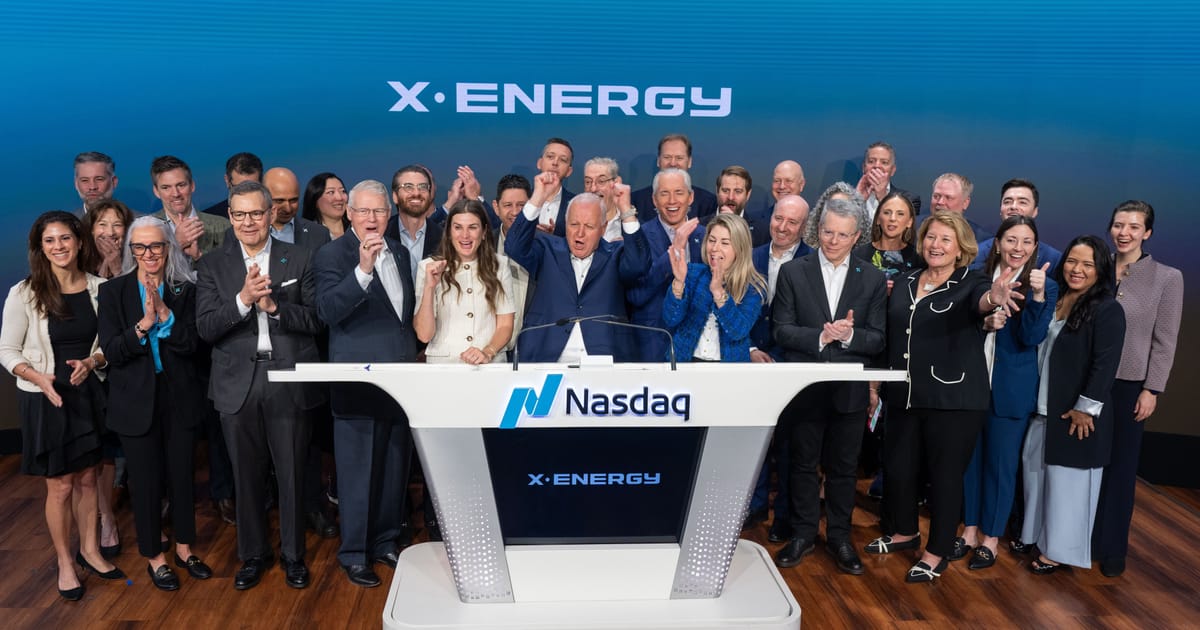
In 2022, X-energy announced Dow as its first commercial offtaker for the Texas project. Two years later, when the artificial intelligence boom spurred tech giants to sign a series of deals with nuclear startups, Amazon placed its bet on X-energy, vowing to help finance construction of 5 gigawatts of reactors through deals to buy power for its data centers. The company took an equity stake in X-energy, which went public on April 24 on the Nasdaq composite.
Amazon is now providing financing for the construction of X-energy’s second project, a multiphase expansion of an existing nuclear-energy complex in Washington state operated by the public utility Energy Northwest. Depending on the utility’s willingness to buy the units, the startup aims to eventually build up to a dozen of its Xe-100 reactors at the site.
On both projects, “a real differentiator for us is truly how we used our pre-application process with the NRC,” Taylor said. The company provided more than two dozen reports to the NRC ahead of submitting its application. “We submitted a vast number of topical reports and white papers that we got feedback on that informed the design and formed the regulatory submittals,” he said. “We substantially de-risked the project with the NRC through all of that engagement. Almost all the methodologies we use in designing the reactor and the support systems have been approved by the NRC.”
While rival developers of next-generation small modular reactors and microreactors have pushed for regulatory changes or new licensing pathways that are designed to benefit new technologies, X-energy chose the time-honored pathway for permitting its first two projects.
“Part 50 is a great process for new designs because it allows changes to the design as you construct,” Taylor said. “Once we get the first approvals of our design under Part 50, and we get through that first operating license, we’ll be in a position to take a standardized design back to the NRC.”
Among the design elements that Taylor said bolster X-energy’s safety qualities is the fact that the company is using tri-structural isotropic fuel, or TRISO for short. The fuel encases tiny bits of enriched uranium inside poppy seed–sized balls coated in ceramic materials that effectively make a meltdown impossible.
TRISO, however, is far more expensive than the traditional low-enriched uranium fuel used in light-water reactors, which has held back its adoption to date. Only one commercial reactor uses TRISO worldwide today: the high-temperature gas-cooled reactor that China hooked up to its grid in December 2022. Another experimental reactor operated by the Japan Atomic Energy Agency at a facility north of Tokyo, whose design a Japanese American startup is now looking to commercialize in the U.S., also uses TRISO, as do nearly half a dozen proposed designs now competing with X-energy.
Unlike many other next-generation reactor designs that are using coolants such as molten salt, liquid sodium, or lead, X-energy’s Xe-100 uses helium. This approach has decades of data to back it up, thanks to the earlier U.S. experiments with similar technology.
“Look, Peach Bottom and Fort St. Vrain were great opportunities to demonstrate the technology nearly 50-plus years ago. But in the ensuing 50 years, [high-temperature gas-cooled reactors] have been run in multiple countries throughout the world, and TRISO fuel has gone through extensive testing,” Taylor said. “HTGRs back in the ’70s were a technology ahead of their time. We have the opportunity to seize on all that advancement and turn it into a truly perfect commercial product that is safely operated throughout the world.”
X-energy still faces the challenge of proving that it can avoid the hiccups previous high-temperature gas-cooled units faced in operation. Water-cooled reactors run at an unrivaled 95% of their lifespans in part because operators have the most experience perfecting the art of piloting such plants.
But Taylor compared earlier versions of high-temperature gas-cooled reactors to one of the American automotive industry’s biggest flops of the mid-20th century.
“The technologies between 50 years ago and today are both nuclear reactors, but it’s an Edsel-to-a-Ferrari comparison,” he said. “In this Ferrari, we know what we need to design for to get maximum performance out of it, we know what the challenging pieces are, what the hard issues are. Will we learn things? Sure, but we have so much more knowledge than those first ones did that we’re designing out so many of the challenges they faced.”
{
if ($event.target.classList.contains(‘hs-richtext’)) {
if ($event.target.textContent === ‘+ more options’) {
$event.target.remove();
open = true;
}
}
}”
>